5 pesos 1896
Market Prices
3 salesAbout This Note
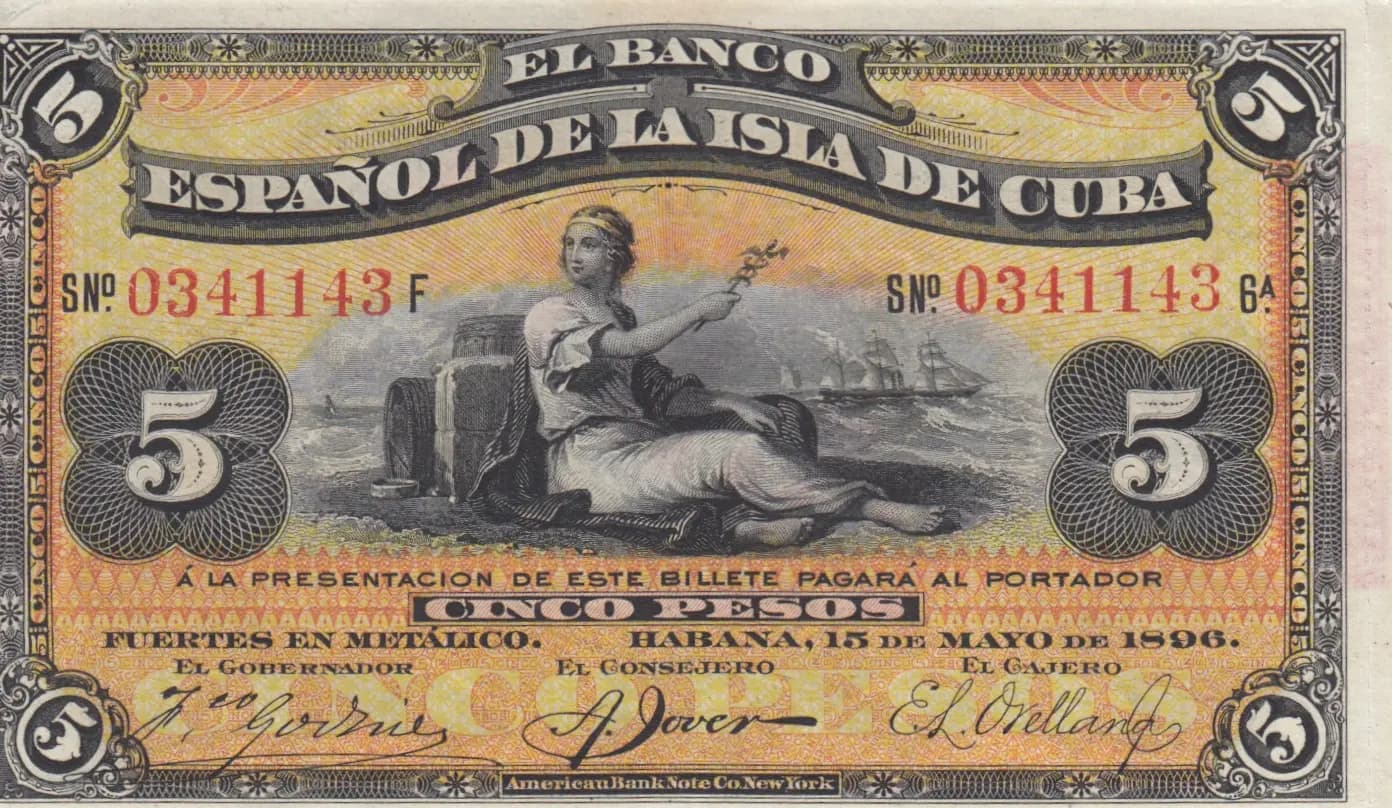
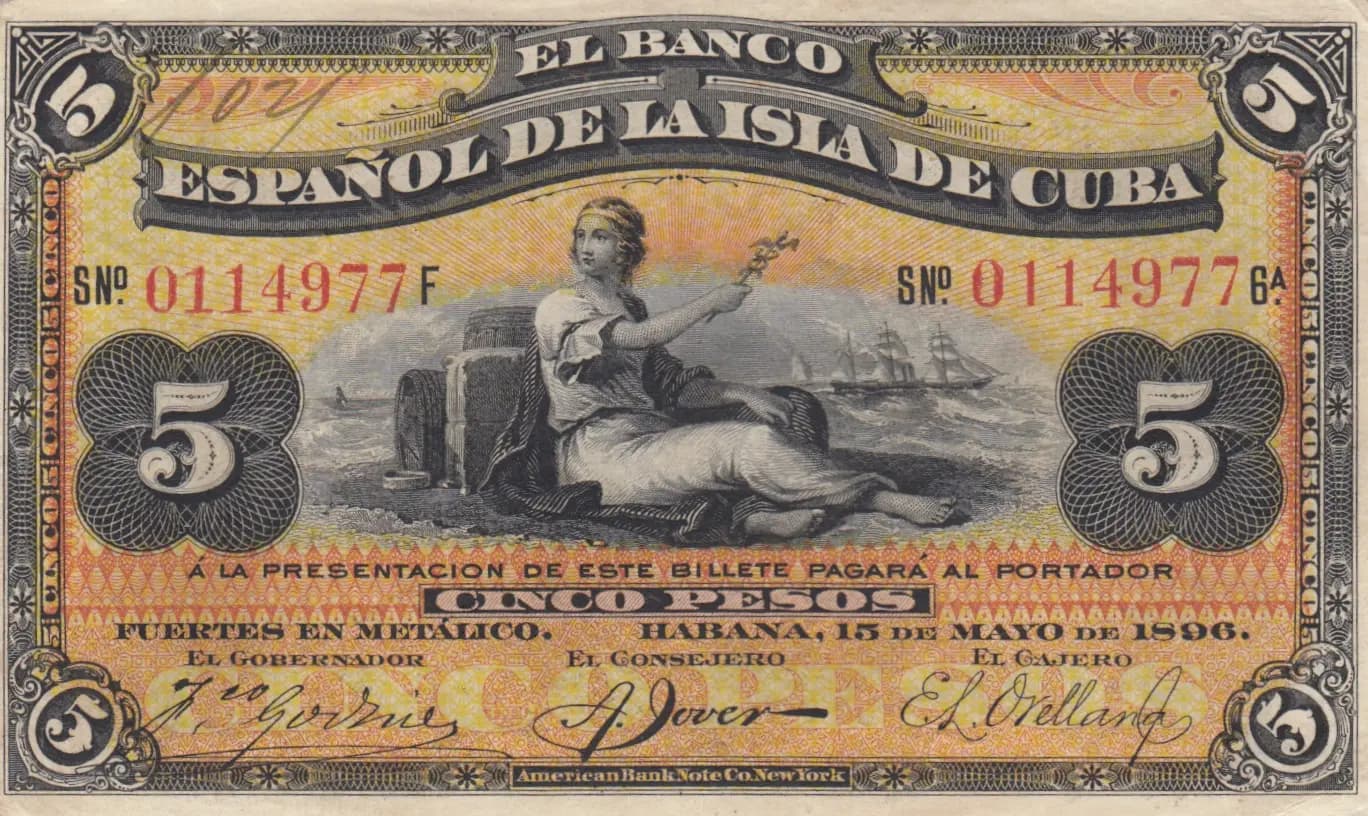
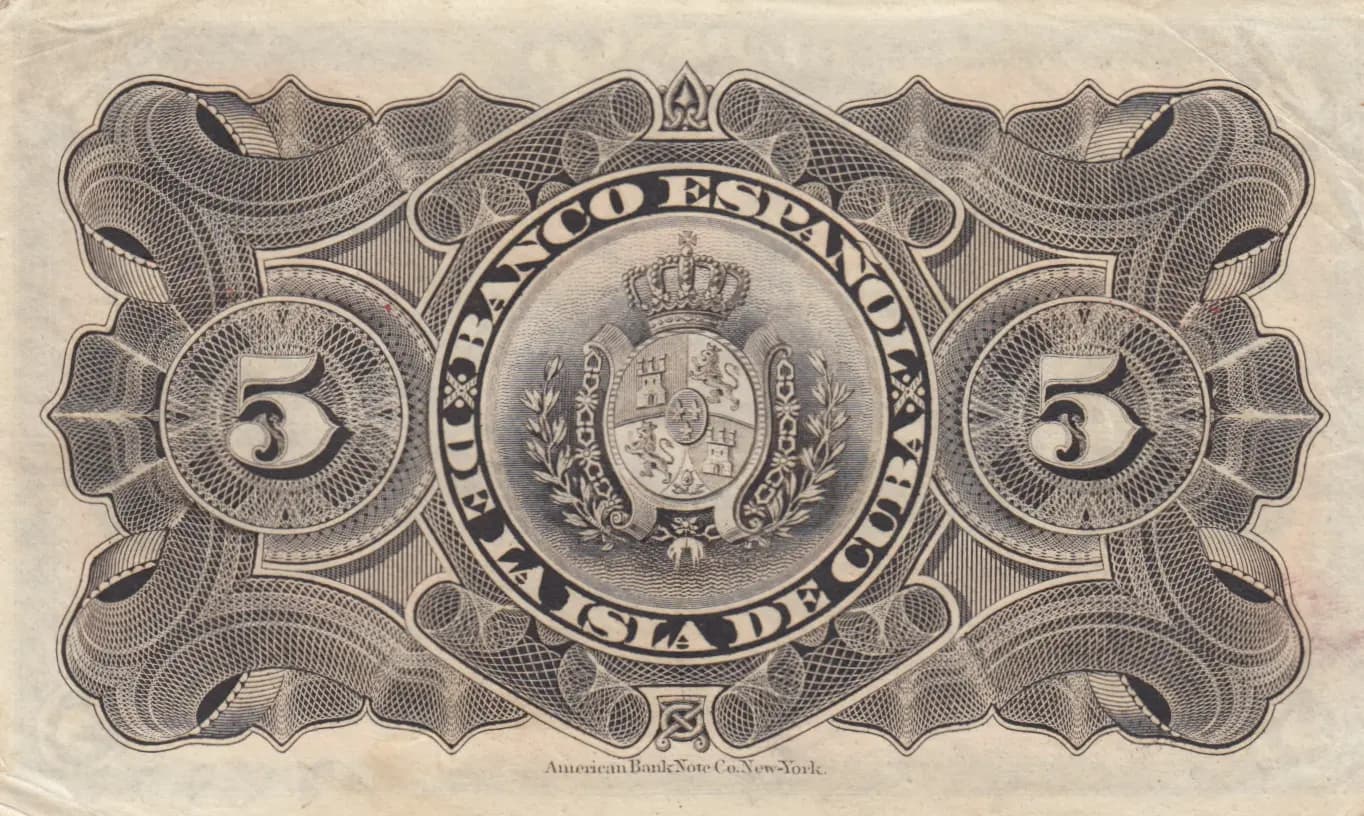
This is a well-preserved AU example of the 1896 Cuban 5 pesos from El Banco Español de la Isla de Cuba, printed by the American Bank Note Company. The note displays the characteristic classical allegorical female figure seated by the seaside on the obverse, rendered in vibrant yellow/gold, orange, and black inks with crisp engraving throughout. Despite age-related yellowing and foxing consistent with a note from 1896, the colors remain relatively vibrant and the intricate border work and coat of arms on the reverse are clearly defined, making this a desirable example from Spain's final years of colonial currency control in Cuba.
Common. Market evidence from the reference catalog shows UNC examples selling for $3.50–$26 on eBay between 2009–2014, with catalog valuations at $12.50 for UNC and $3.50 for VF in 2016. These modest price levels indicate steady availability in the collector market. The note was issued by a major colonial bank with significant circulation during its year of issue (1896), and no evidence of short print runs or recall exists. The AU condition grade commands a modest premium above VF but remains well within normal market expectations for this issue.
Issued in May 1896 during the final years of Spanish colonial rule in Cuba, this banknote represents El Banco Español de la Isla de Cuba's currency authority before the Spanish-American War fundamentally altered the island's political status. The Spanish coat of arms prominently displayed on the reverse symbolizes Madrid's dominion over the colony, while the allegorical female figure on the obverse—likely representing either Cuba or Commerce—reflects the mercantile interests that sustained the colonial relationship. The note's inscription promising payment in metallic currency ('fuertes en metálico') underscores the monetary standards of Spain's late-19th-century colonial banking system.
The obverse features an ornately engraved classical allegorical female figure—personifying either Cuba or Commerce—seated in flowing robes beside the sea with sailing vessels visible in the distant background, symbolizing maritime commerce and the island's economic importance. The figure is framed within an elaborate geometric and floral border composed of ornamental patterns, acanthus leaves, and architectural flourishes typical of Gilded Age security printing. Denomination circles displaying the numeral '5' anchor the top left and right corners. The reverse presents the Spanish coat of arms—featuring the quartered shield with castles, lions, and heraldic crown—contained within an ornate circular medallion surrounded by a quatrefoil decorative border with scrollwork and leaf motifs. The color scheme combines black engraving with gold, orange, and yellow tones on the obverse, while the reverse employs black engraving on cream/white stock.
FRONT: 'EL BANCO ESPAÑOL DE LA ISLA DE CUBA' (The Spanish Bank of the Island of Cuba); '5' (denomination); 'SNº 0114977F' and 'SNº 0114977GA' (serial numbers); 'CIEN PESOS' (One Hundred Pesos); 'A LA PRESENTACION DE ESTE BILLETE PAGARA AL PORTADOR' (At the presentation of this banknote [the bank] will pay to the bearer); 'FUERTES EN METALICO' (Strong in metallic [currency]); 'HABANA, 15 DE MAYO DE 1896' (Havana, May 15, 1896); 'EL GOBERNADOR' (The Governor); 'EL CONSEJERO' (The Counselor); 'EL CAJERO' (The Cashier); 'American Bank Note Co New York' (printer attribution). BACK: 'BANCO ESPAÑOL DE LA ISLA DE CUBA' (Spanish Bank of the Island of Cuba); '5' (denomination); 'American Bank Note Co. New York' (printer attribution).
Steel or copper plate intaglio engraving combined with chromolithographic color printing, executed by the American Bank Note Company of New York. The multiple color application (yellow/gold, orange, black underprints on obverse; black on cream/white on reverse) indicates multi-plate printing typical of ABNC's advanced security printing methods of the 1890s. The crisp, fine-line engraving visible throughout—particularly in the allegorical figure's details, border work, and heraldic elements—demonstrates the high-security standards characteristic of ABNC's banknote production.
This note is cataloged as Pick 48a (1896 issue). The serial number visible on this specimen (SNº 0114977F on obverse, SNº 0114977GA noted in analysis) should be recorded for variety tracking. This is an issued note without overprint, consistent with the regular issue type. The May 15, 1896 date and Havana location are standard for P-48a. Variations in signature placement or serial number prefixes may exist among specimens of this Pick number, but no major varieties are documented in standard catalogs for the 1896 Cuban 5 pesos.