5 pesos 1960 specimen
Market Prices
About This Note
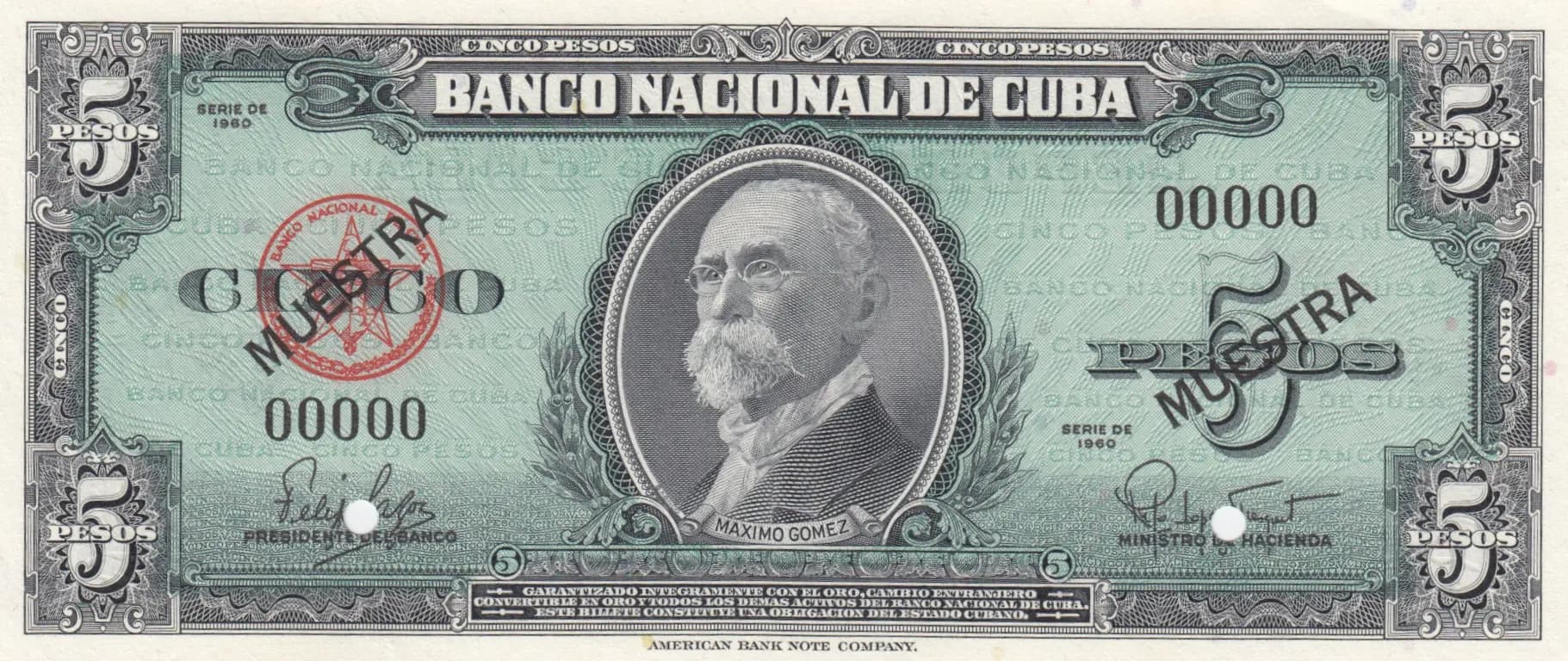
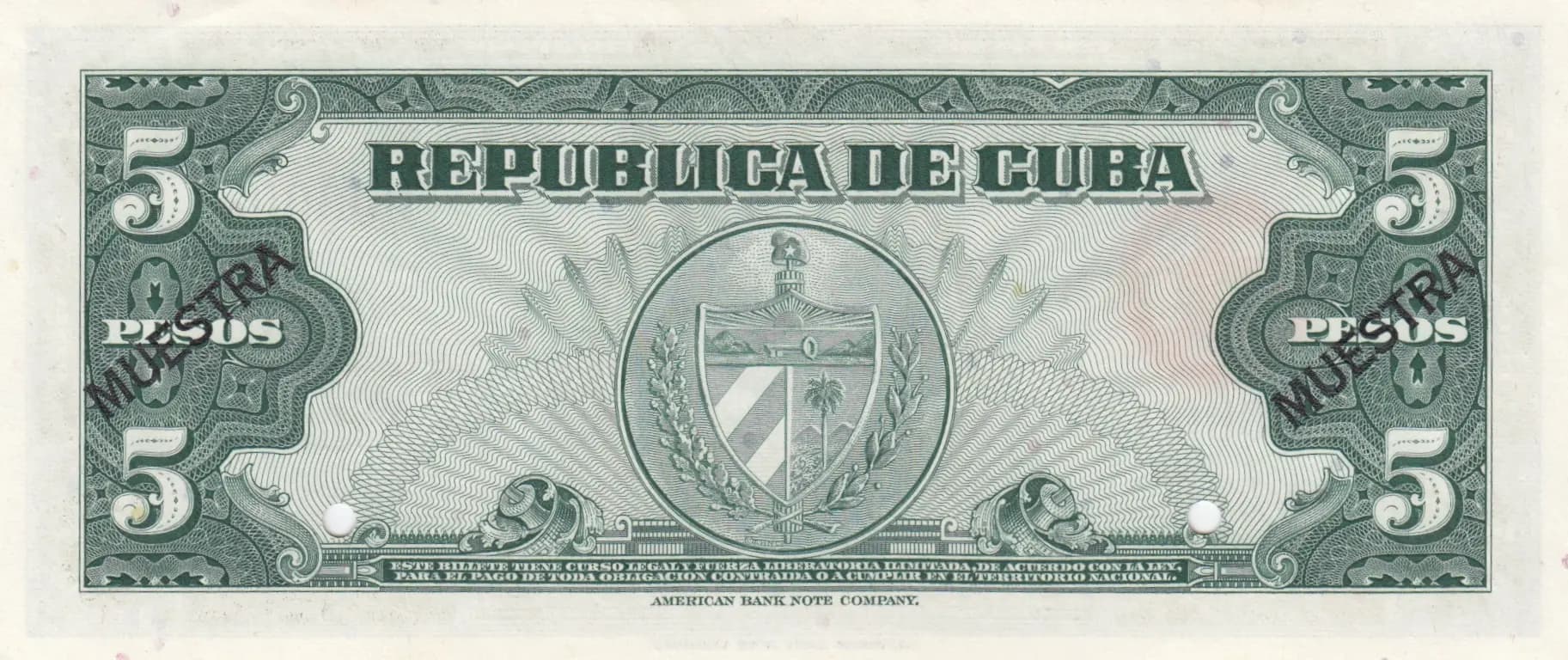
This is an uncirculated 1960 Cuban 5 pesos specimen note (Pick P-92s) printed by the American Bank Note Company. The note features a striking light green underprint with the portrait of Máximo Gómez at center on the obverse and the Cuban national coat of arms on the reverse, both surrounded by intricate ornamental borders. As a specimen note, it bears a red diagonal 'MUESTRA' (specimen) stamp and two small binding holes consistent with specimen distribution practices, and remains in pristine condition with no circulation wear.
Common. While this is a specimen note (which reduces circulation population compared to regular issued notes), specimen notes from major world banks and established denominations like this Cuban 5 pesos are regularly encountered in the collector market. The 2016 catalog valuation of $250 USD for UNC specimens indicates steady but modest collector demand, consistent with common-grade pricing. The note was produced by a professional security printer (ABNC) for a major national bank, suggesting substantial production runs. Specimen notes are typically preserved in better condition than circulated currency but are not inherently scarce.
This note was issued in 1960 by the Banco Nacional de Cuba, marking a pivotal moment in Cuban history as the newly established Revolutionary government was consolidating control over the nation's monetary system. The choice to feature Máximo Gómez, the legendary military commander of Cuban independence wars, reflected the regime's connection to Cuba's nationalist heritage and struggle for sovereignty. The prominent display of the Cuban coat of arms with its distinctive shield, star, and palm tree symbolized national identity during this transformative period in Cuban governance.
The obverse features a portrait of Máximo Gómez (1836–1905), the iconic Cuban military leader and independence hero, depicted as a bearded man wearing glasses and formal attire within an elaborate oval frame adorned with decorative laurel wreaths. The design incorporates ornate corner elements with scrollwork and guilloché patterns characteristic of fine banknote engraving. The reverse displays the Cuban national coat of arms at center, featuring a shield with vertical stripes, a prominent five-pointed star, and a royal palm tree, all contained within a circular frame with radiating lines suggesting governmental authority. Both sides maintain symmetrical decorative borders in black and gray on the light green/mint background, with the denomination '5 PESOS' prominently displayed on each side.
{"front":{"BANCO NACIONAL DE CUBA":"National Bank of Cuba","5 PESOS":"5 Pesos","SERIE DE 1960":"Series of 1960","MAXIMO GOMEZ":"Máximo Gómez","PRESIDENTE":"President","TESORERO":"Treasurer","MUESTRA":"Specimen","AMERICAN BANK NOTE COMPANY":"American Bank Note Company","WARRANTY_TEXT":"Fully guaranteed with gold, foreign exchange, convertible into gold the deposits in gold, in accordance with the law for the payment of all obligations incurred or to be fulfilled in national territory"},"back":{"REPUBLICA DE CUBA":"Republic of Cuba","5 PESOS":"5 Pesos","AMERICAN BANK NOTE COMPANY":"American Bank Note Company","LEGAL_STATUS_TEXT":"This banknote has legal status and limited liberatory force in accordance with the law for the payment of all obligations incurred or to be fulfilled in national territory"}}
Intaglio engraving (also known as steel engraving or copperplate printing), the premium security printing method employed by the American Bank Note Company, New York. The visual characteristics—fine line work, intricate guilloché patterns, elaborate border designs, and deep engraved details—are hallmarks of intaglio production. This technique was the industry standard for high-security banknote printing during the 1960 production period and provides excellent anti-counterfeiting properties through the detail and tactile quality of the printed image.
This is cataloged as P-92s, where the 's' suffix designates this as a specimen note. The red diagonal 'MUESTRA' (specimen) overprint and the characteristic two binding holes are definitional features of the specimen variety. Serial numbers read '00000' (typical of specimen notes which are not assigned to regular circulation). The note represents the 1960 series issue. No signature varieties or alternative designs are apparent from the visual analysis. The specific binding hole pattern and specimen stamp placement are consistent with standard ABNC specimen distribution practices of the era.