5 pesos 1991 specimen
Market Prices
1 saleAbout This Note
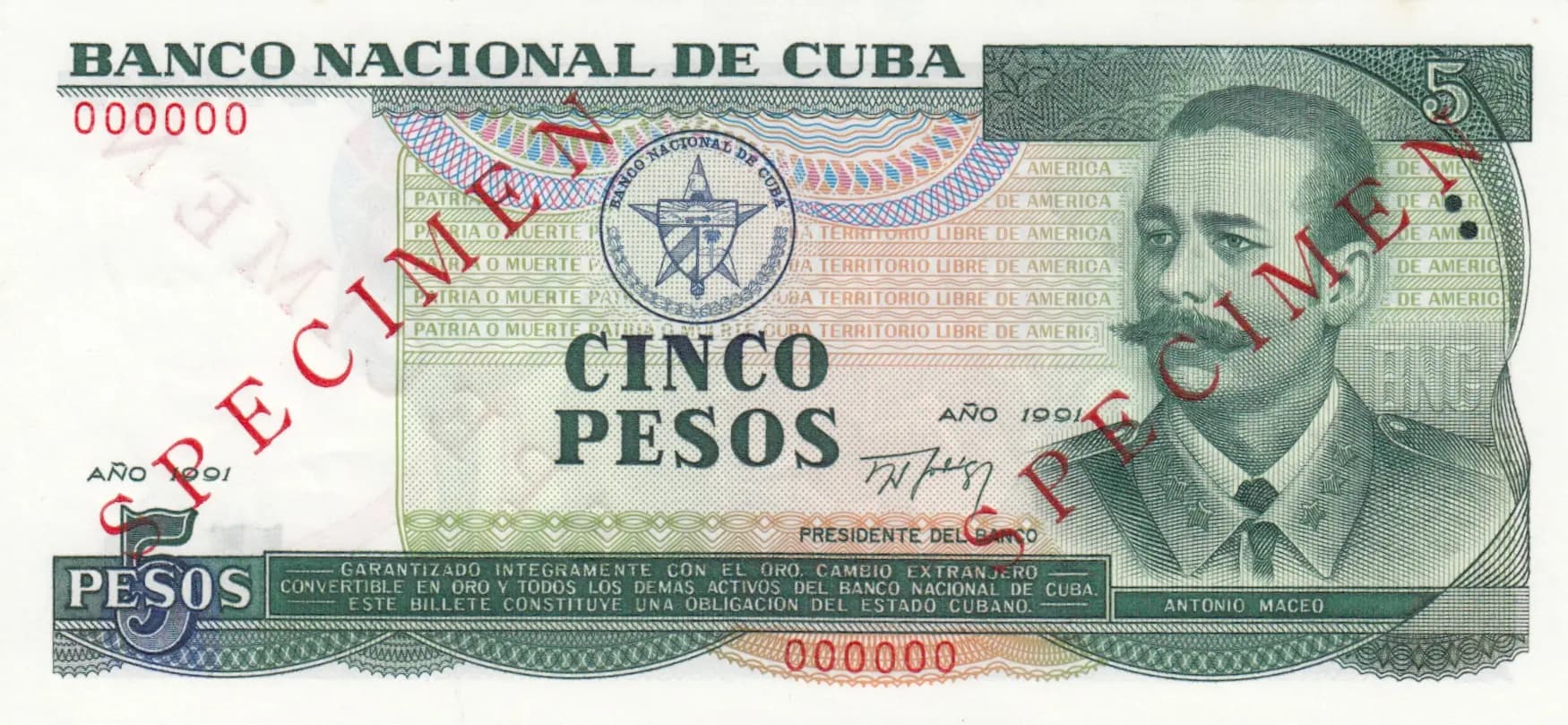
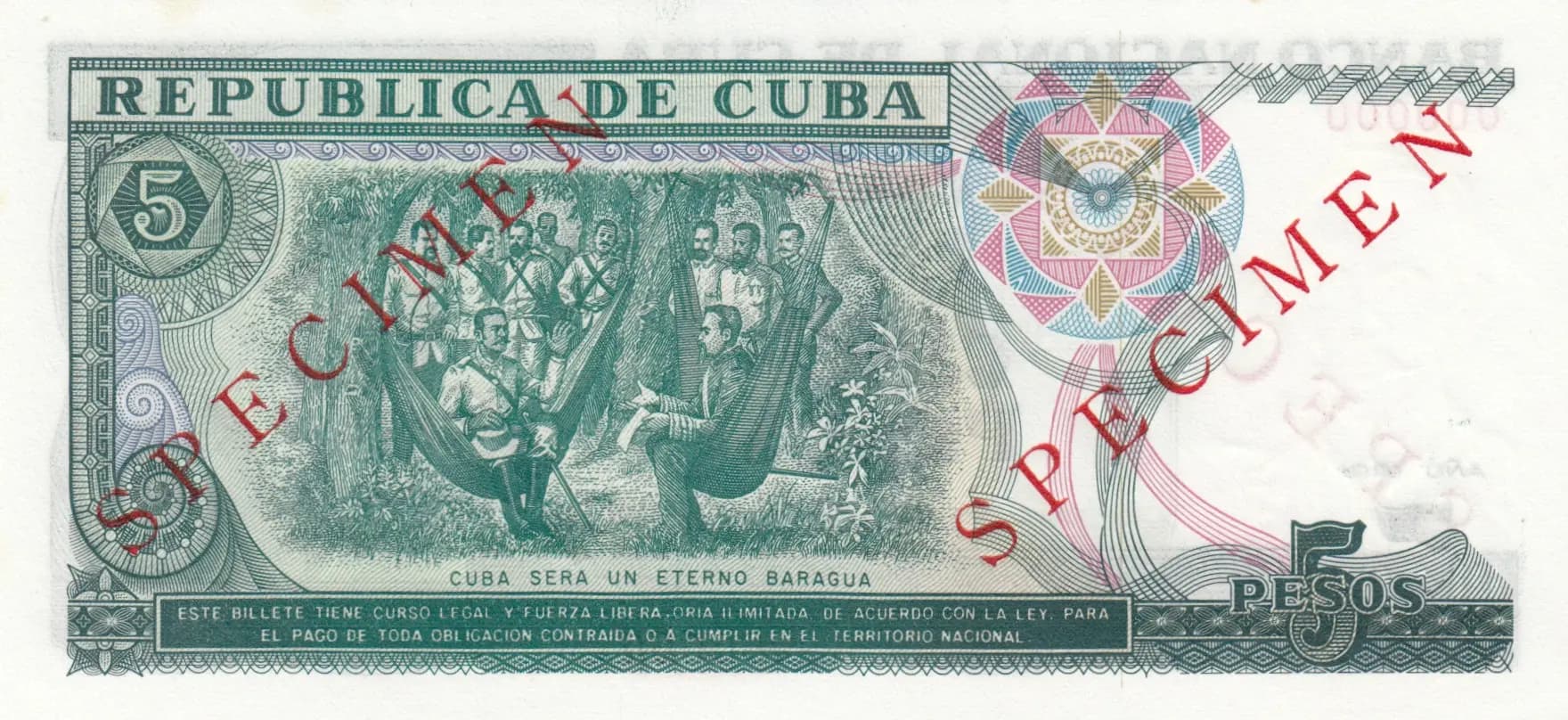
This is a Cuban 5 Pesos specimen note from 1991, issued by the Banco Nacional de Cuba (Pick P-108s). The note features a portrait of independence hero Antonio Maceo on the obverse and a historically significant engraved scene depicting the 1878 Conference at Mangos de Baragua between Maceo and Spanish General Martínez Campos on the reverse. The specimen is in uncirculated condition with the characteristic red diagonal 'SPECIMEN' overprint, vibrant green and multicolored printing, and retains excellent sharpness in the fine line work and security features.
common. Specimen notes from the 1991 5 Pesos issue are relatively common in the collector market. The referenced eBay pricing data indicates AUNC examples selling for $12 (2016) and catalog valuations of $15 UNC (2019), which are values typical of common circulation-era banknotes. While specimen overprints command slight premiums over regular circulation notes, the 1991 5 Pesos was produced in substantial quantities by the Banco Nacional de Cuba and remains readily available to collectors. The lack of evidence of a short print run, recall, or limited mintage supports a common classification.
The 5 Pesos note commemorates Antonio Maceo (1845-1896), one of Cuba's most revered independence leaders and a central figure in the Wars of Independence against Spanish colonial rule. The reverse depicts the pivotal 1878 meeting at Mangos de Baragua, where Maceo famously refused to accept Spanish peace terms, declaring 'Cuba sera un eterno Baraguá' (Cuba will be an eternal Baraguá), continuing the struggle for independence. This 1991 note was issued during the Special Period following the collapse of Soviet support, when Cuba reasserted its nationalist identity through commemorative currency.
The obverse features a formal three-quarter portrait of General Antonio Maceo positioned on the right side, rendered in classical intaglio style typical of 19th-century independence hero commemorations. The note employs a predominantly green and beige color palette with red accents. The central design incorporates a circular seal featuring a star motif (representing Cuba's national symbol) at the top center, with the denomination prominently displayed as 'CINCO PESOS.' Decorative guilloche patterns and geometric wave designs frame the note, with the Cuban patriotic motto 'PATRIA O MUERTE' featured prominently. The reverse depicts a detailed multi-figure engraved historical scene showing approximately 10-12 figures in 19th-century formal attire engaged in the historical parley at Mangos de Baragua, with tropical foliage in the background. A large ornate circular medallion with geometric star and rosette patterns in pink, blue, and gold occupies the center-right of the reverse, serving as both a security device and commemorative element. The denomination numeral '5' appears in a circle on the lower right.
{"obverse":{"BANCO NACIONAL DE CUBA":"National Bank of Cuba","CINCO PESOS":"Five Pesos","SPECIMEN":"Specimen","AÑO 1991":"Year 1991","PATRIA O MUERTE TERRITORIO LIBRE DE AMERICA":"Homeland or Death Free Territory of America","PRESIDENTE DEL BANCO":"Bank President","ANTONIO MACEO":"Antonio Maceo","GARANTIZADO INTEGRAMENTE CON EL ORO, CAMBIO EXTRANJERO CONVERTIBLE EN ORO Y TODOS LOS DEMAS ACTIVOS DEL BANCO NACIONAL DE CUBA. ESTE BILLETE CONSTITUYE UNA OBLIGACION DEL ESTADO CUBANO":"Fully guaranteed with gold, foreign exchange convertible to gold and all other assets of the National Bank of Cuba. This banknote constitutes an obligation of the Cuban State"},"reverse":{"REPUBLICA DE CUBA":"Republic of Cuba","SPECIMEN":"Specimen","CUBA SERA UN ETERNO BARAGUÁ":"Cuba will be an eternal Baraguá","ESTE BILLETE TIENE CURSO LEGAL Y FUERZA LIBERA. ORIA LIMITADA DE ACUERDO CON LA LEY. PARA EL PAGO DE TODA OBLIGACION CONTRAIDA A CUBA EN EL TERRITORIO NACIONAL":"This banknote has legal tender status and force. Limited circulation in accordance with the law. For payment of all obligations contracted with Cuba in national territory","PESOS":"Pesos"}}
This note was produced using intaglio (engraved) printing, the primary security printing method for Cuban banknotes of this era. The technique is evidenced by the fine line work, sharp detail in the portrait and historical scene, complex guilloche patterns, and the characteristic raised texture of intaglio printing. The multicolor application suggests sequential intaglio printing runs or combined intaglio with offset lithography for the background colors. The security printer for Cuban banknotes during the 1991 period was typically Cuba's own state printing facilities or contracted security printers. The intricate engraved scene and medallion patterns demonstrate the sophisticated anti-counterfeiting measures employed.
This note is cataloged as P-108s, with the 's' suffix indicating it is a specimen overprint issue. The specimen designation is confirmed by the prominent red diagonal 'SPECIMEN' stamp visible across both obverse and reverse. The serial numbers shown (000000) are typical of specimen notes and do not represent varieties in the traditional sense. Standard varieties for the 1991 5 Pesos series may include signature varieties (Presidente del Banco and Tesorero signatures vary by printing period) and minor color shade variations across print runs, though these are not extensively documented in major catalogs for this denomination.