100 pesos 1961 specimen
Market Prices
About This Note
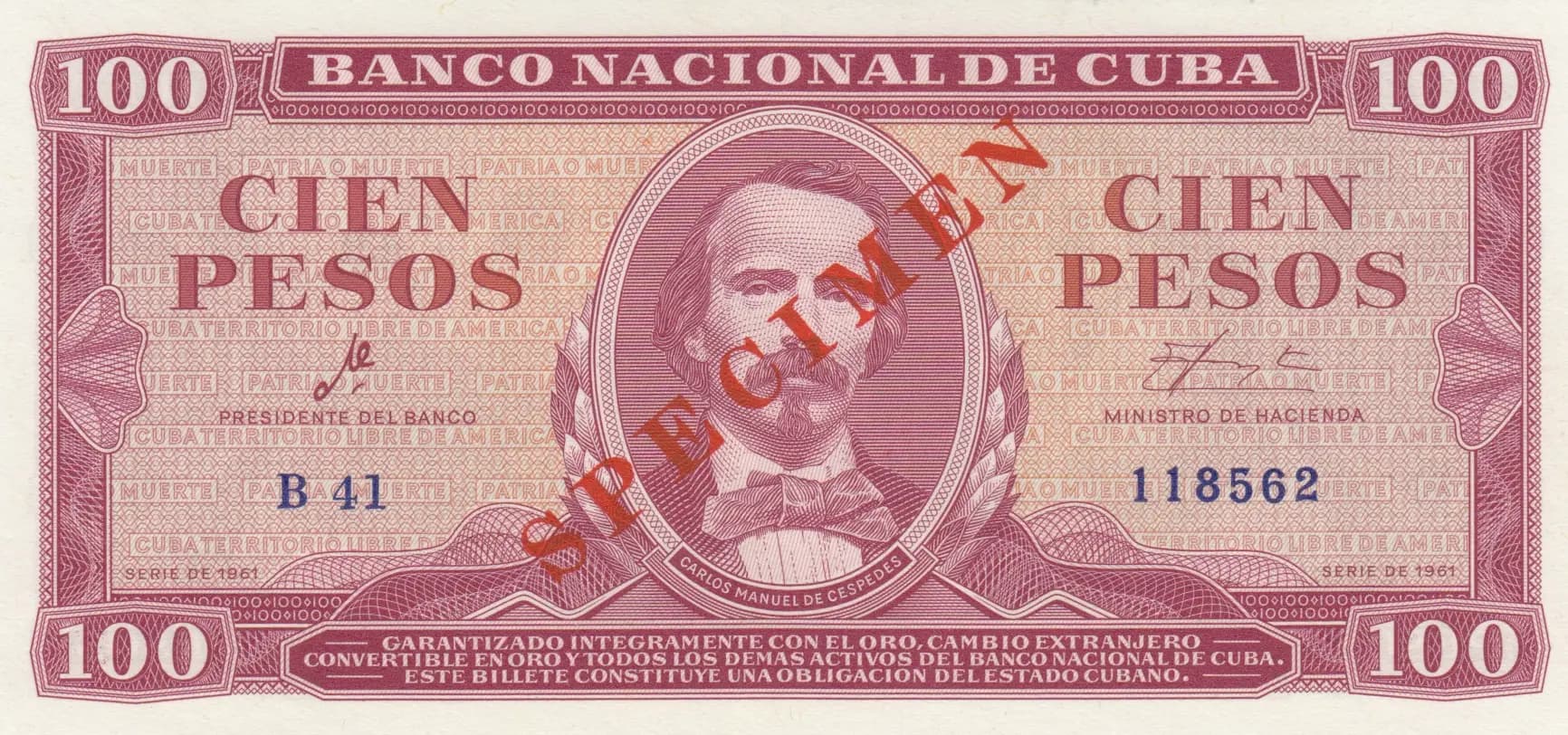
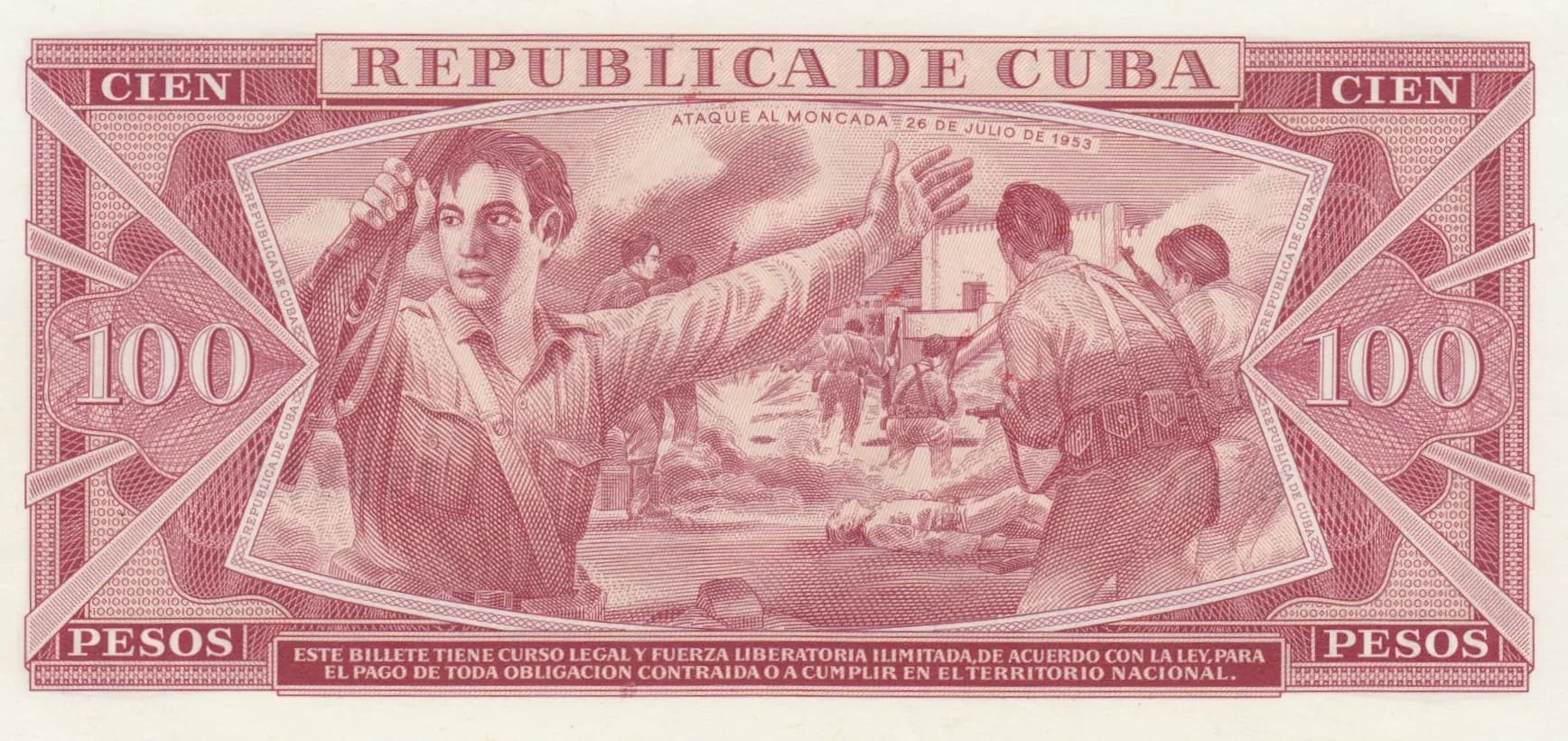
This is a 1961 Cuban 100 pesos specimen note (Pick P-99s) issued by Banco Nacional de Cuba in uncirculated condition. The note features a striking mauve and burgundy color scheme with the portrait of Carlos Manuel de Céspedes on the obverse and a dramatic historical scene of the Attack on the Moncada Barracks (July 26, 1953) on the reverse. The specimen designation is evidenced by red overprint marks across the portrait, and the note exhibits excellent preservation with crisp printing, intricate security patterns, and fine line engraving throughout—making it an important historical document of post-revolutionary Cuba.
Common. While this is a specimen note (marked with red overprints and not released into circulation), specimen notes from this 1961 series appear with reasonable frequency in the collector market. The catalog value of approximately $100 USD (based on 2019 realbanknotes.com data) is moderate and consistent with common specimen issues. The print run for this series appears to have been substantial enough that specimens remain accessible to collectors, and there is no evidence of this Pick number being recalled, short-lived, or from a severely limited printing.
This 1961 specimen note commemorates the pivotal July 26, 1953 attack on the Moncada Barracks in Santiago de Cuba, a defining moment in the Cuban Revolution led by Fidel Castro. The obverse portrait honors Carlos Manuel de Céspedes (1819-1874), the 'Father of the Cuban Nation' and leader of the Ten Years' War for independence, connecting pre-revolutionary and revolutionary Cuban nationalism. The reverse scene depicts this revolutionary assault, while the note's inscription 'Cuba Territorio Libre de América' and the motto 'Muerte o Patria' (Death or Country) reflect the ideological messaging of the newly established revolutionary government.
The obverse features a formal oval-framed portrait of Carlos Manuel de Céspedes, the 19th-century Cuban independence leader, rendered as a dignified bearded gentleman in formal attire. The portrait is flanked by laurel wreaths symbolizing victory and honor. The reverse depicts a dramatic historical scene of the July 26, 1953 assault on the Moncada Barracks fortress in Santiago de Cuba, with multiple revolutionary figures engaged in military action and a prominent young combatant in the foreground gazing upward—likely representing the revolutionary spirit and determination of Castro's movement. Both sides feature ornate decorative borders with geometric corner ornaments, and the entire note is characterized by fine line engraving with repeating security microtext patterns incorporating the denomination, nationalist slogans, and the phrase 'Muerte o Patria.' The color scheme of mauve, burgundy, and pink tones was typical of Cuban banknotes of this era.
OBVERSE: 'Banco Nacional de Cuba' (National Bank of Cuba), 'Cien Pesos' (One Hundred Pesos), 'Carlos Manuel de Céspedes' (proper name), 'Presidente del Banco' (President of the Bank), 'Ministro de Hacienda' (Minister of Treasury), 'Serie de 1961' (Series of 1961), 'Garantizado integramente con el oro. Cambio extranjero convertible en oro y todos los demás activos del Banco Nacional de Cuba. Este billete constituye una obligación del Estado Cubano.' (Fully guaranteed with gold. Foreign exchange convertible into gold and all other assets of the National Bank of Cuba. This note constitutes an obligation of the Cuban state.), 'Cuba Territorio Libre de América' (Cuba Free Territory of America), 'Muerte o Patria' (Death or Country—repeating security pattern). REVERSE: 'República de Cuba' (Republic of Cuba), 'Cien Pesos' (One Hundred Pesos), 'Ataque al Moncada - 26 de Julio de 1953' (Attack on the Moncada - July 26, 1953), 'Este billete tiene curso legal y fuerza liberatoria ilimitada de acuerdo con la ley, para el pago de toda obligación contraída o a cumplir en el territorio nacional.' (This note has legal tender status and unlimited liberatory force in accordance with the law, for the payment of any obligation contracted or to be fulfilled in the national territory.)
Intaglio (recess) engraving on steel plates, as evidenced by the fine line work, intricate guilloche patterns, and the crisp, dimensional quality of the printed image. The note was produced by the Sociedad Tipográfica Cubana-Ponce (STC-P) printer without an imprint mark. Security features include repeating microtext patterns visible in the background, fine-line engraved borders, and elaborate ornamental designs typical of high-security banknote production of the early 1960s.
This is specifically a specimen note (P-99s designation), distinguished from regular circulation notes (P-99) by red overprint marks/stamps applied to the obverse. The specimen marking appears as red ink impression across the portrait area, a standard practice for banknotes set aside for archival, official, and collector distribution rather than intended for circulation. Serial number observed: B41 118562. Series designation: 'Serie de 1961.' No major die varieties or signature variants are evident from the visual analysis, though specimen examples may exist with varying red overprint placements or intensities.