10 pesos 1991 specimen
Market Prices
1 saleAbout This Note
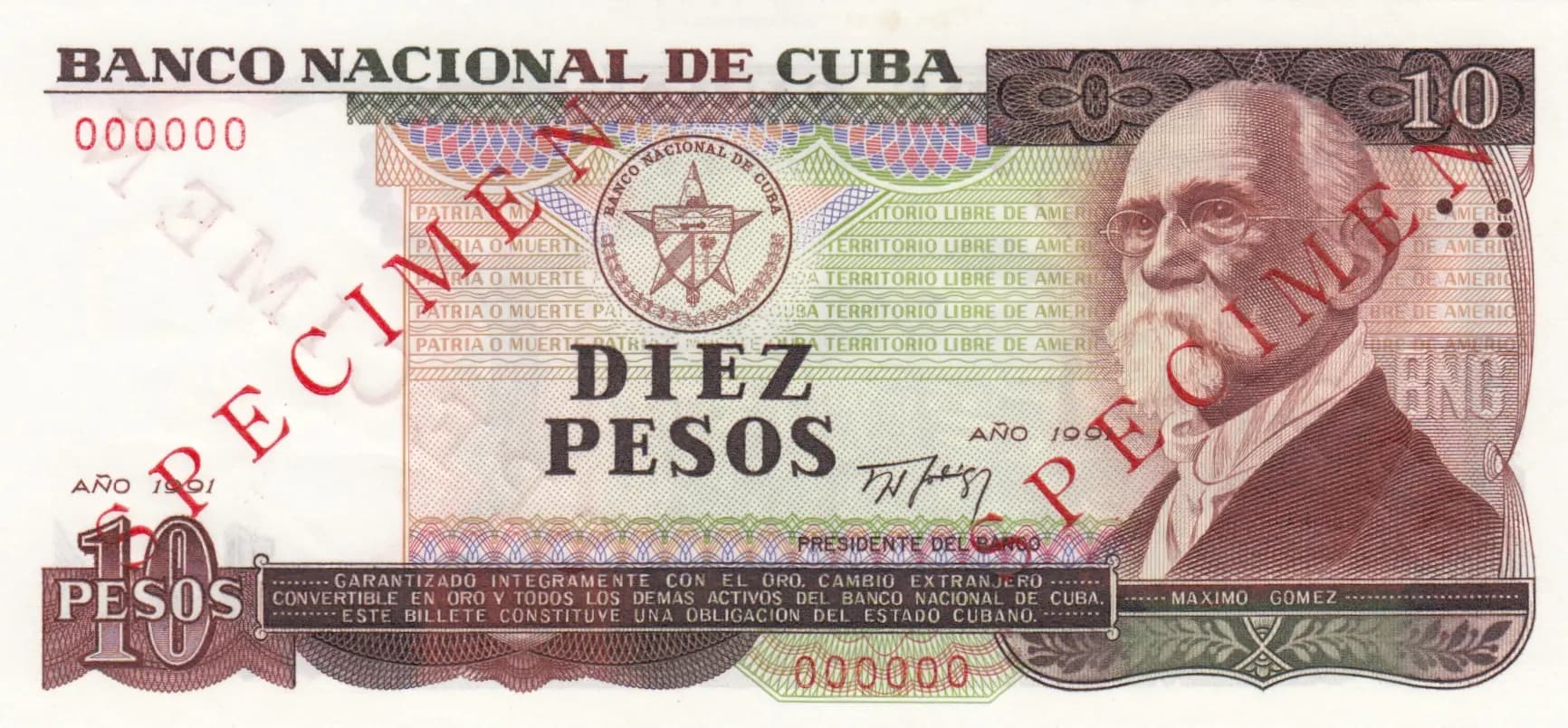
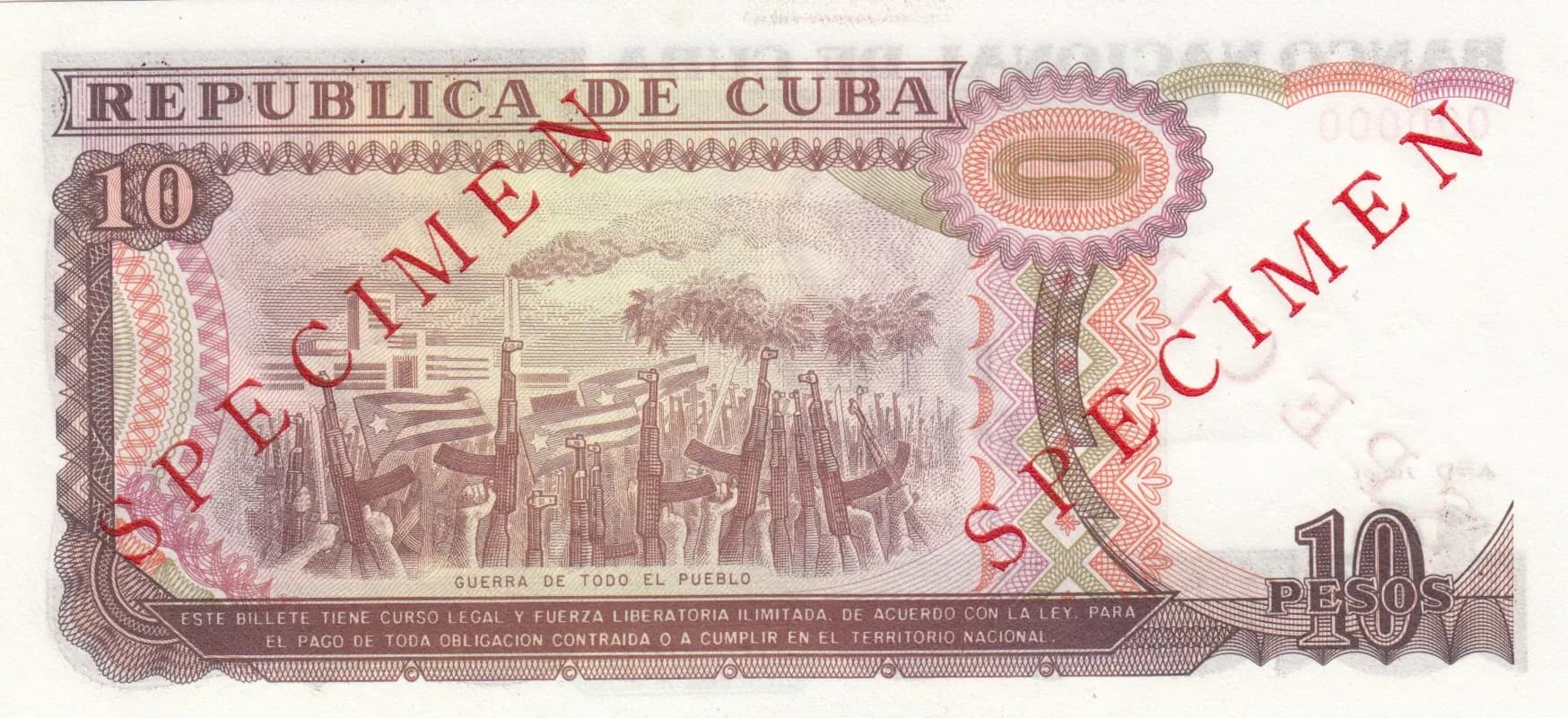
A Cuban 10 Pesos specimen note from 1991 in uncirculated condition, featuring a portrait of revolutionary figure Máximo Gómez on the obverse and a dynamic scene titled 'Guerra de Todo el Pueblo' (War of All the People) on the reverse. The note displays the characteristic brown, olive-green, red, and cream color palette with ornamental borders and a red diagonal 'SPECIMEN' overprint, representing an important documentary example of early 1990s Cuban currency design during the Special Period.
Common. This is a specimen note from a standard 1991 issue of Cuban currency. The eBay market price data provided (AUNC examples sold for $16.50 in 2016, with 2019 catalog value of $15 UNC) indicates modest collector demand and readily available supply. Specimen notes, while technically not circulated, are typically produced in quantities sufficient for banking and numismatic distribution. No evidence of short print runs, recalls, or exceptional scarcity exists for Pick P-109s.
Issued during 1991, this note reflects Cuba's revolutionary heritage and the nation's positioning during the economically challenging Special Period following the collapse of Soviet support. The obverse honors Máximo Gómez, a key figure in Cuba's wars of independence against Spanish colonial rule. The reverse's 'Guerra de Todo el Pueblo' imagery celebrates the concept of popular revolutionary struggle, a central theme in Cuban state symbolism, while inscriptions emphasizing state obligation ('This note constitutes an obligation of the Cuban State') reinforce the socialist government's control over currency.
The obverse features a formal portrait of Máximo Gómez, an aging man wearing glasses and dark formal clothing, positioned on the right side of the note. A circular seal containing a five-pointed star appears in the upper center, representing Cuban state symbolism. The reverse depicts a complex revolutionary scene titled 'Guerra de Todo el Pueblo,' showing multiple figures with raised fists in a crowd scene, suggesting collective revolutionary action and liberation. Palm trees and industrial/agricultural structures visible in the background contextualize Cuba's economy and landscape. Both sides employ ornamental borders with intricate decorative patterns and fine line work characteristic of security printing. The dominant color scheme combines brown and olive-green base colors with red, pink/magenta, and cream accents throughout.
OBVERSE: 'BANCO NACIONAL DE CUBA' (National Bank of Cuba), 'DIEZ PESOS' (Ten Pesos), 'AÑO 1991' (Year 1991), 'PATRIA O MUERTE' (Fatherland or Death — Cuba's revolutionary motto), 'TERRITORIO LIBRE DE AMERICA' (Free Territory of America), 'MAXIMO GOMEZ' (identifying the portrait subject), 'GARANTIZADO INTEGRAMENTE CON EL ORO, CAMBIO EXTRANJERO' (Fully guaranteed with gold, foreign exchange), 'CONVERTIBLE EN ORO Y TODOS LOS DEMAS ACTIVOS DEL BANCO NACIONAL DE CUBA. ESTE BILLETE CONSTITUYE UNA OBLIGACION DEL ESTADO CUBANO.' (Convertible into gold and all other assets of the National Bank of Cuba. This note constitutes an obligation of the Cuban State.). REVERSE: 'REPUBLICA DE CUBA' (Republic of Cuba), 'GUERRA DE TODO EL PUEBLO' (War of All the People), 'PESOS' (Pesos), 'ESTE BILLETE TIENE CURSO LEGAL Y FUERZA LIBERATORIA ILIMITADA, DE ACUERDO CON LA LEY. PARA PAGO DE TODA OBLIGACION CONTRAIDA O A CUMPLIR EN EL TERRITORIO NACIONAL.' (This note has legal tender status and unlimited liberatory force, in accordance with the law. For payment of all obligations made or to be fulfilled in the national territory.)
Intaglio (engraved) printing on banknote paper, evidenced by the fine detail work, cross-hatching, complex line patterns, and the high-quality definition visible in both the portrait and the reverse scene. The multiple color printing appears to employ traditional currency security printing methods, with separate color passes for the base colors and security elements. No specific printer attribution is definitively documented for P-109s in standard catalogs, though Cuban banknotes of this era were typically produced by state-controlled printing facilities or contracted international security printers.
This is a specimen variety (indicated by 'SPECIMEN' overprint designation in Pick catalog as P-109s). The serial number appears as '000000' in red, typical for specimen notes. No significant varieties in signature blocks, date variations, or serial number prefixes are noted from the visual analysis. The specimen overprint in red diagonal format is the defining characteristic distinguishing this from standard circulated issues (P-109).