10 pesos 1971 specimen
Market Prices
1 saleAbout This Note
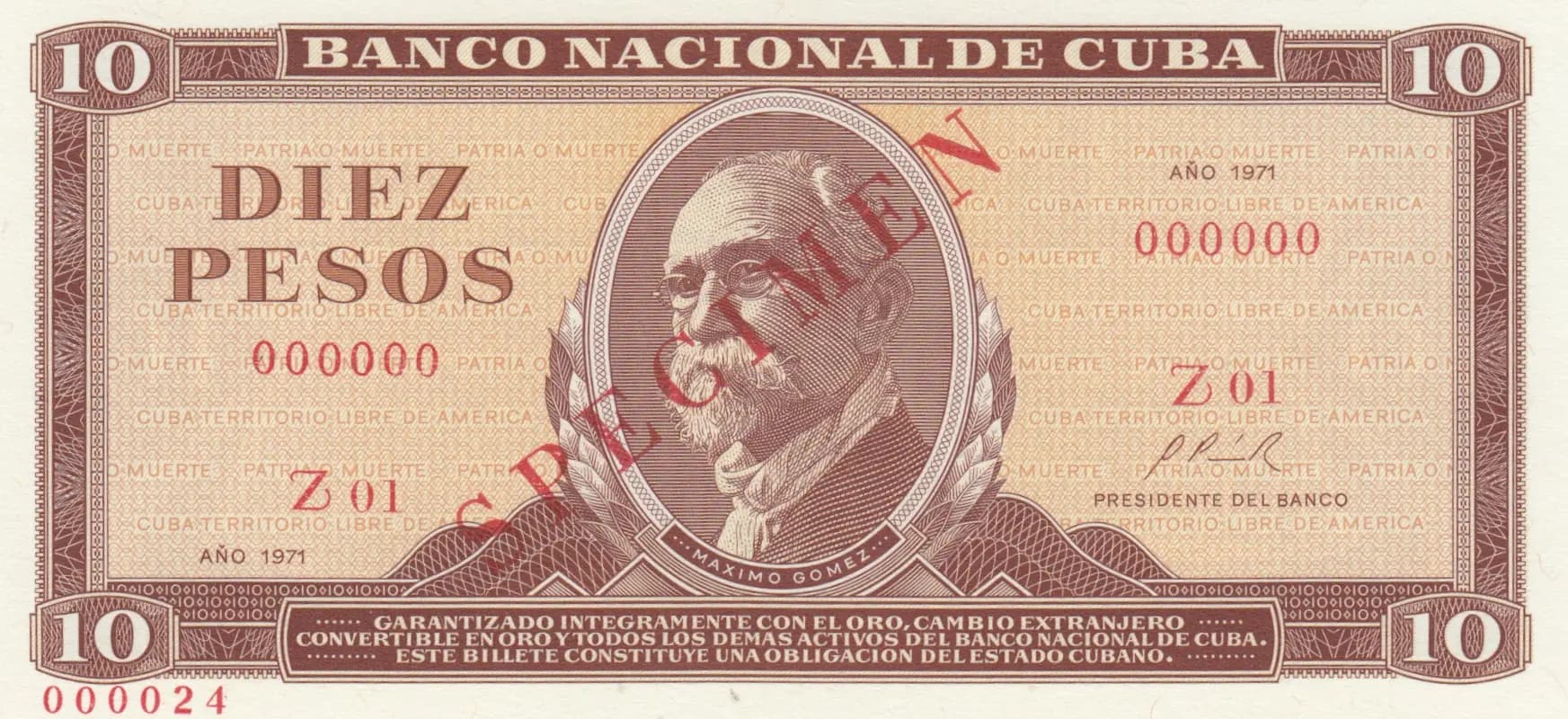
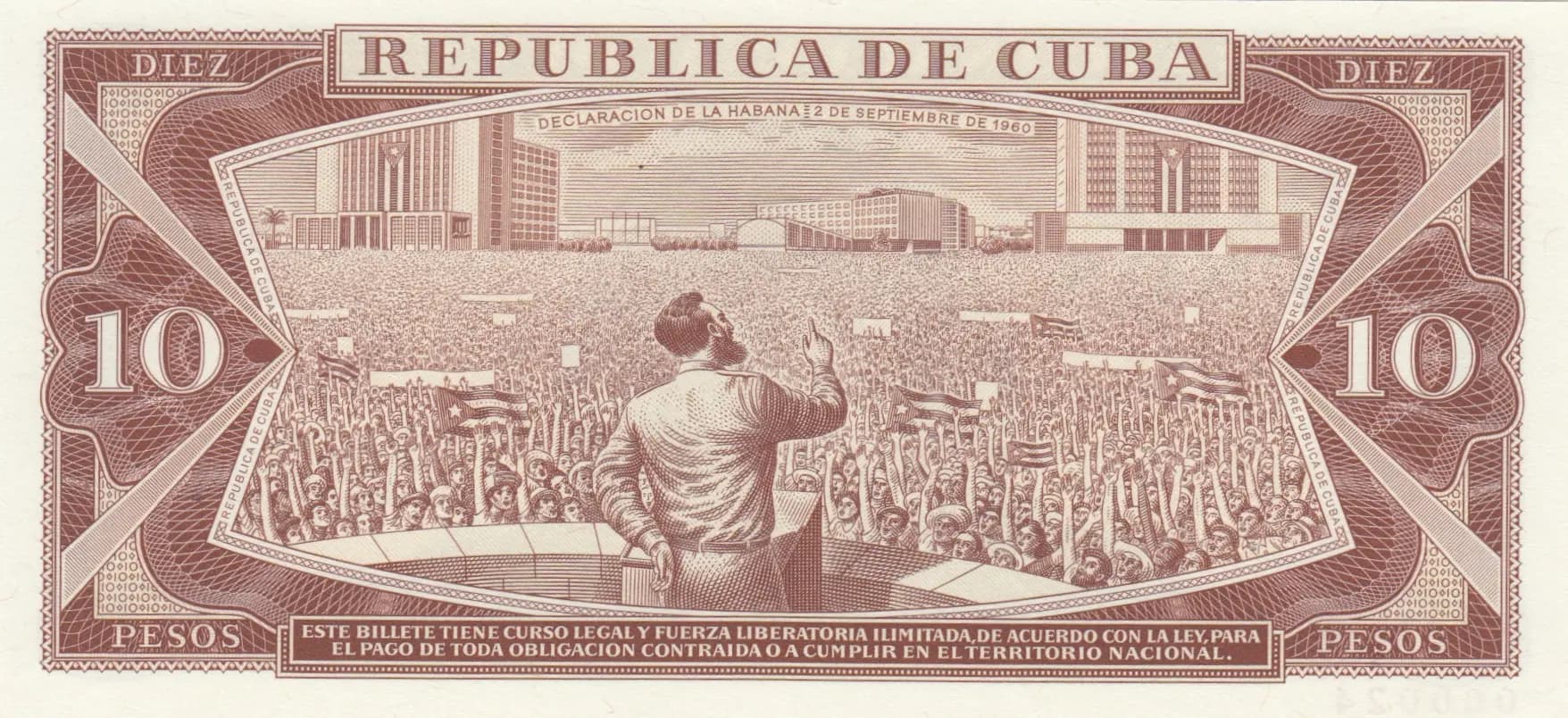
This is a 1971 Cuban 10 Pesos specimen note (Pick P-104as) in pristine uncirculated condition, featuring a striking portrait of Máximo Gómez in brown and maroon tones on the obverse. The reverse depicts a revolutionary mass gathering scene referencing the Declaration of Havana (September 2, 1960), exemplifying the post-revolutionary Cuban state's commemorative banknote design philosophy. As a specimen note with overprint markings and serial number 000000, this represents an official presentation piece rather than circulation currency, making it a particularly interesting item for collectors of Cuban Revolutionary-era currency.
Common. This note was issued in regular production by the Banco Nacional de Cuba from 1967-1989, with the 1971 date representing a mid-production example. The catalog pricing data indicates VF examples sold for approximately $6 in 2016, with 2019 catalog values of $15 for UNC specimens, reflecting typical collector pricing for common Cuban Revolutionary currency. The specimen overprint version (P-104as) is slightly less common than circulation examples but remains readily available in the collector market at modest premiums.
Issued during the Fidel Castro era by the Banco Nacional de Cuba, this 10 Pesos note commemorates the Declaration of Havana of 1960, a key revolutionary manifesto issued following the triumph of the Cuban Revolution. The dual imagery—honoring 19th-century independence figure Máximo Gómez on the obverse and depicting a mass gathering of revolutionary support on the reverse—reflects Cuba's state ideology linking historical nationalist struggle with contemporary revolutionary achievement. The motto 'Patria o Muerte' (Fatherland or Death) and designation of Cuba as 'Territorio Libre de América' (Free Territory of America) underscore the anti-imperialist messaging central to Cuban state currency during this period.
The obverse features a centered portrait of Máximo Gómez, the 19th-century Cuban military independence leader, rendered in profile facing right within an ornamental oval frame flanked by laurel wreaths. The design employs a brown and maroon color palette on a cream and yellow underprint, with decorative geometric border patterns and ornamental corner designs displaying the denomination '10'. The reverse depicts a commemorative scene of a mass public gathering with a revolutionary figure addressing crowds from an elevated platform, with modernist 1960s architecture visible in the background, reinforcing the connection between historical struggle and revolutionary present. Both sides feature fine-line engraving throughout with intricate decorative borders and denomination numerals in ornamental corner cartouches.
FRONT SIDE: 'Banco Nacional de Cuba' (National Bank of Cuba); 'Diez Pesos' (Ten Pesos); 'Año 1971' (Year 1971); 'Patria o Muerte' (Fatherland or Death); 'Cuba Territorio Libre de América' (Cuba Free Territory of America); 'Presidente del Banco' (President of the Bank); 'Garantizado integramente con el oro, cambio extranjero...' (Fully guaranteed with gold, foreign exchange...); 'Convertible en oro y otros valores del Banco Nacional de Cuba. Este billete constituye una obligación del Estado Cubano.' (Convertible into gold and other values of the National Bank of Cuba. This note constitutes an obligation of the Cuban state.). REVERSE SIDE: 'República de Cuba' (Republic of Cuba); 'Diez Pesos' (Ten Pesos); 'Declaración de la Habana 2 de Septiembre de 1960' (Declaration of Havana September 2, 1960); 'Este billete tiene curso legal y fuerza liberatoria ilimitada de acuerdo con la ley, para el pago de toda obligación contraída o a cumplir en el territorio nacional.' (This note has legal tender status and unlimited liberatory force in accordance with the law, for payment of any obligation incurred or to be fulfilled in the national territory.)
This note was produced using intaglio (engraved) printing, evidenced by the fine-line engraving observed throughout the design, intricate border patterns, and complex scene details visible in the crowd gathering on the reverse. The printer is identified as STC-P (Sociedad Tipográfica de Cuba-Prensa or similar) without imprint, consistent with the Cuban state security printing practices of the early 1970s. The crisp, clean impression typical of uncirculated specimen notes reflects the high-quality production standards of Cuban state security printing.
This specific example is identified as a specimen note (marked P-104as rather than P-104) by the red 'SPECIMEN' overprint and sequential specimen serial number (000000 with Z01 prefix designation). The note displays the standard 1967-1971 design period characteristics with brown coloring, Máximo Gómez portrait at center, and Declaration of Havana reverse. Serial designation Z01 with specimen zeros indicates this is an official specimen/presentation piece issued by the Banco Nacional de Cuba for archival, presentation, or currency validation purposes rather than for circulation.