10 pesos 1960
Market Prices
21 salesAbout This Note
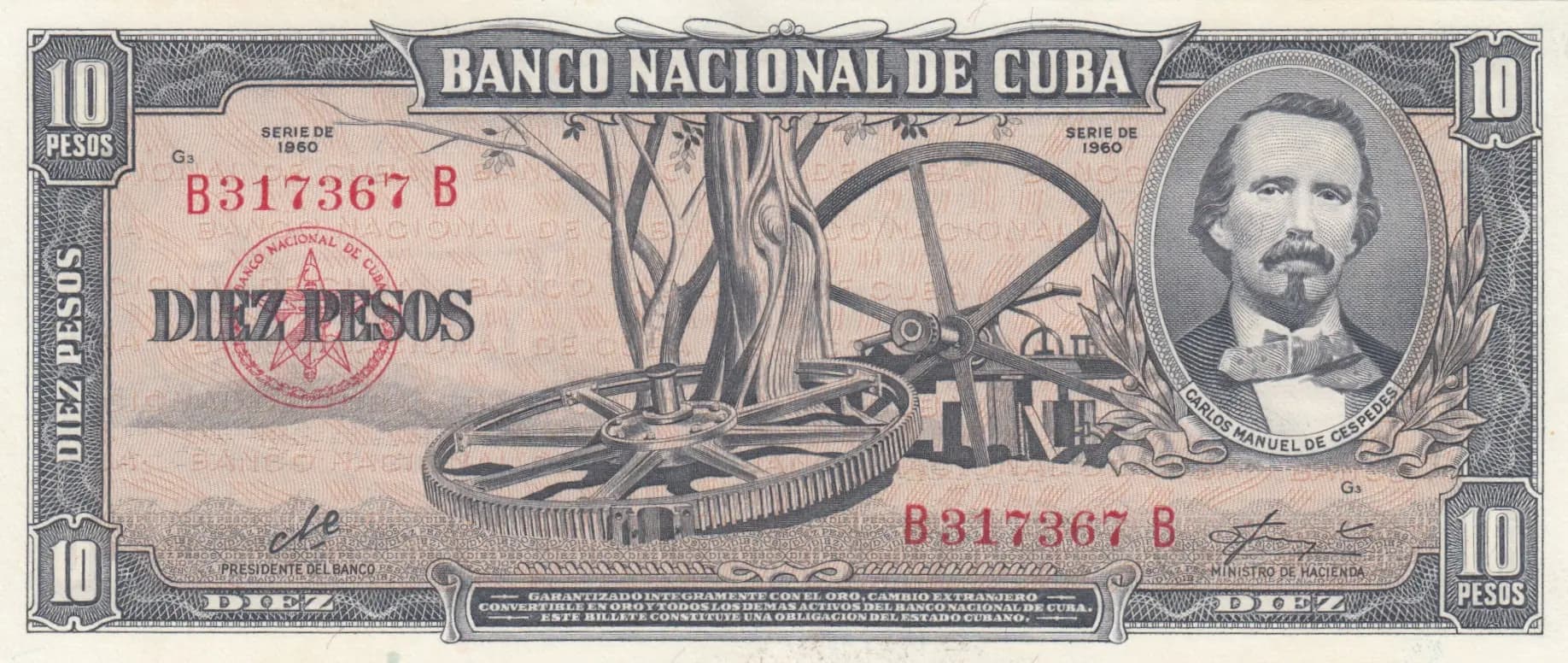
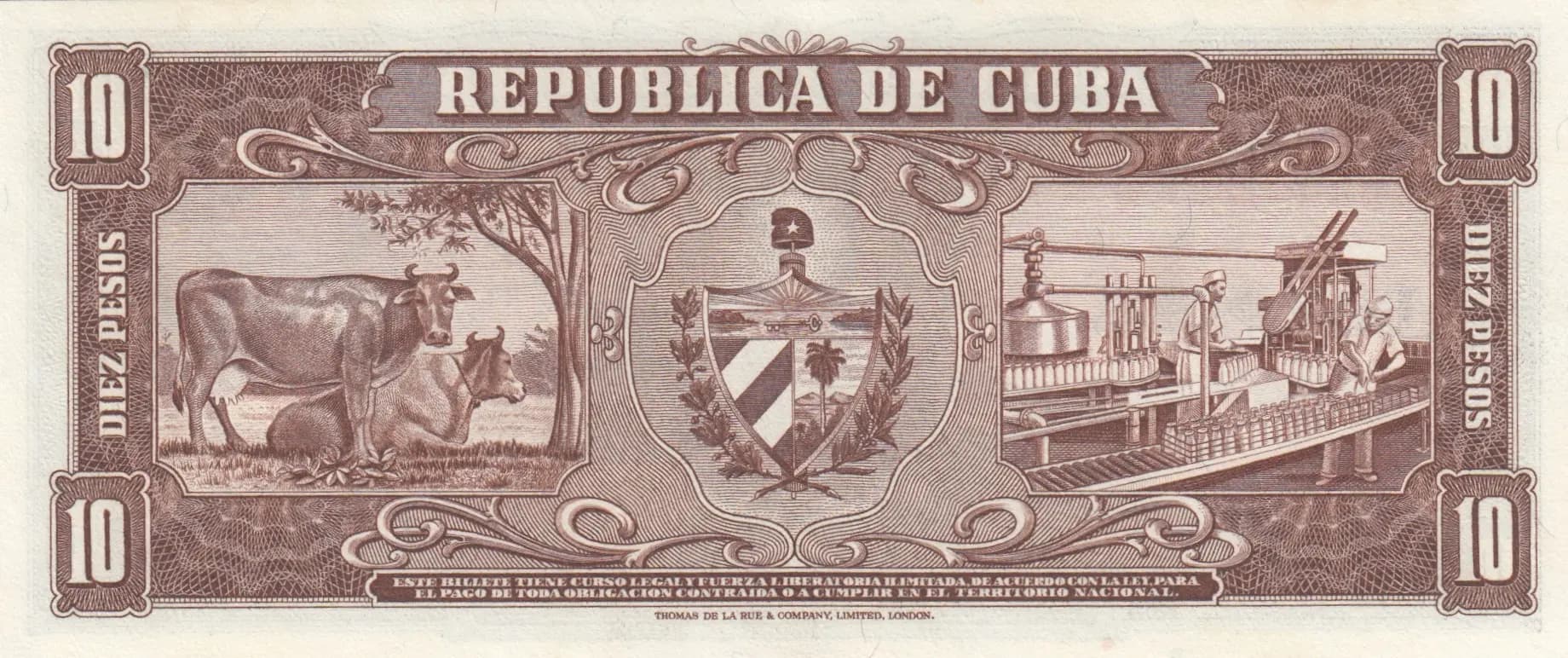
A striking UNC 10 Pesos note from Cuba's 1960 series, featuring Carlos Manuel de Céspedes on the obverse and a tripartite design on the reverse showcasing cattle, the Cuban coat of arms, and industrial/agricultural infrastructure. The note displays crisp, clear engraving throughout with no visible wear, creases, or tears, exemplifying the exceptional preservation typical of uncirculated specimens from this issue. This Thomas De La Rue printing represents an important transitional moment in Cuban currency, issued just months before the revolutionary government would fundamentally reshape the nation's monetary system.
Common. The eBay price tracking data provided shows consistent sales in the $3–$15 range across multiple condition grades (F, VF, EF, AUNC) spanning 2009–2022, with UNC examples notably selling for as low as $1.75 (2009) and generally not exceeding $15 catalog value. Print runs for this series were substantial, and surviving specimens in all grades remain readily available in the secondary market. The consistent supply and modest valuation across years confirm this as a standard circulation issue with no rarity premium.
The 1960 10 Pesos note was issued during a critical period in Cuban history, as Fidel Castro's revolutionary government consolidated power following the 1959 triumph of the Revolution. The reverse design deliberately emphasizes Cuba's agricultural and industrial wealth—depicting pastoral cattle grazing, a sugar mill (reflecting Cuba's primary export industry), and modern factory infrastructure—imagery designed to project economic stability and national prosperity during a time of radical political upheaval. Carlos Manuel de Céspedes, honored on the obverse, was a 19th-century independence leader and founding father, making his inclusion a link to Cuban nationalist traditions even as the new regime was charting a radically different political course.
The obverse (front) features a portrait of Carlos Manuel de Céspedes, the 19th-century Cuban independence leader and founding father of the Republic, positioned on the right side within an oval frame adorned with a laurel wreath. The central vignette depicts the Demajagua Sugar Mill ruins beneath a spreading tree, with prominent sugar processing machinery including a large decorative wheel—a visual metaphor for Cuba's agricultural heritage and industrial capacity. A red circular seal reading 'Garantizado Integramente con el Oro' emphasizes the note's gold backing. The reverse presents three distinct vignettes: cattle grazing in pastoral countryside (left), the Cuban coat of arms featuring a shield with diagonal division, palm tree, torch, and star topped by a laurel wreath (center), and a modern industrial sugar mill or processing facility with factory buildings, smokestack, and harbor infrastructure (right). This tripartite design symbolizes Cuba's integration of agricultural tradition, national identity, and industrial modernization. The color scheme combines light pink/tan on the obverse with brown/maroon tones on the reverse, typical of Thomas De La Rue's sophisticated banknote aesthetic from this period.
FRONT: 'Banco Nacional de Cuba' (National Bank of Cuba) / 'Serie de 1960' (Series of 1960) / 'Diez Pesos' (Ten Pesos) / 'Carlos Manuel de Céspedes' (proper name) / 'Presidente del Banco' (President of the Bank) / 'Ministro de Hacienda' (Minister of Finance) / 'Garantizado integramente con el oro, cambio extranjero convertible en oro y todos los demas valores autorizados por el Banco Nacional de Cuba. Este billete constituye una obligacion del Estado Cubano.' (Guaranteed entirely with gold, foreign exchange convertible into gold and all other values authorized by the National Bank of Cuba. This note constitutes an obligation of the Cuban State.) / Serial number: 'B3173367 B' / Batch identifier: 'G3'. BACK: 'Republica de Cuba' (Republic of Cuba) / 'Diez Pesos' (Ten Pesos) / 'Este billete tiene curso legal y fuerza liberatoria ilimitada, acuedo con la ley para el pago de toda obligacion contraida a cumplir en el territorio nacional.' (This note has legal tender status and unlimited liberatory force, in accordance with the law for the payment of all obligations contracted to be fulfilled in the national territory.) / 'Thomas De La Rue & Company, Limited, London.' (printer attribution).
Intaglio engraving (copper plate engraving), the standard security printing method employed by Thomas De La Rue & Company, London, one of the world's premier banknote security printers. The visual analysis confirms the characteristic deep, crisp line work, fine detail resolution in portraiture and architectural elements, and the precise layering of multiple color impressions typical of intaglio production. Security features include intricate engraved borders, decorative frames, and fine line work throughout, along with the incorporation of a watermark visible in the paper stock itself.
This specimen is identified as Pick P-88c, the third cataloged variety of the 1960 10 Pesos issue. Serial number prefix 'B' and batch identifier 'G3' are visible on this example. The note belongs to the regular issue (not an overprint or special issue variant). Thomas De La Rue is confirmed as the printer via the inscription on the reverse. No overprints, date variations, or signature variants are apparent on this example, which represents the standard design of the 1960 series during this cataloging period.