1 peso 1869
Market Prices
1 saleAbout This Note
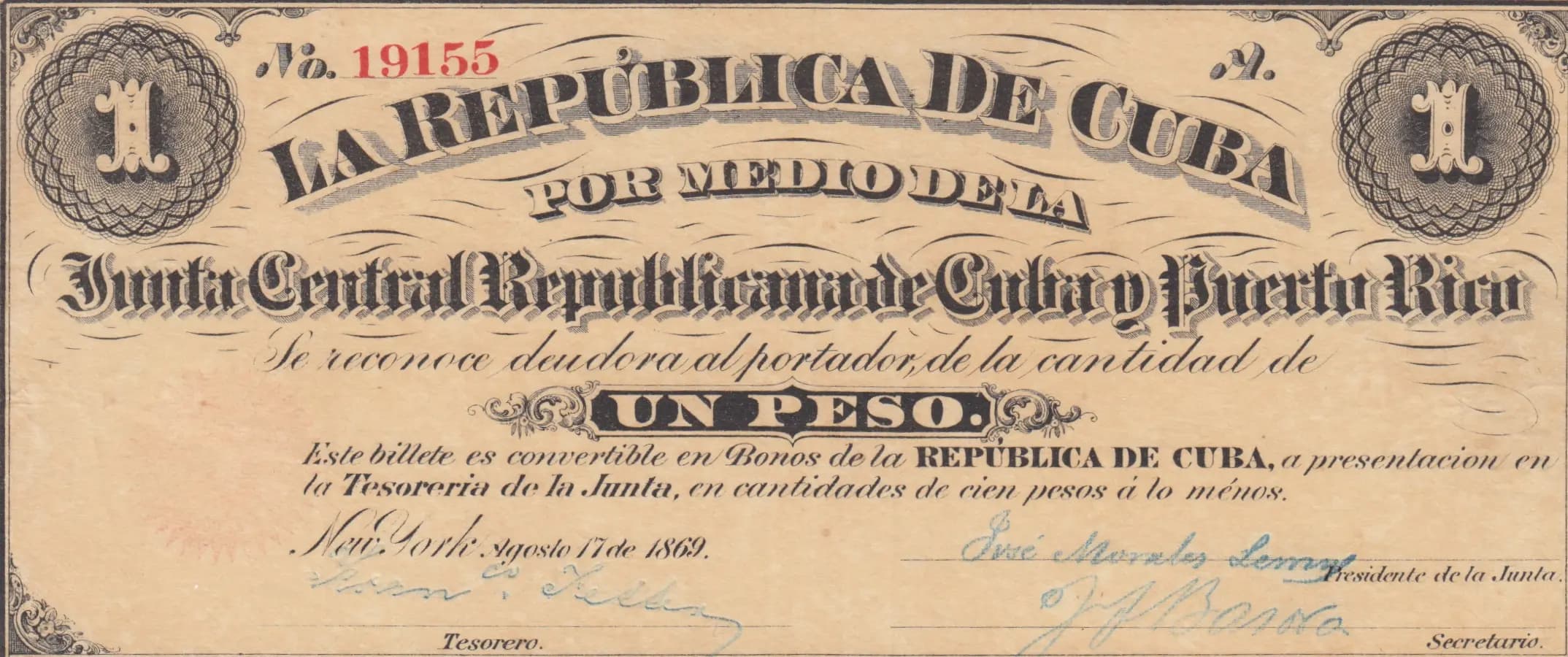
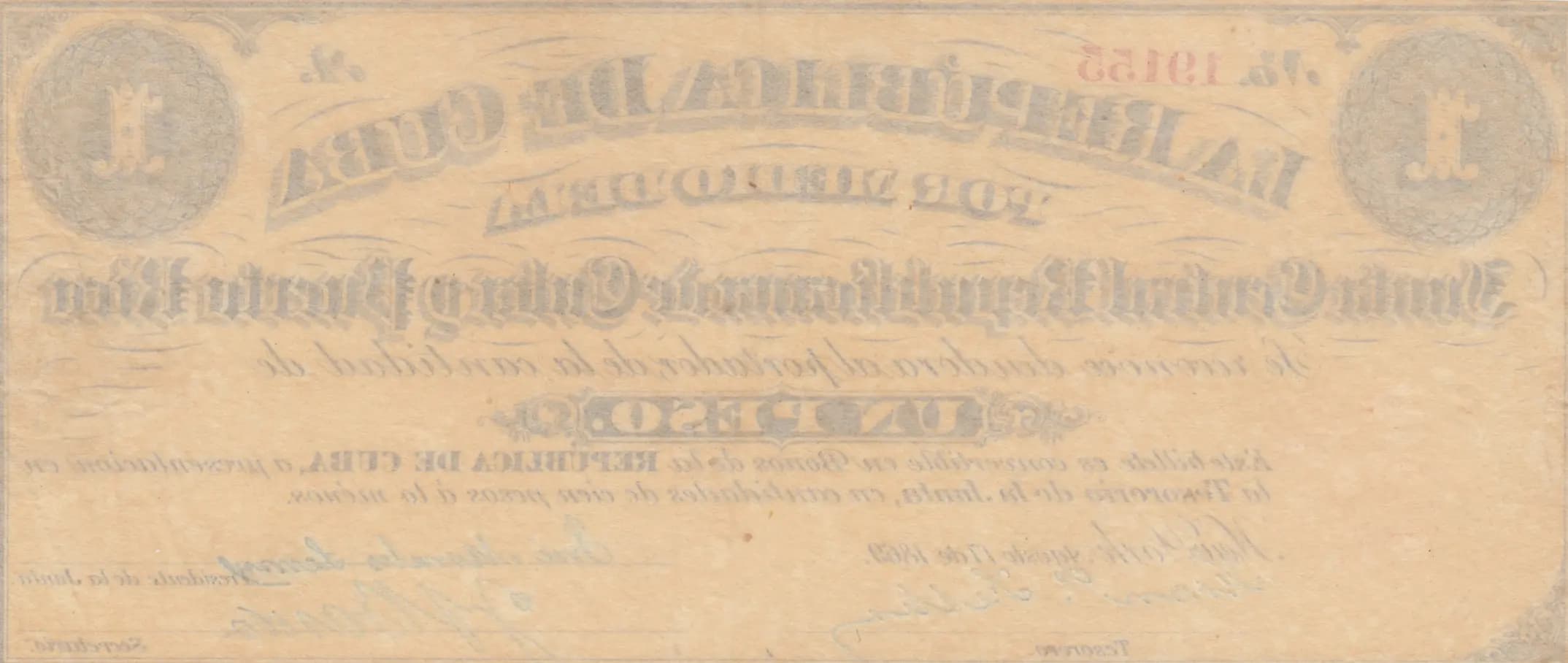
This is a historically significant Cuban one peso note from 1869, issued by the Junta Central Republicana de Cuba y Puerto Rico during the independence struggle. The front displays elegant ornamental design with circular medallions in both corners, printed in black and red ink on aged tan paper with handwritten signatures in blue. In VF condition, this note shows expected age-related foxing and creasing but remains legible, with the reverse heavily faded—typical for notes of this era that are now over 150 years old.
Common. While this is a historically important revolutionary issue and genuinely scarce from a numismatic perspective due to its age and the limited survival of 1869 Cuban revolutionary currency, the eBay price tracking data shows a VF specimen sold for $39.99 in 2013 with modest catalog values ($10 in Good, $50 in Fine, $150 in EF as of 2016). These price points indicate the note is not rare in absolute terms—examples are available to serious collectors willing to search, and the denomination is a basic 1 peso rather than a scarcer higher denomination. The Pick catalog listing as P-61 reflects its inclusion in standard references without rarity designation.
This note was issued on August 17, 1869, by a revolutionary board operating from New York during Cuba's Ten Years' War for independence from Spain. The inscription crediting the 'Junta Central Republicana de Cuba y Puerto Rico' and the note's convertibility into bonds of the Republic of Cuba reflect the provisional governance structure of the independence movement. The printing in New York rather than Havana underscores the diaspora nature of Cuban revolutionary activity during this turbulent period.
The obverse features a classical banknote design centered on the denomination 'UN PESO' with ornamental framing. Two identical circular medallions with intricate geometric patterns occupy the upper corners (left and right), serving both decorative and security purposes. The main text is rendered in elaborate calligraphic script typical of 19th-century currency design. A decorative border frames the entire note with fine line work and engraving details throughout. The reverse, though heavily deteriorated, appears to mirror the ornamental structure with faint medallion designs visible on both sides. No portraits are depicted on this revolutionary bond-style currency. The color scheme utilizes black and red inks on a tan/beige base paper stock, with formal signatures in blue ink at the lower right of the obverse.
FRONT SIDE: 'LA REPÚBLICA DE CUBA' (The Republic of Cuba) / 'POR MEDIO DE LA Junta Central Republicana de Cuba y Puerto Rico' (By means of the Central Republican Board of Cuba and Puerto Rico) / 'Se ofrece válida al portador, de la cantidad de UN PESO' (Is offered as valid to the bearer, in the amount of ONE PESO) / 'Este billete es convertible en Bonos de la REPÚBLICA DE CUBA, a presentacion en la Tesoreria de la Junta, en cantidades de cien pesos a lo menos' (This note is convertible into Bonds of the REPUBLIC OF CUBA, upon presentation at the Treasury of the Board, in quantities of one hundred pesos or more) / 'New York, agosto 17 de 1869' (New York, August 17, 1869) / 'Tesorero' (Treasurer) / 'Secretario' (Secretary) / 'Presidente de la Junta' (President of the Board) / Serial number: No. 19155. REVERSE SIDE: [Text illegible due to severe fading and age-related deterioration].
This note was produced using traditional intaglio (steel engraving) printing, evidenced by the fine line work, precise geometric patterns in the medallions, and the quality of detail visible in the ornamental borders. The two-color printing (black and red) combined with handwritten signatures in blue ink is consistent with 19th-century banknote production methods. The printer for this specific revolutionary issue is not identified on the note itself, though revolutionary Cuban currency was often produced by sympathetic printers in New York and other northeastern American cities during this period.
This specimen is serial number 19155, issued August 17, 1869. Known varieties for this Pick number include different signature combinations of the Treasurer (Tesorero), Secretary (Secretario), and President of the Board (Presidente de la Junta), as well as potentially different serial number ranges. The handwritten nature of the signatures means each note is technically unique in terms of signature appearance. No major overprints or reissue variants are evident on this particular example. Collectors should note that these revolutionary notes were issued in limited quantities and geographic distribution was restricted to diaspora communities, making geographic sourcing (New York imprint) a consistent identifying feature.