1 peso 1979
Market Prices
12 salesAbout This Note
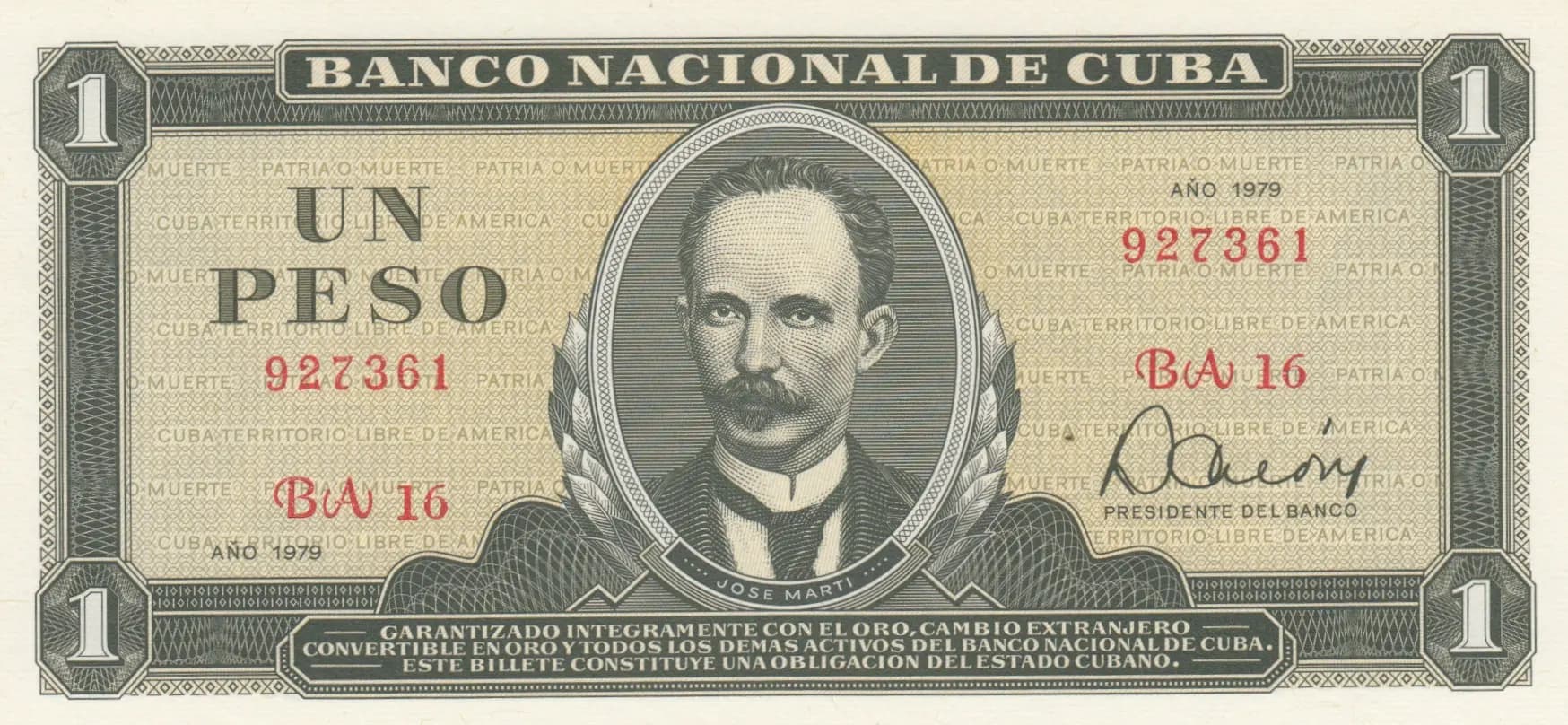
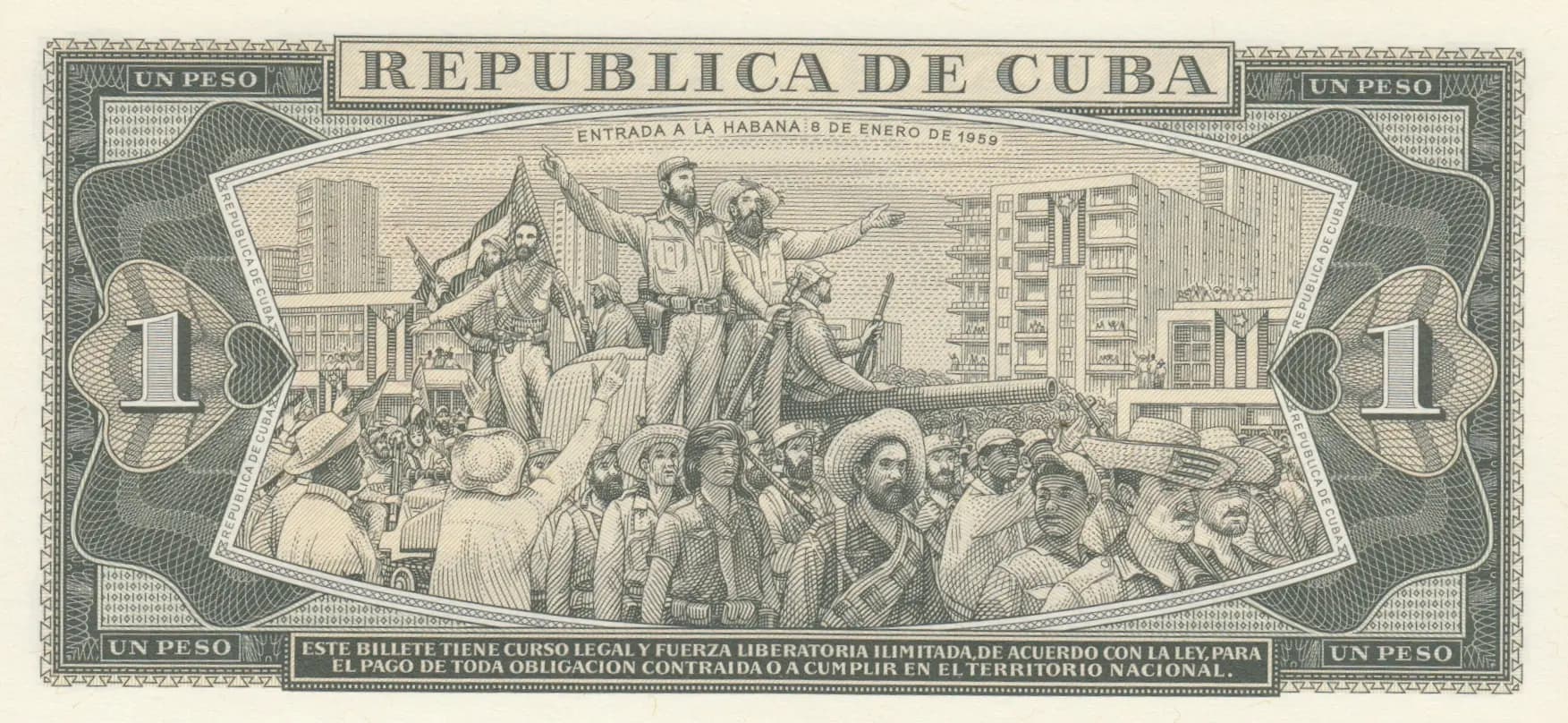
This is an uncirculated 1979 Cuban 1 Peso note (Pick P-102b) featuring José Martí on the obverse and a dramatic revolutionary scene depicting Fidel Castro and his soldiers entering Havana on January 8, 1959 on the reverse. The note exhibits pristine condition with sharp engraving, vibrant green and ochre coloring, and no signs of wear, making it an excellent example of this regular-issue commemorative banknote from the late Castro era.
Common. This note from the 1978-1985 series was a regular issue with substantial production runs throughout the period. eBay sales data shows consistent market activity with UNC examples selling for $0.99 to $5.51 over a decade-long period, with 2019 catalog values listing UNC at only $3.50. The large number of sales transactions across multiple condition grades indicates healthy supply in the collector market.
Issued during the height of the Cuban Revolution's consolidation of power, this 1979 note commemorates the triumphant entry into Havana exactly twenty years earlier on January 8, 1959, marking the definitive moment when revolutionary forces overthrew the Batista regime. The dual imagery of national hero José Martí (19th-century independence advocate) alongside the modern revolutionary victory creates a visual narrative linking Cuba's independence struggles to the contemporary socialist state. The inscriptions 'Patria o Muerte' (Homeland or Death) and 'Cuba Territorio Libre de América' reinforce the ideological messaging of the post-revolutionary Cuban state.
The obverse features a central portrait of José Martí (1853-1895), Cuba's national independence hero and revolutionary thinker, depicted as a bearded man in formal attire within an ornate oval frame flanked by laurel wreaths symbolizing victory and honor. The reverse depicts the historically significant moment of January 8, 1959, when Fidel Castro and his revolutionary soldiers entered Havana to consolidate their victory over the Batista dictatorship, shown as a dynamic crowd scene with multiple armed revolutionaries, raised weapons, and civilian figures against urban architecture. The dominant color scheme of olive-green on ochre underprint provides visual harmony while the ornate border patterns and corner denomination numerals follow classical currency design conventions of the era.
FRONT: 'BANCO NACIONAL DE CUBA' (National Bank of Cuba); 'UN PESO' (One Peso); 'AÑO 1979' (Year 1979); 'PATRIA O MUERTE' (Homeland or Death); 'CUBA TERRITORIO LIBRE DE AMERICA' (Cuba Free Territory of America); 'JOSE MARTI' (name of portrait subject); 'PRESIDENTE DEL BANCO' (Bank President - signature title); 'GARANTIZADO INTEGRAMENTE CON EL ORO, CAMBIO EXTRANJERO CONVERTIBLE EN ORO Y TODOS LOS DEMAS ACTIVOS DEL BANCO NACIONAL DE CUBA. ESTE BILLETE CONSTITUYE UNA OBLIGACION DEL ESTADO CUBANO.' (Fully guaranteed with gold, foreign exchange convertible into gold and all other assets of the National Bank of Cuba. This note constitutes an obligation of the Cuban state.) BACK: 'UN PESO' (One Peso); 'REPUBLICA DE CUBA' (Republic of Cuba); 'ENTRADA A LA HABANA : 8 DE ENERO DE 1959' (Entry into Havana: January 8, 1959); 'ESTE BILLETE TIENE CURSO LEGAL Y FUERZA LIBERATORIA ILIMITADA DE ACUERDO CON LA LEY, PARA EL PAGO DE TODA OBLIGACION CONTRAIDA O A CUMPLIR EN EL TERRITORIO NACIONAL.' (This note has legal tender status and unlimited liberatory force in accordance with the law, for the payment of any obligation incurred or to be fulfilled in national territory.)
Intaglio (line engraving) on high-quality banknote paper with repeating text background patterns for security. The fine line engraving and detailed cross-hatching visible throughout both sides, particularly in the complex revolutionary scene on the reverse, indicate professional security printing. Printed by STC-P (Sociedad Tipográfica de Cubanacán or similar Cuban state printer) without imprint marking, as was typical for Cuban state currency of this period.
This specific variety is identified as P-102b (the 'b' designation likely indicating a signature or design variant within the 1978-1985 production run). The note displays 'PRESIDENTE DEL BANCO' signature titles at left and right, consistent with the variant described in standard catalogs. Serial number 927361 is visible on the obverse. The 'AÑO 1979' marking confirms this as part of the mid-period production, though the series ran from 1978-1985 with multiple signature combinations possible.