5000 gold yuan 1949
Market Prices
4 salesAbout This Note
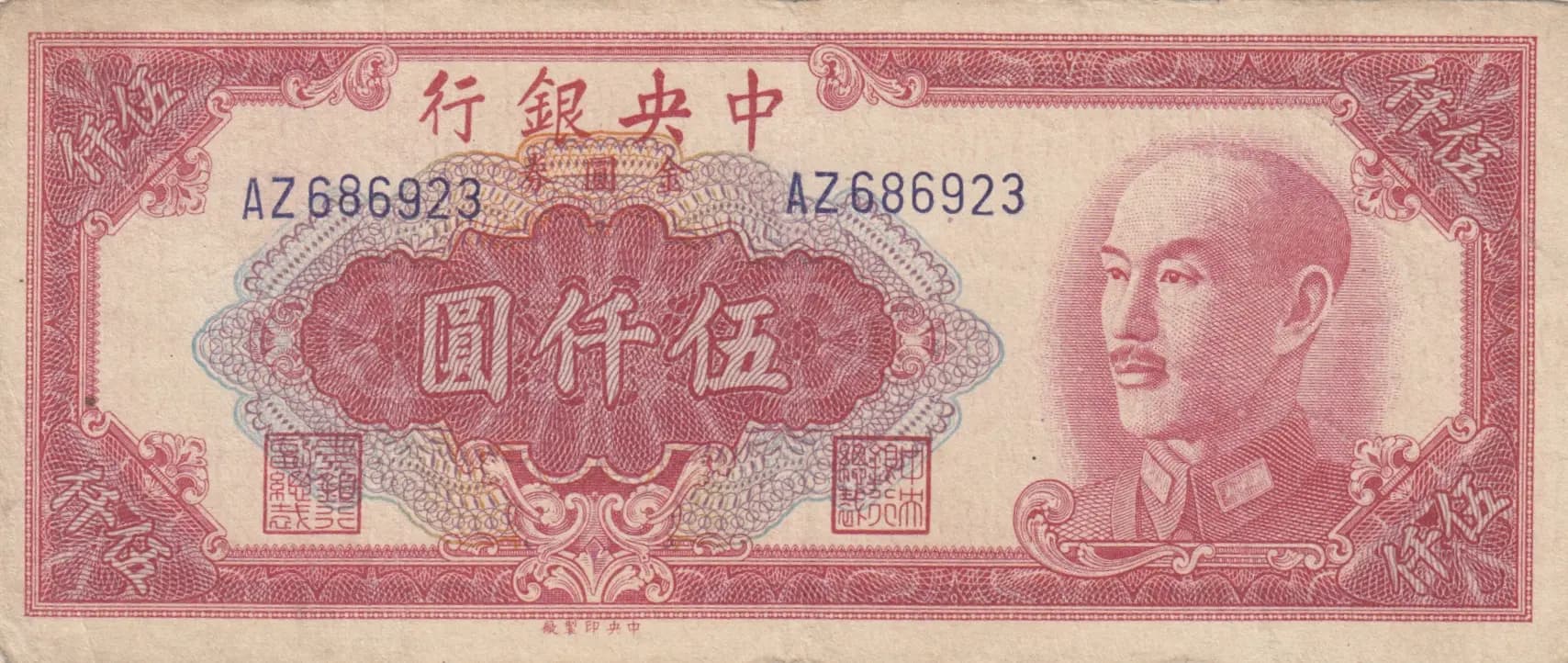
This 5000 Gold Yuan note from the Central Bank of China (1949) exhibits the characteristic red and multicolor design typical of late-stage Republic of China currency. The obverse features a portrait of Chiang Kai-shek (CKS) in military dress facing left, accompanied by ornate scrollwork borders and a central cloud-burst cartouche with Chinese characters. In Fair (F) condition, the note shows visible aging with creasing, foxing, and yellowing consistent with nearly 75 years of storage or light circulation—a common state for notes from this transitional period in Chinese history.
Common. Despite the historical significance of 1949 as the final year of KMT currency production, these notes were printed in substantial quantities and are widely available to collectors. eBay sales data confirms this: Fair specimens sell for $6–$10 in the secondary market, while even higher grades (AUNC) fetch under $20. The 2016 catalog valuation of $5 for VF condition further supports common status. No evidence of limited print runs, recalls, or exceptional scarcity exists for Pick 415a.
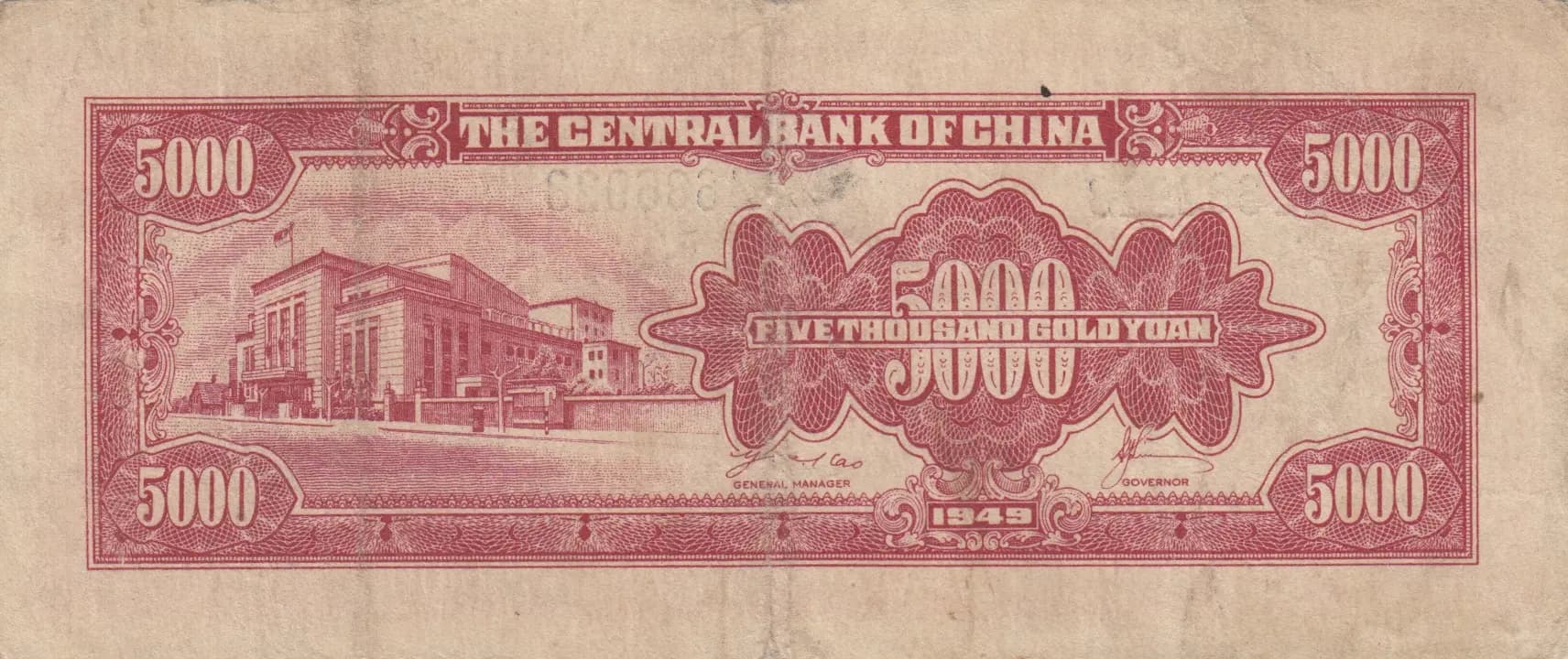
Issued in 1949, this note represents the final year of the Republic of China's currency production before the Communist takeover. The Central Bank of China continued issuing high-denomination notes even as hyperinflation rendered them nearly worthless; the 5000 Gold Yuan denomination was an attempt to address monetary collapse through revaluation. The architectural landmark depicted on the reverse—a prominent governmental or institutional building—symbolized the authority and legitimacy the Nationalist government sought to project during its retreat to Taiwan.
The obverse features a left-facing profile portrait of Chiang Kai-shek (CKS), the Generalissimo and leader of the Republic of China, rendered in military uniform with collar insignia befitting his status. The portrait is surrounded by ornate corner medallions with traditional scrollwork patterns and floral/geometric border motifs characteristic of Chinese engraving aesthetics. A prominent cloud-burst cartouche occupies the center, a symbolic design element rooted in traditional Chinese decorative arts. The reverse displays an institutional building—likely the Central Bank's headquarters or a significant governmental structure—rendered in detailed line-art engraving style, emphasizing the note's official authority. Large denomination numerals (5000) are positioned in all corners; the cartouche repeats the denomination in both English and Chinese.
Front: Central Bank (中央銀行) appears prominently; Serial number AZ686923 printed in blue ink; Nationalist party-related text (國民黨中) visible. Back: THE CENTRAL BANK OF CHINA; 5000 (denomination in corners); FIVE THOUSAND GOLD YUAN; 1949 (issue year); GENERAL MANAGER and GOVERNOR (signature titles). Chinese characters in cloud-burst cartouche denote denomination and issuing authority.
Intaglio engraving (line engraving) on banknote paper, evidenced by the fine line patterns, complex decorative borders, and crisp architectural details visible throughout. The printer is identified as CPF (China Printing Factory). Security features include fine-line engraving complexity, multiple seal stamps with Chinese characters, and serial numbers rendered in blue ink—standard anti-counterfeiting measures for mid-20th-century Central Bank of China notes.
Pick 415a represents the standard regular issue variety. The visual analysis confirms the typical obverse design with CKS portrait and red multicolor underprint, and the reverse with the Bank building depicted at left. Serial number prefix AZ686923 is within the standard range for 1949 issuance. No overprints, commemorative variants, or printing errors are evident in the specimen examined. This note aligns with catalog reference S/M #C302-56a as noted in the reference data.