5 yuan 1919
Market Prices
2 salesAbout This Note
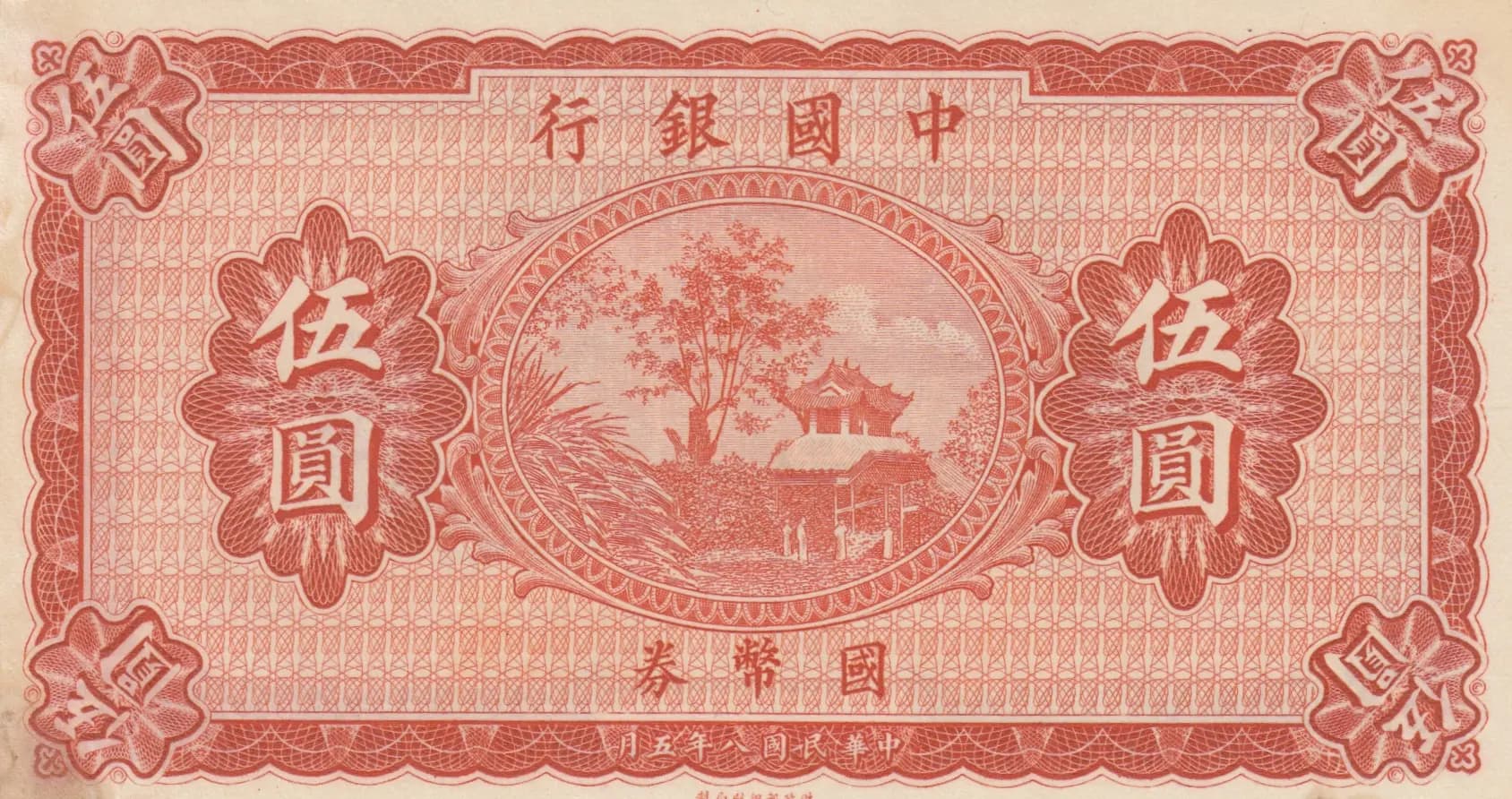
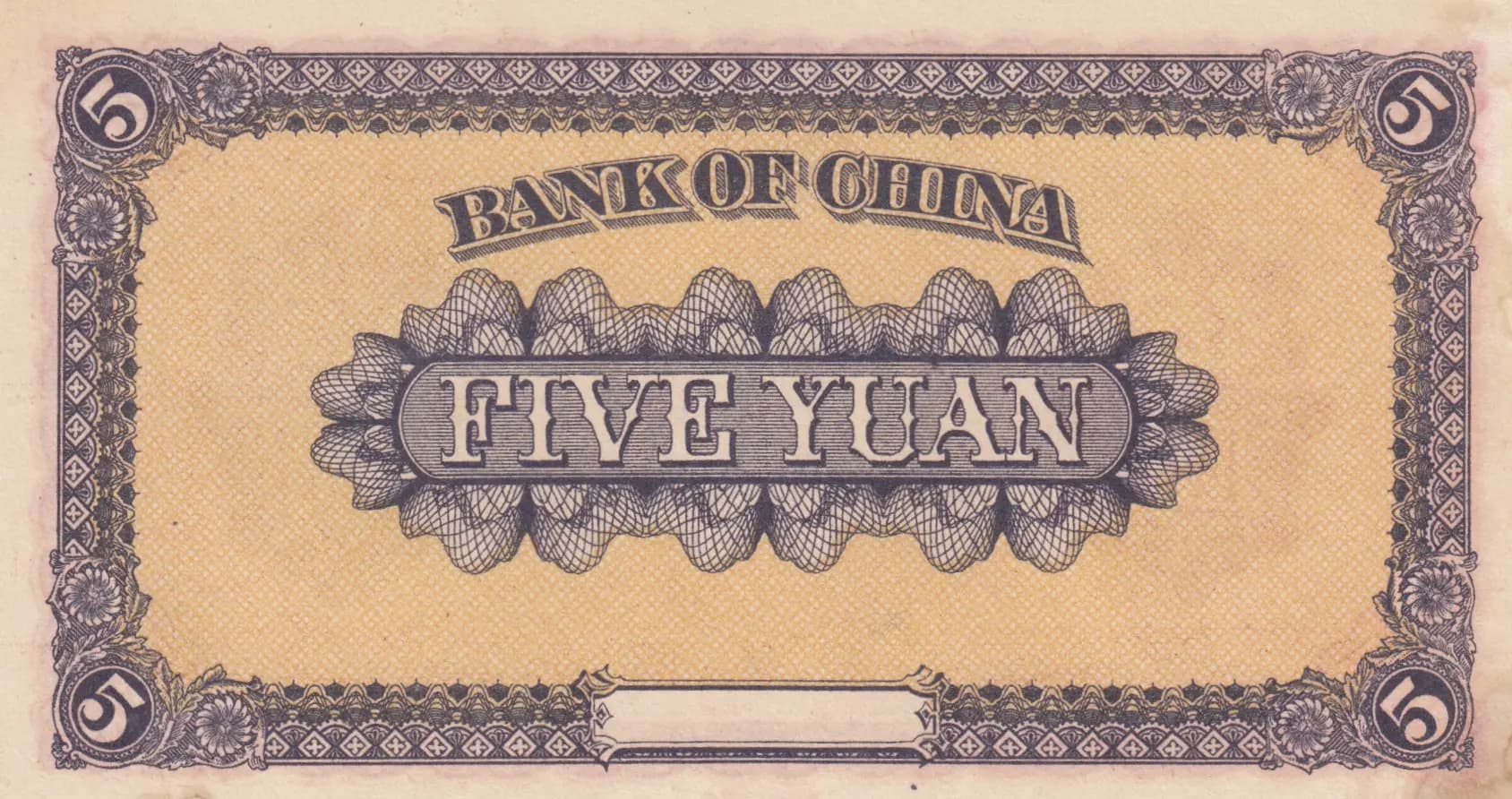
This is a beautiful 1919 Bank of China 5 yuan remainder banknote in AU condition, featuring an exceptional design with a central oval medallion depicting traditional Asian architecture and landscape elements. The obverse is printed in vibrant red/crimson tones, while the reverse displays purple on a light cream/yellow underprint, with intricate fine-line engraving throughout providing impressive security detail. As a remainder note without serial numbers or signatures, this represents an important artifact of early 20th-century Chinese banking and the craftsmanship of BEPP printing in Harbin, Manchuria.
Uncommon. While the catalog value of $450 UNC (2016) and recent eBay sales in the $250-370 range for PMG-graded examples suggest moderate collector demand, this is a remainder note without serial numbers or signatures, which affects its desirability compared to regularly-issued notes. The small number of sales and specialized appeal to remainder banknote collectors indicates this is not a common circulation note, but neither is it extremely rare given that remainder printings often produced significant quantities. The AU condition grade is above average for survivors.
This 5 yuan note was issued in May 1919 by the Bank of China, a critical period when the fledgling Republic of China was establishing modern financial institutions. The traditional Asian pavilion and landscape depicted in the central medallion reflects the Bank of China's effort to maintain cultural identity while adopting Western banking practices and security printing standards. The inclusion of both Chinese inscriptions and English denomination text ('BANK OF CHINA' and 'FIVE YUAN') on the reverse demonstrates the international commercial context of early Republican China.
The obverse features a refined oval cartouche containing a traditional Chinese landscape with a pavilion or temple structure surrounded by trees, rendered in the style typical of early Chinese banking aesthetics. This central medallion is framed by an ornate scalloped border and flanked by large floral rosette designs containing Chinese characters. Corner ornaments display geometric and botanical patterns with fine scalloped frame borders throughout. The reverse presents a more austere design with a large decorative cartouche in the center containing the denomination, surrounded by ornate geometric and floral border patterns in dark blue/purple on a light cream base. Circular design elements in the corners reinforce the denomination. The entire design employs sophisticated fine-line engraving work characteristic of high-security Western printing techniques applied to Chinese currency.
Front: 中國銀行 (Bank of China), 拾圓 (Ten Yuan - note: visual analysis indicates this field, though catalog indicates 5 yuan), 中華民國國務院 (Republic of China State Council). Back: 'BANK OF CHINA' (English), 'FIVE YUAN' (English), '5' (Arabic numeral).
Intaglio engraving (line engraving), printed by BEPP (British-American Bank Note Company or equivalent) in Harbin, Manchuria. The security features include intricate cross-hatching patterns, fine line engraving backgrounds, and detailed ornamental borders typical of early 20th-century Western bank note security printing. The multi-color design (red/crimson obverse; purple on light yellow reverse) suggests the use of separate engraved plates for each color impression.
This is specifically cataloged as P-59r, the 'r' designation indicating a remainder note. The Pick catalog notes this as a Remainder Banknote without serial number, signature seals, or place name. The S/M number C294-121 provides additional identification. The absence of printed serial numbers and signatures distinguishes this from the issued version (P-59). The May 1919 issue date and Harbin, Manchuria printing location are defining characteristics of this variety.