500 yuan 1942
About This Note
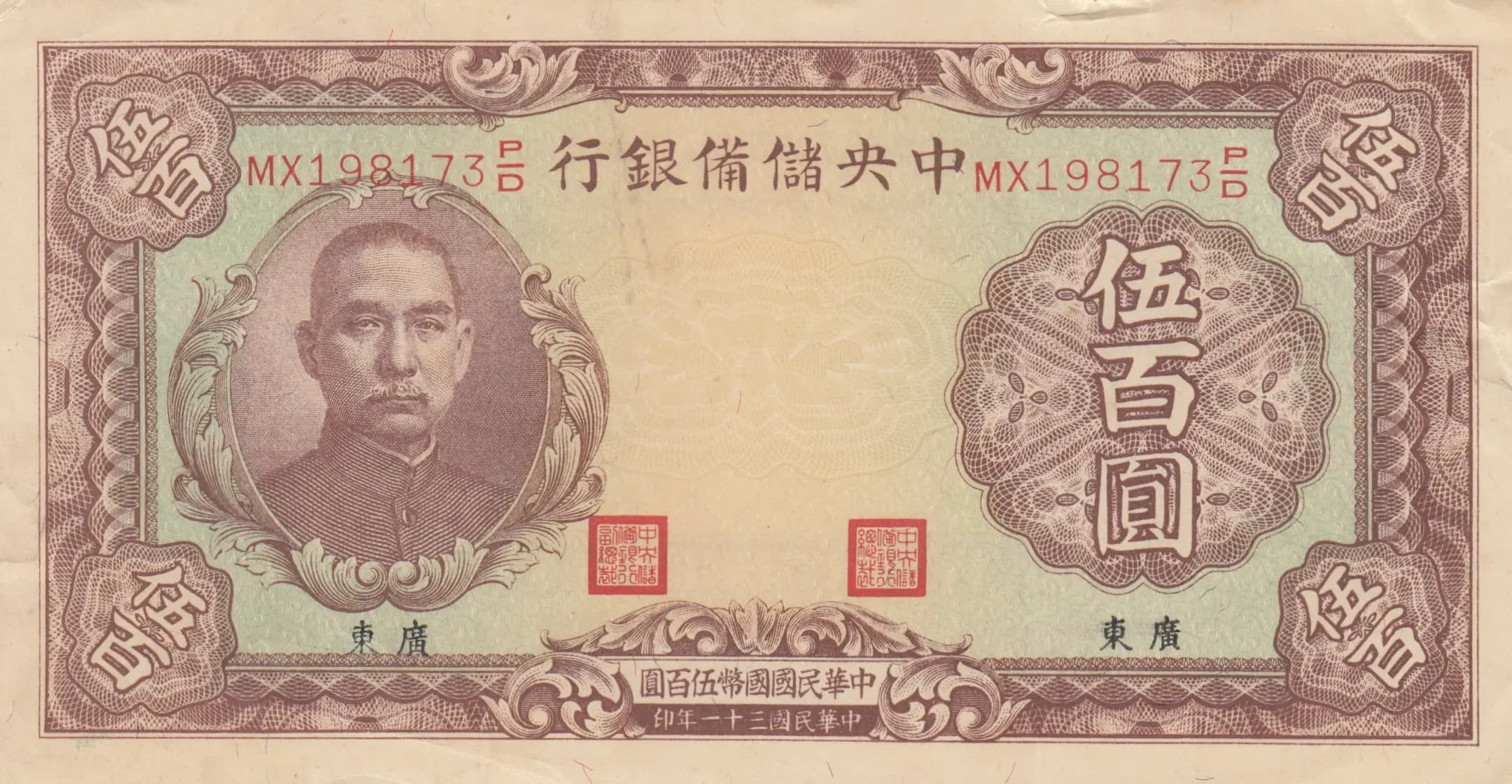
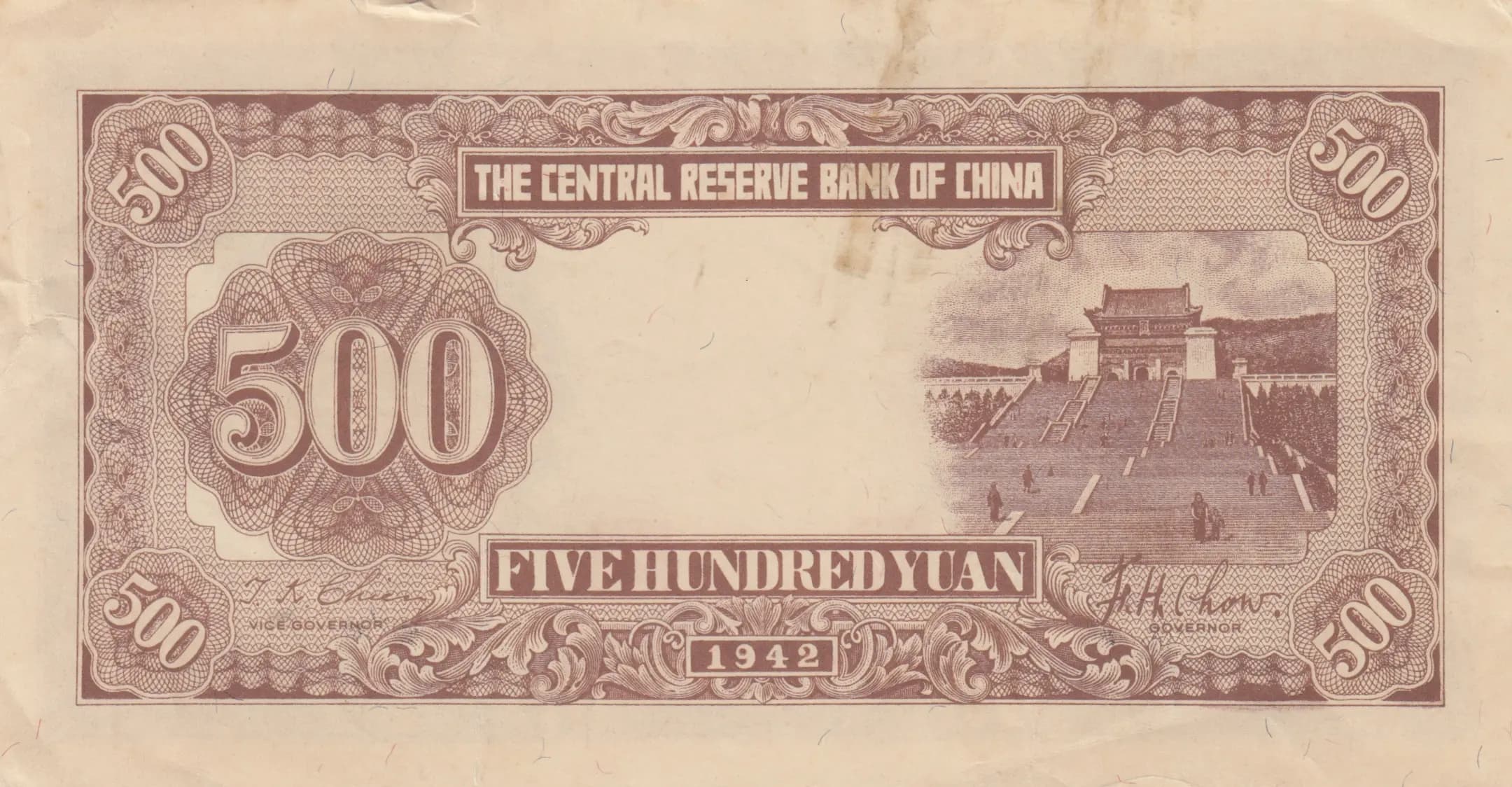
This is a Central Reserve Bank of China 500 Yuan note from 1942 (Pick J15b), presented in EF condition with the characteristic aging patina of a WWII-era Chinese banknote. The obverse features a formal portrait of a dignitary in an ornate oval frame, while the reverse showcases a striking photographic image of a fortified gate structure, likely the Great Wall. The note displays excellent engraving detail and period-appropriate security features including red seals, though it shows the expected creasing, foxing, and yellowing consistent with nearly 80-year-old circulated currency.
Common. The Central Reserve Bank of China 500 Yuan 1942 (Pick J15b) was issued in substantial quantities across multiple printing runs to meet wartime demand. While all surviving examples show age and condition issues, the denomination and issuer were sufficiently established that circulation was widespread across both Japanese-occupied and Nationalist-controlled territories. No documented short print runs, major recall events, or extraordinary scarcity markers are associated with this Pick number. EF examples are more desirable than lower grades but remain readily available in the collector market at modest valuations.
Issued during the Second Sino-Japanese War when China's currency was under extreme inflationary pressure, this 500 Yuan denomination reflects the escalating denominations needed to conduct everyday commerce in occupied and unoccupied territories. The bilingual English-Chinese text and Western-style engraving represent the Central Reserve Bank's attempt to establish international credibility during wartime, while the depicted fortified gate symbolizes Chinese historical strength and resistance. This note represents a critical but economically turbulent period in Chinese numismatic history, when traditional banking structures were competing with Japanese-sponsored puppet currencies.
The obverse presents a formal three-quarter portrait of a male dignitary, likely a Central Reserve Bank official or Chinese nationalist leader, rendered in fine-line engraving within a baroque-style oval cartouche with ornamental flourishes on both sides. The denomination appears in a decorative shield cartouche. Red square seals with Chinese characters are positioned centrally, serving as official stamps. The reverse features a photographic reproduction of a fortified defensive structure—identified as a section of the Great Wall of China with characteristic multiple tiers, crenellated towers, and a wide ceremonial staircase populated with period figures, mountains visible in the background. The note is framed throughout by ornate engraved borders with decorative corner elements. The cream and beige paper stock with brown and mauve design elements is typical of wartime Chinese banknote production.
FRONT SIDE: Serial Number: MX198173 (appearing twice); Central Bank Reserve/Storage (中央銀行備儲); Number markers (號); Two Hundred Yuan (貮佰圓) [note: this appears to be a variant or overprint anomaly, as the catalog lists 500 Yuan]; Eastern Mongolia (東蒙, appearing twice); Republic of China Year 23 of the Calendar (中華民國紀年二十三年). BACK SIDE: THE CENTRAL RESERVE BANK OF CHINA (English text); Five Hundred Yuan (500 / FIVE HUNDRED YUAN); Year 1942 (1942).
Intaglio engraving (copperplate) combined with photographic reproduction. The portrait, borders, and denominations are rendered via traditional fine-line engraving, while the reverse landmark employs photogravure or similar photomechanical reproduction technique. Red seals and security elements appear to be separately applied during currency production. The Central Reserve Bank of China contracted with established Western security printers for these issues; this series was likely produced by the American Bank Note Company or similar specialist printer capable of handling bilingual, high-security denominations.
Serial number MX198173 observed on this example. The noted discrepancy between the catalog denomination (500 Yuan) and the visible inscription (貮佰圓, Two Hundred Yuan) may indicate this is a 200 Yuan note miscataloged, or possibly an overprint variety where the denomination was altered during production. The 'MX' serial prefix may indicate a specific printing series or geographic allocation. Further examination of the shield cartouche and exact denomination characters would clarify the specific variety within the P-J15b designation, as the Central Reserve Bank issued multiple denominations simultaneously with overlapping design elements.