500 custom gold units 1930
Market Prices
14 salesAbout This Note
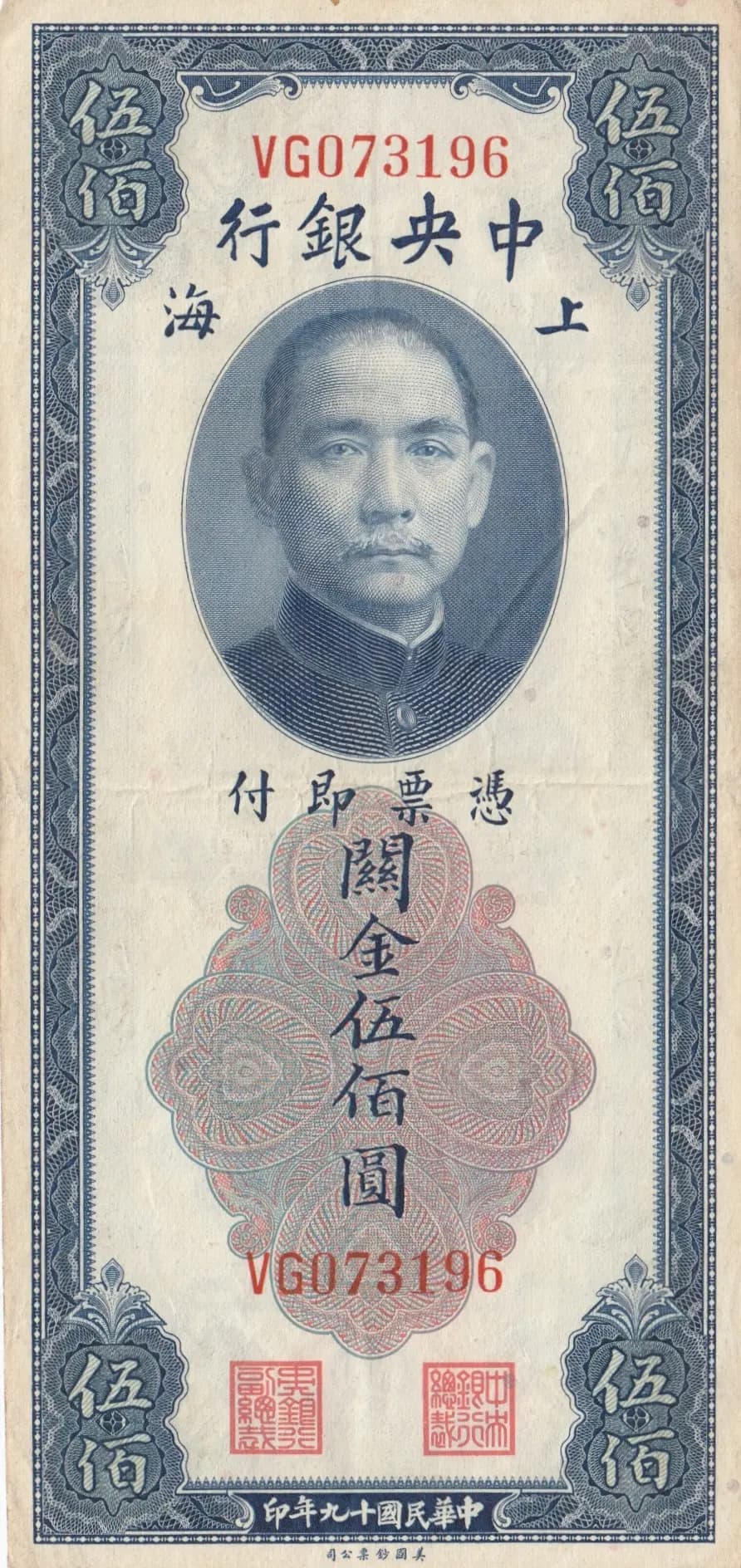
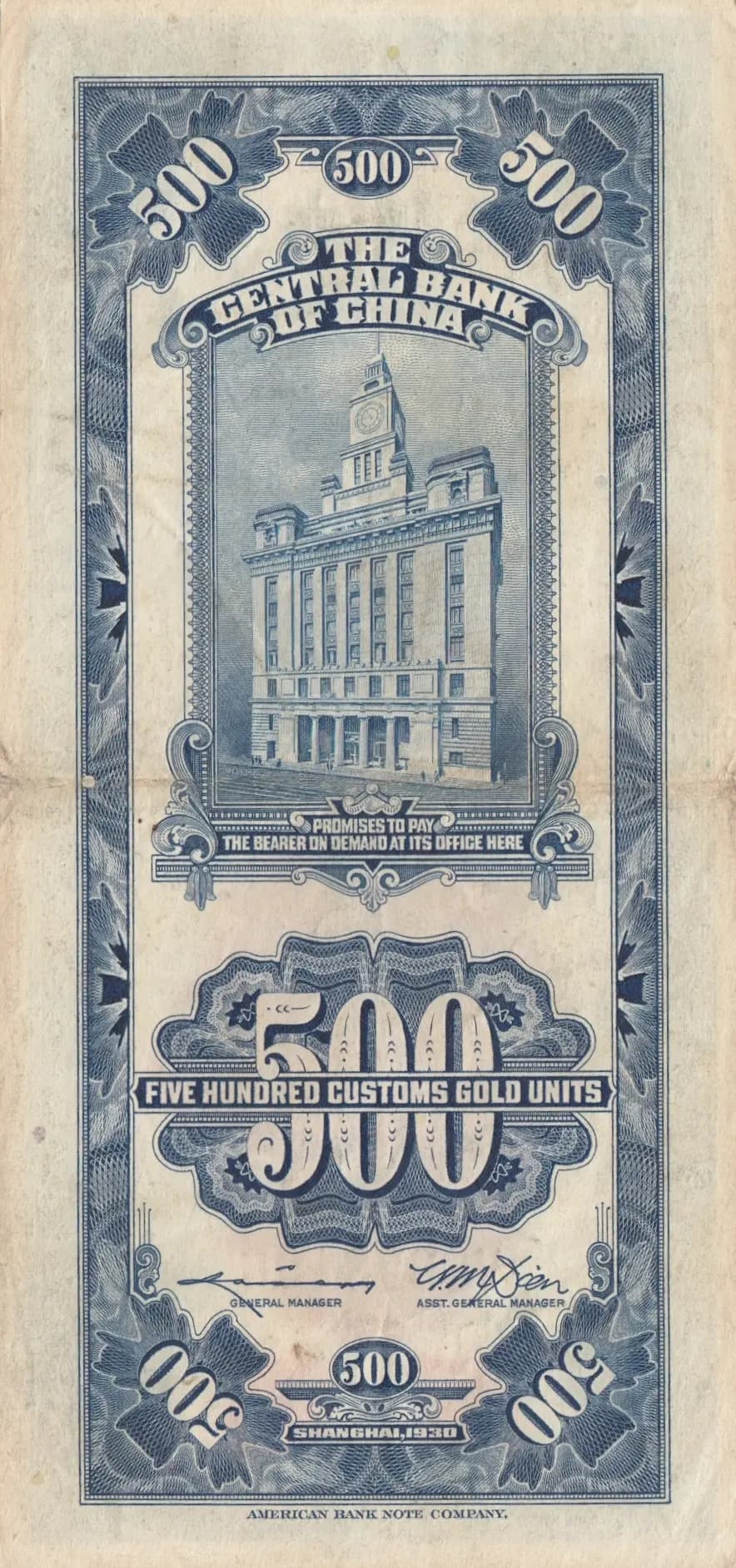
This is a 1930 Central Bank of China 500 Customs Gold Units note (Pick P-332) in Very Fine condition, featuring a striking blue and red color scheme with a formal portrait of Sun Yat-sen at center and an architectural vignette of the bank building on the reverse. The note exhibits typical circulation wear with visible creasing, foxing, and slight yellowing consistent with its age, yet the engraving remains crisp and the serial number clearly visible, making it an attractive example of early Republican-era Chinese currency.
Common. This note appears regularly on the secondary market with consistent eBay sales data spanning from 2009 to 2022. VF examples have sold multiple times in the $5-$9 range, and even graded PMG 64 examples, while commanding higher prices ($30-$53.50), are not exceptionally scarce. The 2016 catalog value of $5 for VF grade aligns with observed market activity. The relatively modest pricing and frequent availability indicate this was a standard issue with substantial print run, not a rare or scarce variety.
Issued in 1930 by the Central Bank of China during the early Republic of China period, this note reflects the modernization efforts of the Nationalist government and the international financial systems of the era. The bilingual English/Chinese inscriptions and American Bank Note Company printing demonstrate China's engagement with Western financial institutions, while the denomination in 'Customs Gold Units' (rather than traditional yuan) indicates the note's role in international trade and the gold standard systems of the 1930s. The portrayed Central Bank building in Shanghai symbolized the financial hub's importance in Republican China's economic infrastructure.
The obverse features a centered formal portrait of Sun Yat-sen (founding father of the Republic of China), rendered in fine line engraving and wearing traditional Chinese high-collared formal dress with a thin mustache. The portrait is framed by ornate decorative borders with geometric and floral patterns executed in blue and red inks. Ornamental panels with Chinese characters occupy the four corners, while red serial numbers appear at top and bottom. Below the portrait is an elaborate pink/red ornamental cartouche containing Chinese denomination and issuing authority text. The reverse displays the Central Bank of China's Shanghai headquarters—a classical multi-story institutional building with symmetrical facade, regular window arrangement, and a prominent cupola/clock tower—depicted within a rectangular frame. Large denomination numerals '500' occupy all four corners, with bilingual text confirming the currency details, location, date, and the American Bank Note Company printer credit.
FRONT: Central Bank (中央銀行) | Shanghai (上海) | Republic of China (中華民國) | Five Hundred Yuan (五佰圓) | Payable on Demand (憑票兌現) | Printed in the 90th Year of the Republic of China (印年九十國民華中, indicating year 1930 in ROC calendar) | Serial Number: VG0731196. BACK: The Central Bank of China | Promises to Pay the Bearer on Demand at Its Office Here | Five Hundred Customs Gold Units | Shanghai, 1930 | American Bank Note Company | Signature lines for General Manager and Assistant General Manager
Intaglio engraving (line engraving) on banknote stock, printed by the American Bank Note Company (ABNC), one of the world's leading security printers. The fine detail throughout the borders, portrait rendering, and architectural vignette, combined with the intricate line work patterns visible in the visual analysis, are characteristic of high-security intaglio production. Multi-color printing (blue, red, cream stock) was achieved through successive passes of engraved plates.
Serial number VG0731196 is visible on the obverse. The note is dated Shanghai, 1930, corresponding to the 19th year of the Republic of China (or the 90th year counting from the founding of Chinese civilization as noted in the inscription). No major varieties (such as signature variations, overprints, or date variants) are apparent from this example, though researchers should note any differences in signature configurations or serial number prefix variations ('VG' prefix observed here) as potential distinguishing features among surviving examples.