50 yuan 1945
About This Note
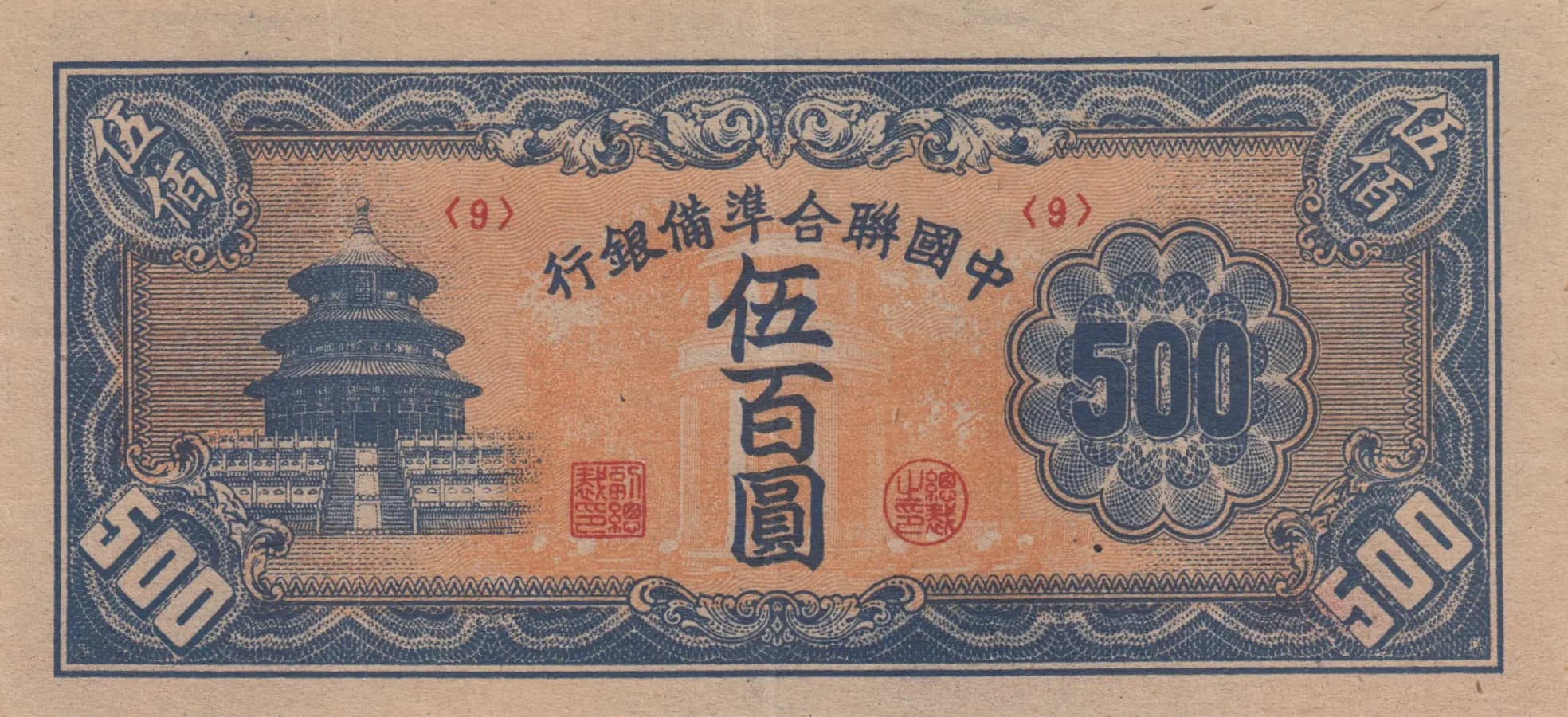
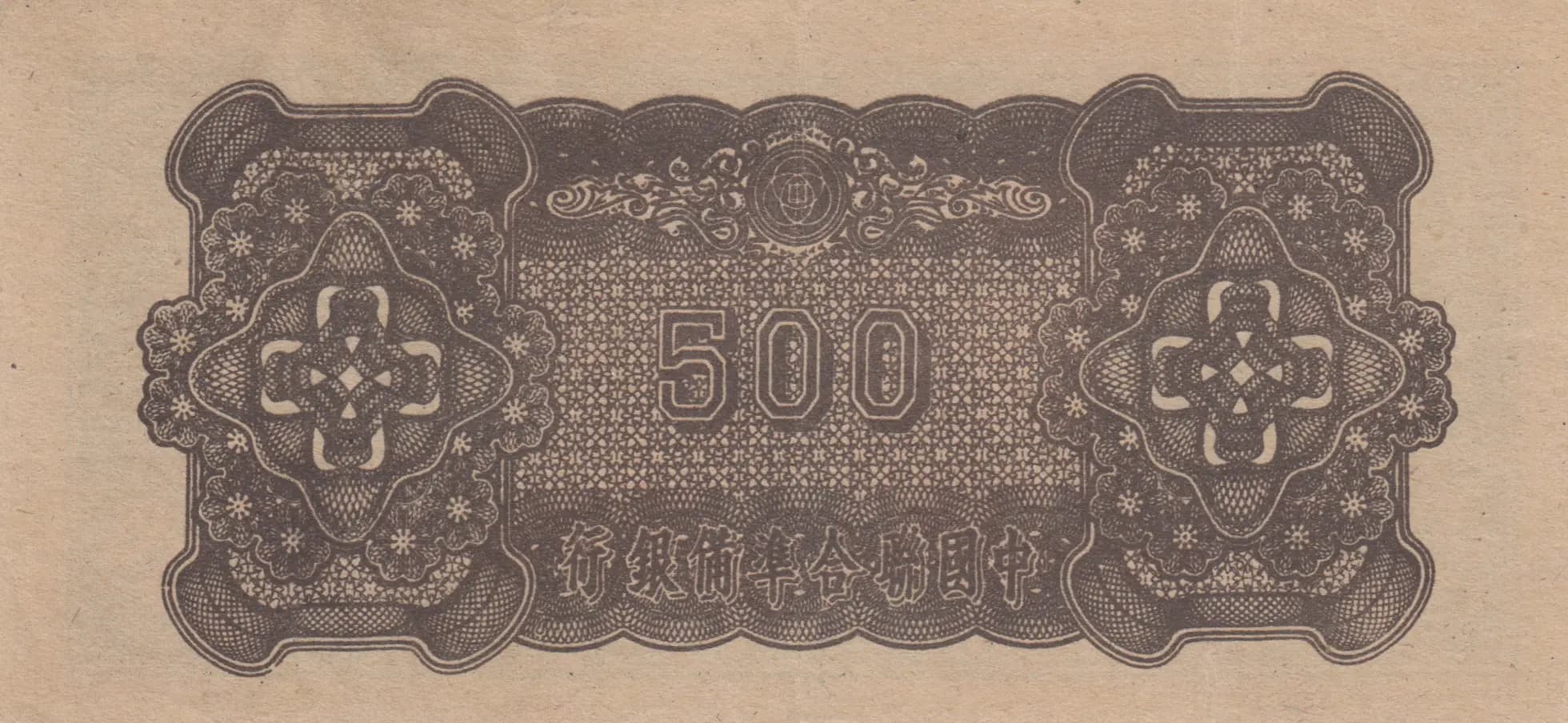
This is a 500 yuan banknote issued by the Federal Reserve Bank of China in 1945, presented in Very Fine condition. The note features exceptional engraved design work with a traditional multi-tiered pagoda on the front rendered in dark blue against a tan background, complemented by an ornate baroque-style reverse showcasing elaborate bird or dragon motifs within decorative panels. The banknote exhibits minimal wear consistent with its age, with intact margins and only slight foxing, making it a well-preserved example of Chinese wartime currency.
Common. The Federal Reserve Bank of China issued substantial quantities of currency during 1945 in various denominations to meet wartime economic needs. While this specific Pick J90 denomination may see moderate collector interest, surviving examples in Very Fine condition are not scarce. No evidence of limited print runs, short-lived issuance periods, or major recall programs suggests this note falls into standard circulation and collector availability. The denomination and condition do not elevate it to rare status.
Issued during the final year of World War II by the Federal Reserve Bank of the Republic of China, this 500 yuan note reflects the monetary institutions of the Chinese Nationalist government during a period of significant economic strain. The elaborate engraved design—featuring traditional architectural elements like the central pagoda and ornamental emblems—demonstrates the continued emphasis on classical Chinese imagery and institutional legitimacy even as inflation severely eroded the currency's purchasing power in the final years of the war.
The obverse features a classically proportioned multi-tiered Chinese pagoda with domed roof, centrally positioned as the primary design element, rendered in dark blue line engraving against a tan background with fine horizontal line work. Red circular seals (likely chops or official stamps) flank the denomination characters. An ornate decorative border with wave patterns and floral scrollwork frames the design, with cloud-like rosette cartouches containing the denomination numerals. The reverse presents a mirror-image baroque composition with two large ornamental side panels containing stylized mythological bird or dragon motifs within elaborate frames, separated by a large stippled denomination '500' with a circular emblem at top center. The overall palette of dark blue, sepia/brown, tan, and cream creates a dignified, traditional aesthetic appropriate to official government currency.
Front side: '中華民國聯合準備銀行' (Federal Reserve Bank of the Republic of China); '五百圓' (500 Yuan); Arabic numerals '500'. Back side: '中華民國中央銀行' (Central Bank of the Republic of China); Arabic numerals '500'. Note: There appears to be a discrepancy in the visual analysis, as the front references 'Federal Reserve Bank' while the back references 'Central Bank'—this requires verification against catalog standards.
Intaglio engraving (copperplate/steel plate engraving) throughout, evidenced by the fine line work, intricate detail reproduction, and characteristic engraved borders with elaborate patterns. The stippled/dotted background pattern on the reverse is consistent with engraved anti-counterfeiting techniques. The security printer for Chinese currency of this period was typically the Chinese Bureau of Engraving and Printing (CBEP) or foreign contractors such as the American Bank Note Company, though the specific printer for this Pick J90 variety would require catalog verification.
Pick catalog number J90 is specified for the 1945 500 yuan Federal Reserve Bank of China note. The visual analysis indicates parenthetical numerals '(9)' visible on the front, which may indicate a series or check digit marking. Without access to the serial number, signature varieties, or specific printer marks in the provided images, definitive variety identification is limited. Standard varieties for this issue type typically include signature varieties, serial number prefixes, and potential overprint states; consultation of the Pick catalog or specialized Chinese currency references would be necessary to fully delineate the specific variety represented by this individual note.