50 sen 1939
About This Note
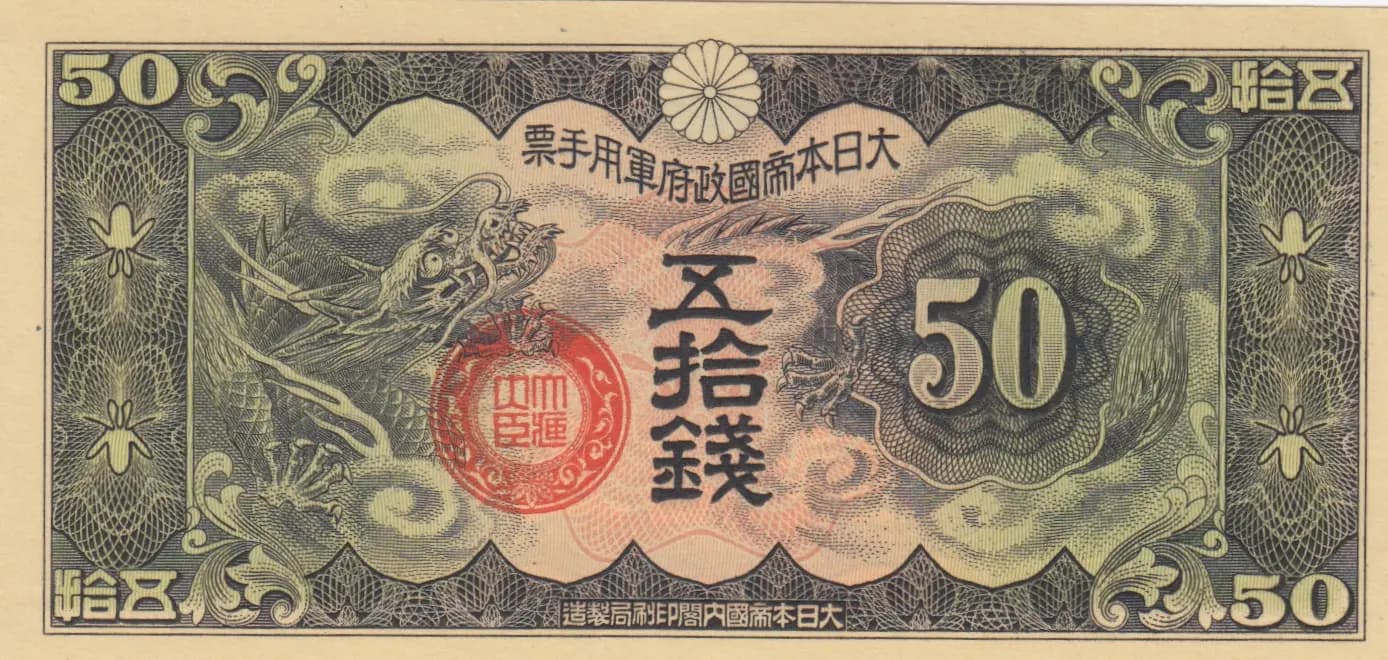
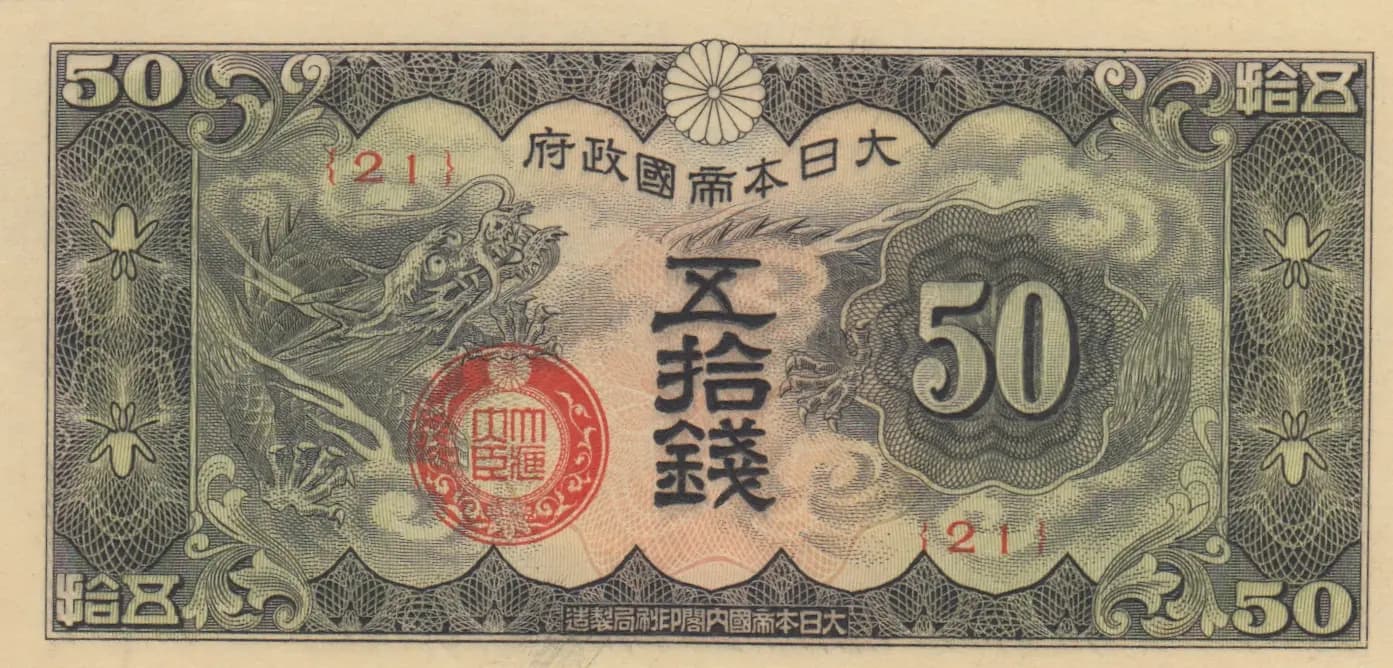
This 50 sen banknote from 1939 issued by the Japanese Military Government during its occupation of China presents an exceptional example of wartime Japanese occupation currency in uncirculated condition. The note features an elaborate design centered on two intertwined dragons amid stylized clouds, framed by intricate floral and geometric borders, with a prominent red seal bearing Chinese characters positioned in the lower left-center area. The pristine condition with only minimal age-related toning and the exceptional quality of the engraved design work make this an important artifact of East Asian numismatic history.
Common. The 50 sen Japanese occupation currency issued in 1939 represents a standard denomination from an extended series of occupation notes produced in substantial quantities throughout the territories under Japanese military administration during 1939-1945. No evidence suggests limited print runs, early recalls, or scarcity in surviving examples. While historically significant as artifacts of wartime occupation, these notes were produced in volumes sufficient to maintain common circulation status even in the present numismatic market. Uncirculated examples command modest premiums over circulated grades, but the denomination and year are not among the scarce or rare issues of this series.
This 50 sen note was issued during Japan's military occupation and administration of Chinese territories in 1939, representing the economic control mechanisms employed by the Japanese Imperial Government during the Second Sino-Japanese War. The dual use of Japanese characters (拾銭) and the inscribed 'Government of the Empire of Japan' (大日本帝國政府) alongside a Chinese seal reflect the occupation authority's attempt to establish legitimacy in occupied territories. The dragon symbolism in the central design carries traditional East Asian imperial significance, while the note's existence underscores Japan's efforts to impose its currency system throughout occupied China.
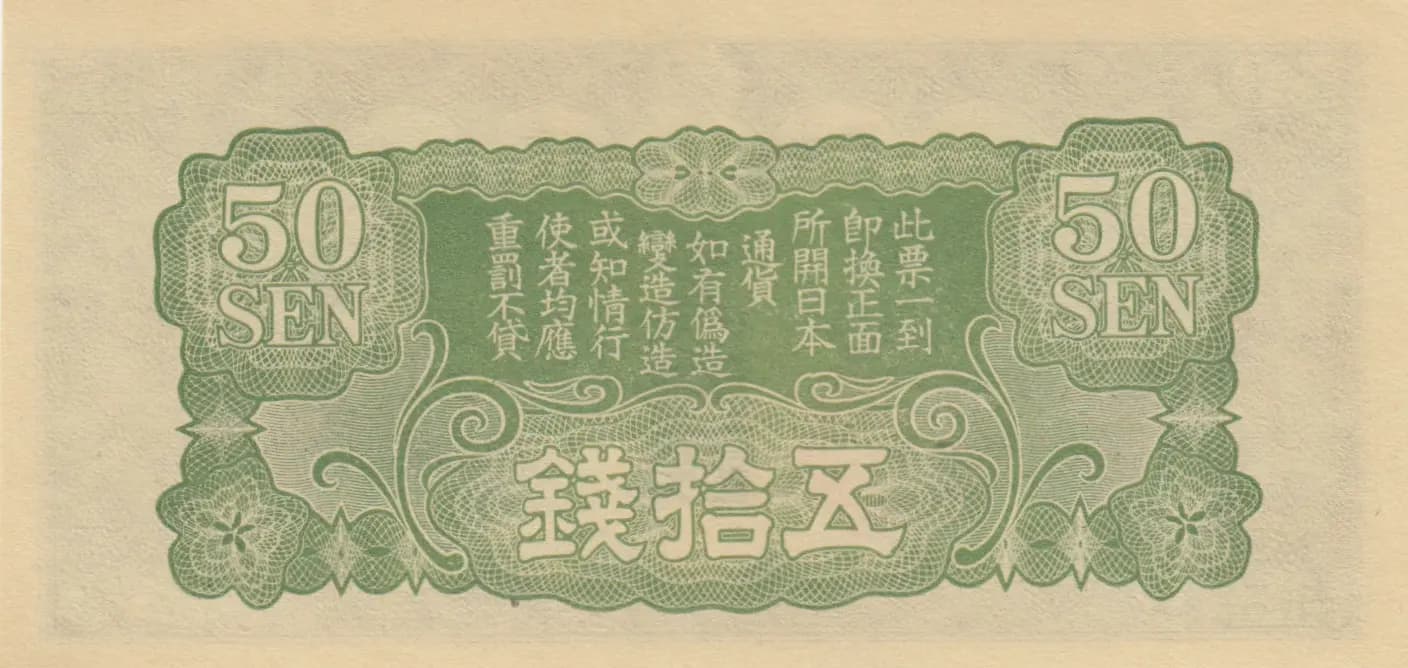
The front side showcases two dragons as the central motif, rendered in an elaborate composition amid swirling clouds—a design element reflecting traditional Chinese imperial iconography appropriated by the Japanese occupying authority. The dragons are enclosed within an ornate rectangular frame featuring sophisticated repeating floral and geometric patterns in the border work. A large red circular seal with decorative border and Chinese characters occupies the lower left-center area, serving both as a security feature and assertion of authority within occupied territory. The denomination '50' appears prominently in both upper left and lower right corners in large Arabic numerals, while Japanese characters fill the right-center area. The back side employs a predominantly green color scheme with a large ornamental rectangular cartouche containing vertically arranged Japanese legal text in multiple columns, flanked by decorative scalloped border panels with floral motifs containing '50 SEN' denominations. Fine-line crosshatch patterns and ornamental scrollwork throughout provide visual complexity and anti-counterfeiting measures.
FRONT SIDE: '大日本帝國政府' translates to 'Government of the Empire of Japan'; '拾銭' and '銭' translate to '50 sen' (the primary denomination marking); Arabic numerals '50' appear in corner positions; '拾' means 'ten' (component of 50 sen). BACK SIDE: '50' and 'SEN' appear in the scalloped border panels at top and bottom (in English/romanized form for international recognition); '七拾銭' appears as additional denomination text (approximately '70 sen' or variant marking); Extended legal text in Japanese provides terms regarding note exchange, validity, counterfeiting prohibitions, and holder obligations, with phrases indicating 'this note may be exchanged at designated locations' and official warning language.
This note exhibits characteristics of high-quality engraved intaglio printing, evidenced by the intricate line work, fine crosshatching patterns, and precise geometric borders visible in both the visual analysis and the exceptional detail reproduction. The sophisticated handling of the dragon composition, cloud formations, and ornamental scrollwork indicates master engraving. The Japanese Military occupation notes of this series were produced by the Japanese government printing facilities, likely involving the Imperial Printing Bureau or contracted security printers with capability for intricate currency design. The multi-color printing (gray, green, red, cream) was executed using the intaglio process with separate color passes, a standard technique for high-security currency production of the 1939 period.
Pick catalog P-M13 specifies this as the standard 50 sen 1939 issue from the Japanese Military occupation series. The visual analysis indicates the number '21' appears on the front side, potentially representing a series letter or print run identifier. Without additional documented varieties (such as signature variants, overprints, or confirmed series letter differences) specified for this Pick number, this should be classified as the standard variety. The English-romanized 'SEN' denomination marking on the reverse is typical for this issue's production to facilitate recognition among occupied territories with diverse linguistic backgrounds.