50 kopeek 1917
Market Prices
1 saleAbout This Note
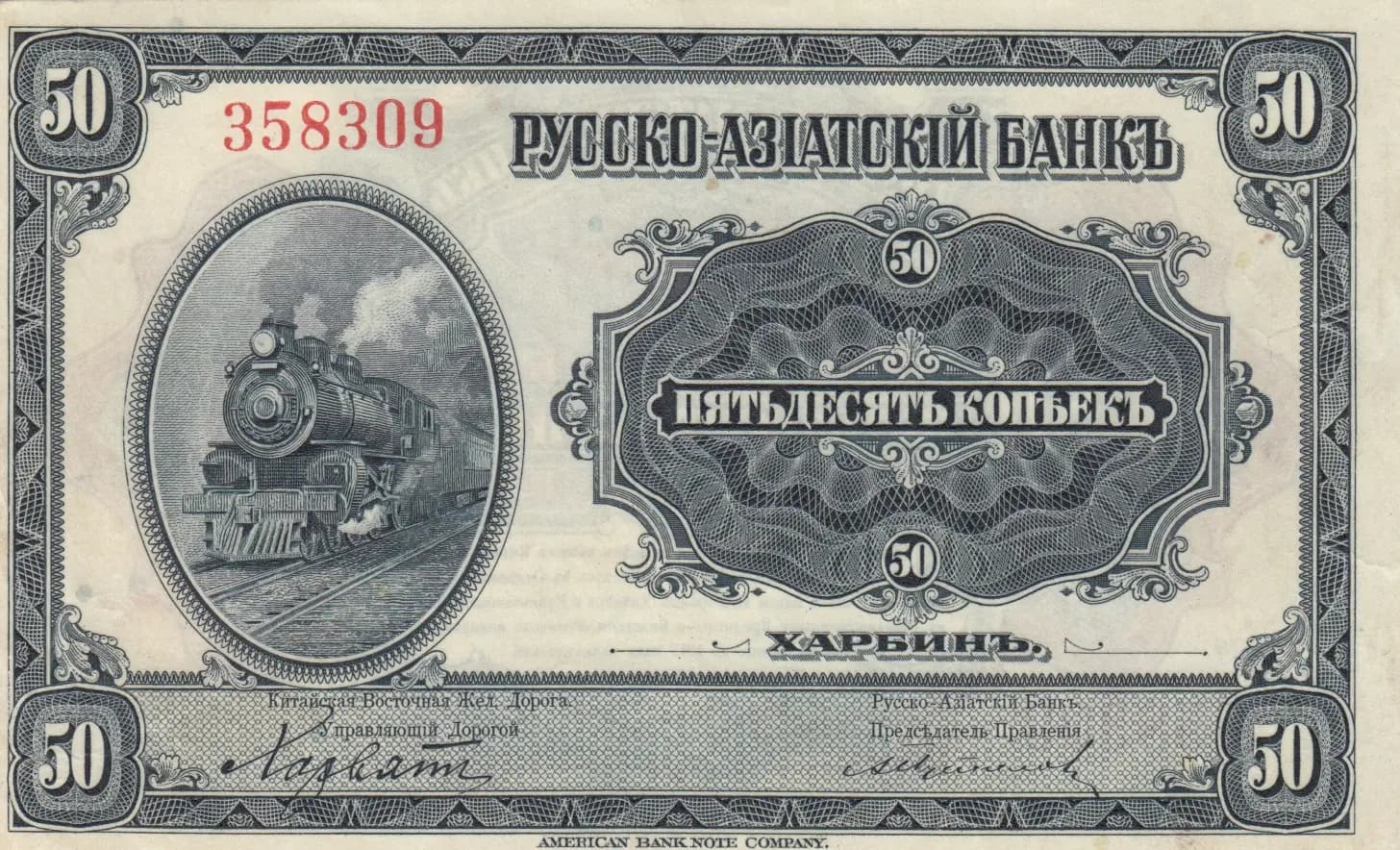
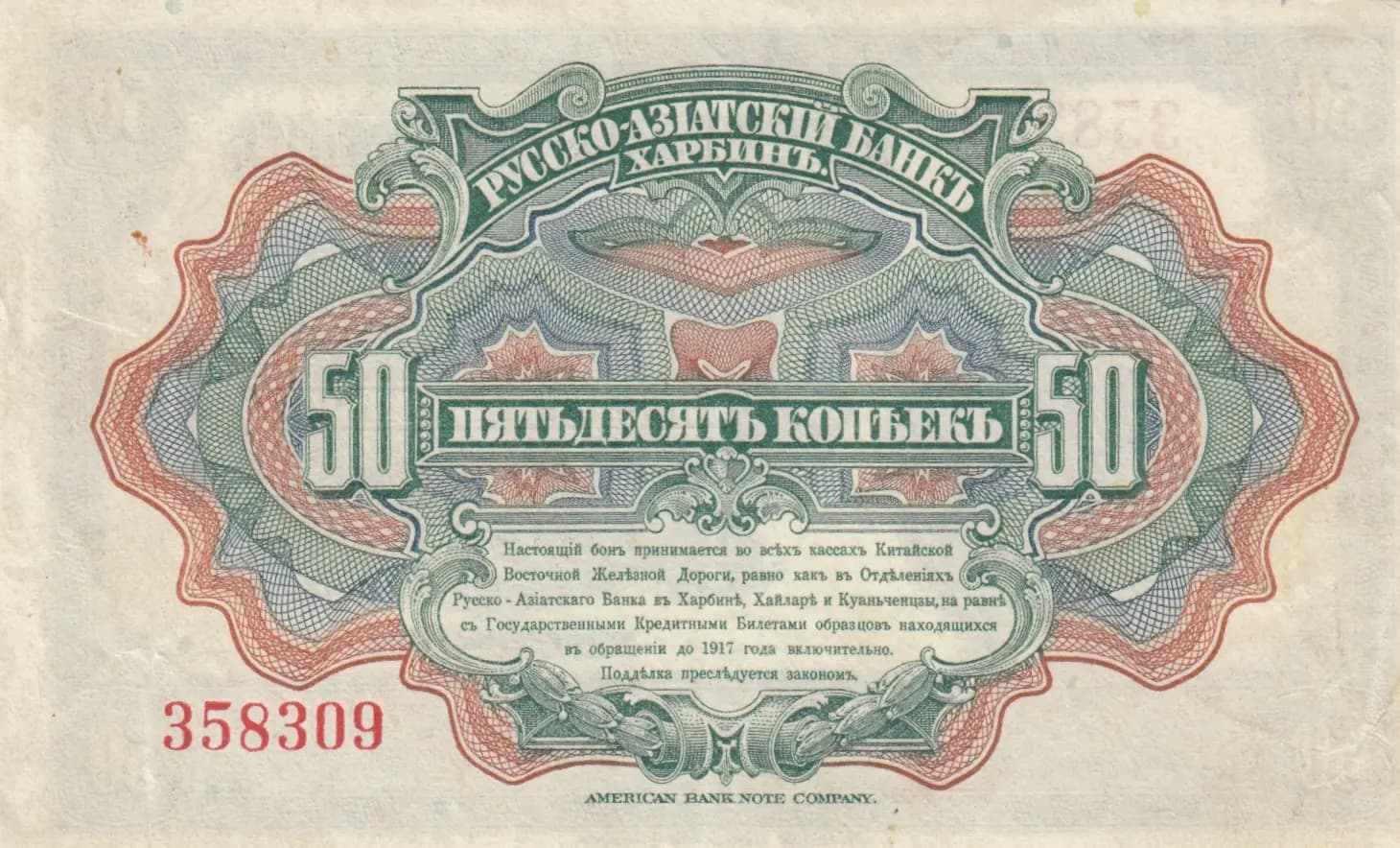
This is a VF-grade 50 kopeck banknote issued by the Russo-Asiatic Bank in 1917, featuring a striking engraved design with a steam locomotive on the obverse and ornate decorative elements on the reverse. The note exhibits excellent paper quality with minimal wear, printed in black/gray on the front and green/red on the back by the American Bank Note Company. The serial number 358309 and bilingual Russian text make this an important example of pre-revolutionary Russian Far Eastern banking currency.
Common. The eBay reference data shows a Fine condition example selling for $11.61, indicating this is a widely available note in the collector market. The 1917 Russo-Asiatic Bank 50 kopeck is not a scarce issue despite its historical interest. Print runs for this denomination were substantial, and examples survive in reasonable quantities. The VF condition grade of the cataloged example does not significantly elevate scarcity, as these notes were produced in volume for circulation in the Harbin banking network.
This note represents a critical moment in Russian Far Eastern monetary history, issued by the Russo-Asiatic Bank during the final year of Tsarist rule. The locomotive imagery reflects the importance of the Chinese Eastern Railway to Russian commerce and strategic interests in Manchuria, while the text referencing Harbin, Hailar, and Kuanchentzy documents the geographic scope of Russian banking operations in China. The 1917 issue date places this note at the intersection of the Russian Revolution and the collapse of Tsarist financial institutions, making such currency historically significant as evidence of pre-Soviet monetary systems.
The obverse features a horizontally-oriented steam locomotive with passenger cars depicted in left-facing profile, complete with smoke rising from its chimney, positioned within an oval frame on the left side of the note. This imagery emphasizes the economic importance of rail transport on the Chinese Eastern Railway. The center and right portions contain an elaborate decorative cartouche with the denomination '50' displayed prominently in opposing corners, surrounded by fine ornamental corner designs with flourishing scrollwork. The reverse presents an ornate scalloped or wavy border design incorporating red and green inks, with a curved banner at top center containing institutional identification. The central cartouche repeats the denomination and denomination text, beneath which runs an extended legal disclaimer regarding the note's validity and geographic circulation. The color palette—black and gray on cream on the obverse, green and red on cream on the reverse—reflects formal banking currency aesthetics of the early 20th century.
FRONT: '50' (denomination); 'РУССКО-АЗИАТСКИЙ БАНКЪ' (Russo-Asiatic Bank); 'ПЯТЬДЕСЯТЪ КОПЬЕКЪ' (Fifty kopeks); 'ХАРБИНЪ' (Harbin); 'Китайская Восточная Жел. Дорога' (Chinese Eastern Railway); 'Председатель Правления' (Chairman of the Board); '358309' (serial number); 'AMERICAN BANK NOTE COMPANY' (printer attribution). BACK: '50' (denomination); 'РУССКО-АЗИАТСКИЙ БАНКЪ ХАРБИНЪ' (Russo-Asiatic Bank Harbin); 'ПЯТЬДЕСЯТЪ КОПЬЕКЪ' (Fifty kopeks); '358309' (serial number); Legal text: 'This note is accepted at all cashiers of the Chinese Eastern Railway, as well as at the branches of the Russo-Asiatic Bank in Harbin, Hailar, and Kuanchentzy, on par with Government Credit Notes in circulation until 1917 inclusive. Support is provided by law.'; 'AMERICAN BANK NOTE COMPANY' (printer attribution).
This note was produced by the American Bank Note Company using intaglio engraving, evidenced by the fine line work, intricate cross-hatching patterns, and deeply incised security borders visible throughout both sides. The front employs single-color black/gray engraving on a cream stock, while the reverse utilizes two-color printing with green and red inks, demonstrating advanced security printing practices of the era. The precision of the decorative cartouches, ornamental borders, and locomotive engraving are hallmarks of American Bank Note Company's craftsmanship during the early 20th century.
The observed example carries serial number 358309 in red printing. No specific signature varieties, date varieties, or overprint varieties are apparent from the visual analysis. Pick catalog number P-S473 denotes this as a standard issue from the series. Without documented information on differing signatures or serial number series that indicate distinct varieties for this Pick number, this note should be cataloged as the standard 1917 50 kopeck issue.