50 dollars 1918
Market Prices
About This Note
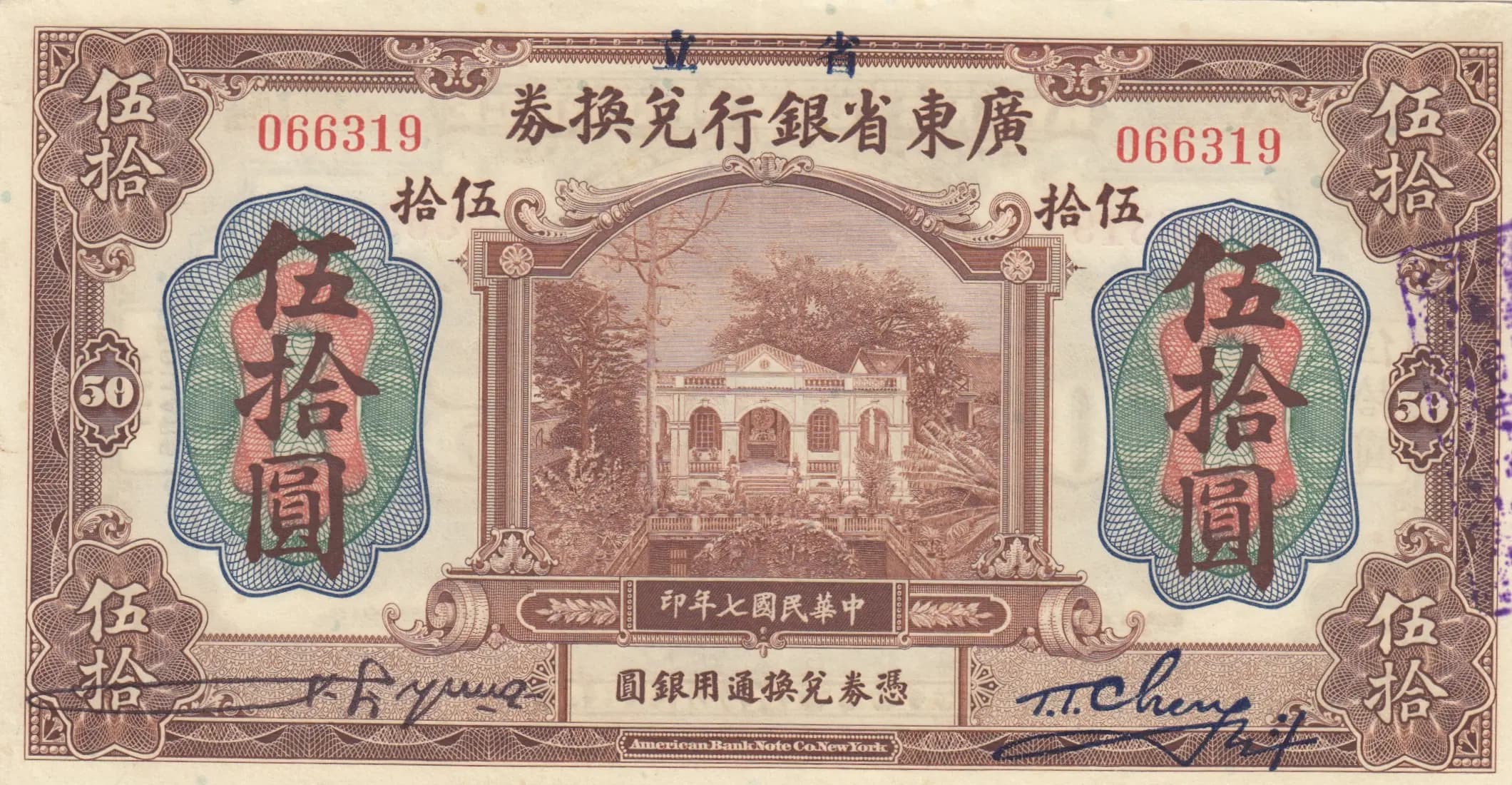
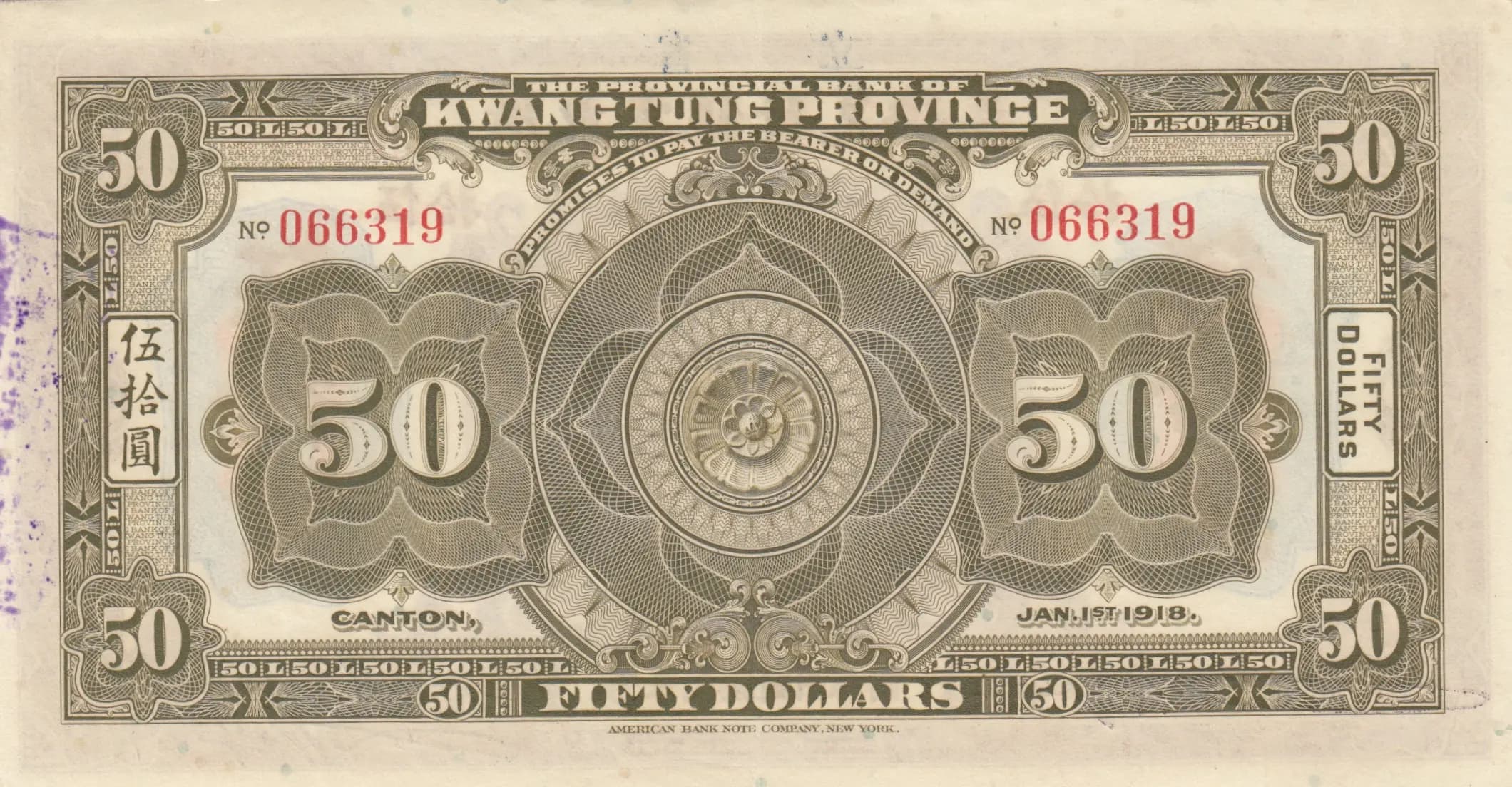
This is a well-preserved example of the 1918 Kwangtung Provincial Bank 50 Dollar note (Pick S2404c), graded EF, featuring an ornate colonial-style pavilion and garden landscape vignette on the obverse rendered in brown, pink, and cream tones. The reverse displays the characteristic large geometric medallion in olive-green and grayscale, with professional American Bank Note Company engraving throughout. Archive stamps and minor age-related foxing are consistent with the note's 105+ year history, while the overall structural integrity and color retention exemplify the EF condition grade.
Common. eBay market data shows a wide range of prices ($30–$450 USD) across multiple condition grades, with notes in comparable XF/AU conditions consistently priced between $40–$300 USD, indicating substantial availability. The 1918 Kwangtung Provincial Bank issues were produced in significant quantities by a major security printer and circulated widely in southern China. No evidence of low print runs or rarity factors specific to this Pick number.
Issued January 1st, 1918, during the early Republic of China period, this note represents the Kwangtung (Guangdong) Provincial Bank's role in regional monetary circulation. The colonial-style mansion depicted reflects Canton's (Guangzhou's) status as a major treaty port and the architectural influences of Western commercial presence in early 20th-century China. The English text and American Bank Note Company printing underscore the dependence of Chinese regional banks on foreign security printers and the internationalized financial systems of the era.
The obverse features a detailed vignette of a colonial-era mansion or pavilion with classical columns, balconies, and balustrades, set within a landscaped garden environment with trees—likely depicting a significant public or institutional building in Canton. The composition is framed by ornate decorative borders incorporating traditional Chinese geometric and floral motifs in corner medallions. The palette employs dark brown primary coloring on a cream/beige background with pink/red and green accents, creating visual hierarchy. The reverse is dominated by a large concentric circular medallion with a sunburst/geometric pattern in monochrome (olive-green and gray tones), surrounded by ornamental floral and geometric corner designs. Multiple denomination indicators (Arabic '50', Chinese '五十', and English 'FIFTY DOLLARS') appear throughout both sides. The design reflects the hybrid aesthetic characteristic of early Chinese republican banknotes—Western security printing standards combined with Chinese linguistic and cultural elements.
OBVERSE: Serial Number: 066319 (left and right); Main text in Chinese: '廣東省銀行兌換券' (Guangdong Provincial Bank Convertible Note); Denomination: '拾位' (Fifty); '中華民國' (Republic of China); '憑票恒用通換銀圓' (Redeemable for silver dollars on demand). REVERSE: 'THE PROVINCIAL BANK OF KWANGTUNG PROVINCE' (English header); Serial Number: 'No 066319' (left and right); Denomination: 'FIFTY DOLLARS' (English); '五十' (Fifty in Chinese numerals); Location and Date: 'CANTON' and 'JAN.1ST.1918' (English); Printer attribution: 'AMERICAN BANK NOTE COMPANY, NEW YORK' (English); Currency marker: '圓' (Yuan/Dollars in Chinese).
Steel plate engraving (intaglio/copperplate printing) executed by the American Bank Note Company, New York. The visual analysis confirms professional fine line engraving throughout, with complex guilloche security patterns evident in the parallel line work, the intricate geometric medallion, and the detailed borders. No evidence of lithography; the note exhibits the characteristic crisp line definition and depth associated with high-quality intaglio security printing of the era.
This note corresponds to Pick S2404c (the 'c' variant designation). The visual analysis shows matching serial number 066319 on both obverse and reverse, consistent with standard production. The reverse identifies English signature without titles, matching catalog reference (S/M #K55-23b). No overprints, date variations, or signature variants are visible in the observed images. The January 1st, 1918 date and 'CANTON' location are standard for this issue.