50 cents 1948
Market Prices
21 salesAbout This Note
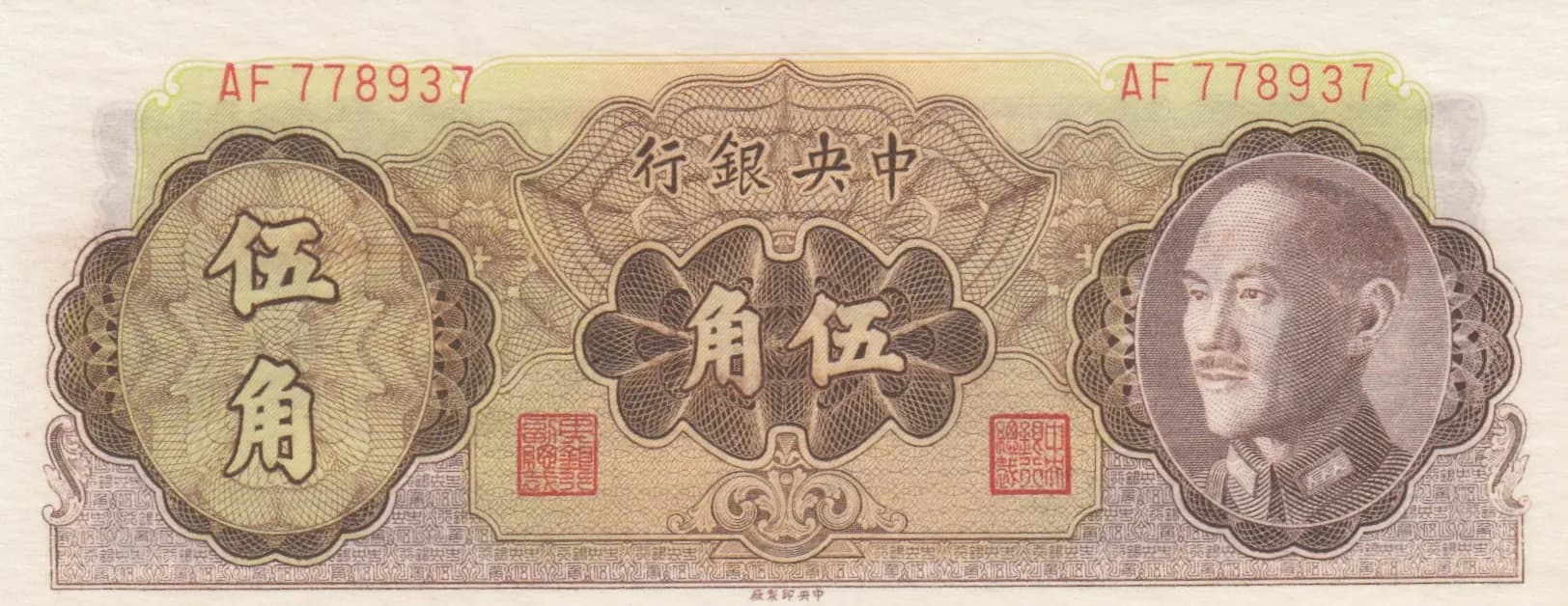
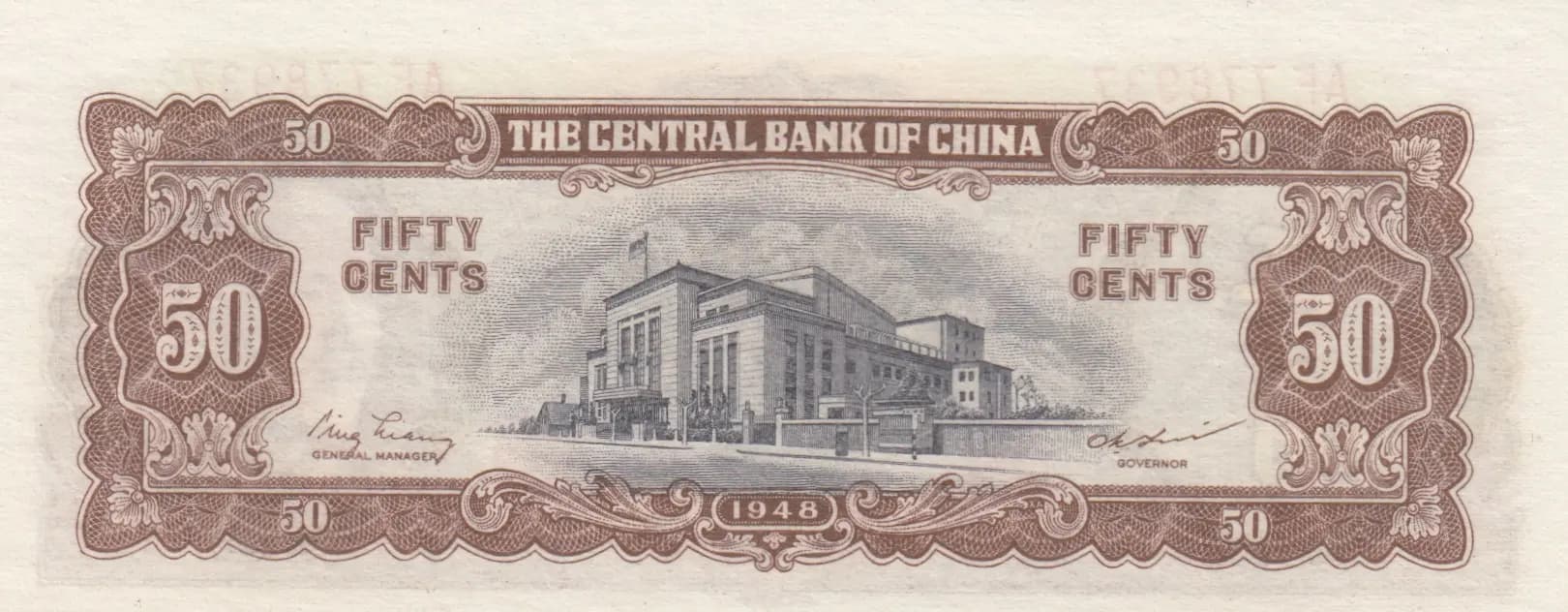
This is an uncirculated 1948 Central Bank of China 50 cents note (Pick #397) featuring exceptional condition with crisp printing and sharp detail throughout. The obverse displays a formal portrait in profile on the right side with ornate scalloped medallion frames and brown-on-yellow coloration, while the reverse showcases a striking neoclassical institutional building in brown and tan tones. This note represents an important transitional period in Chinese monetary history, issued during the waning years of the Republic of China before the Communist takeover.
Common. While this is a historic note from the final years of the Republic of China, market data clearly indicates common status. eBay sales data spanning 2013-2023 shows consistent pricing in the $8-$79 range, with most sales clustering around $12-$35 even for graded PMG 64-65 examples. The 2016 catalog value of $10 UNC further confirms this is a readily available note. Print runs for this denomination and period were substantial, circulation was limited only by the rapid monetary reform of 1949, and surviving examples are plentiful in the collector market.
The 1948 Central Bank of China notes were issued during a period of significant economic and political upheaval in China, as the Chinese Civil War reached its critical phase. The neoclassical architectural style of the building depicted on the reverse reflects the modernization efforts of the Republican government and the institutional prestige of the Central Bank. The bilingual presentation (Chinese and English) on the note underscores China's international banking relationships during this era, though hyperinflation would soon render these denominations obsolete by 1949.
The obverse features a formal portrait of a man in Western-style business attire shown in right profile, positioned within an ornate scalloped medallion frame on the right side of the note. The left medallion contains Chinese characters in similar decorative framing. The center of the note displays the denomination '伍角' (50 cents) in an elaborate scalloped cartouche with decorative flourishes, flanked by red rectangular seals bearing Chinese characters. The reverse prominently features a substantial neoclassical or Art Deco style institutional building—likely representing the Central Bank of China headquarters or a major financial institution—rendered with classical columns, a pediment, and symmetrical architectural details. The 'FIFTY CENTS' text and year '1948' appear in decorative cartouches, with signatory titles (General Manager and Governor) flanking the building. The entire design employs fine geometric background patterns and ornate scrollwork borders typical of high-security banknote production.
FRONT: '中央銀行' (Central Bank of China) — main issuing authority; '伍角' (Fifty Cents) — denomination in Chinese; 'AF 778937' — serial number (printed twice). BACK: 'THE CENTRAL BANK OF CHINA' — issuer name in English; 'FIFTY CENTS' — denomination in English; '1948' — year of issue; 'GENERAL MANAGER' — title of left signatory; 'GOVERNOR' — title of right signatory; '50' — denomination markers in ornate frames (appears multiple times for anti-counterfeiting purposes).
This note was produced by CPF (Central Printing Factory) using intaglio engraving methods, as evidenced by the sharp detail of fine geometric lines, ornate borders, and the precisely rendered architectural elements. The layered color application (brown on yellow underprint on the obverse; brown and tan on the reverse) indicates multi-plate printing typical of security printing standards of the 1948 period. The crisp impressions and fine linear work visible in the visual analysis confirm professional intaglio production rather than lithography.
Serial number prefix 'AF' is visible on this example (AF 778937). Varieties for Pick #397 are primarily distinguished by signature combinations (General Manager and Governor signatures vary by individual), serial number prefixes (which indicate different printing batches), and minor plate varieties. The CPF printer identification (as noted in catalog data) is a primary variety marker. Additional research into the specific signatories would be required to fully classify this note within the known signature varieties of the 1948 issue, though the UNC condition and clear impressions make this specimen suitable for variety study.