5 yuan 1938
About This Note
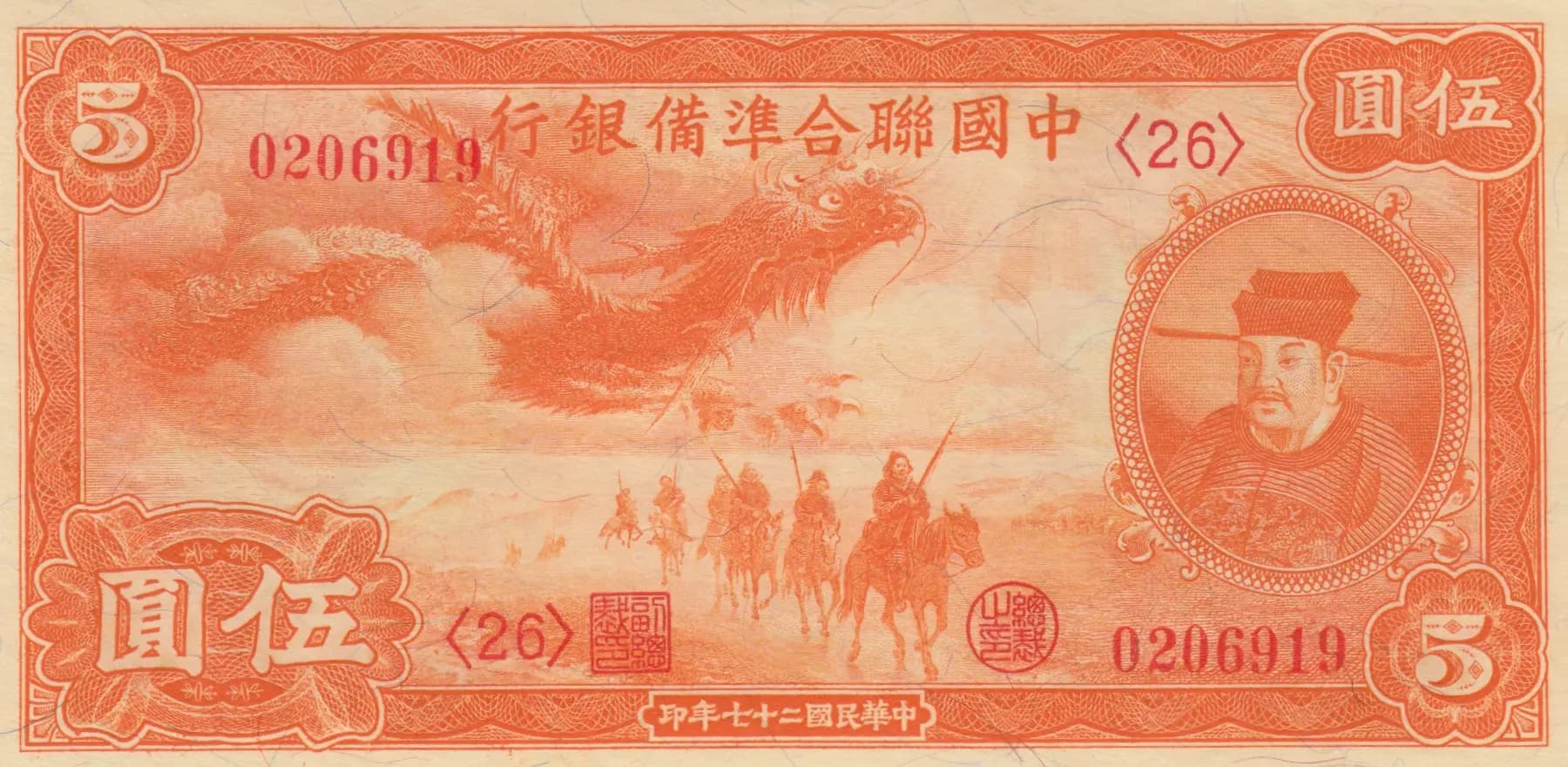
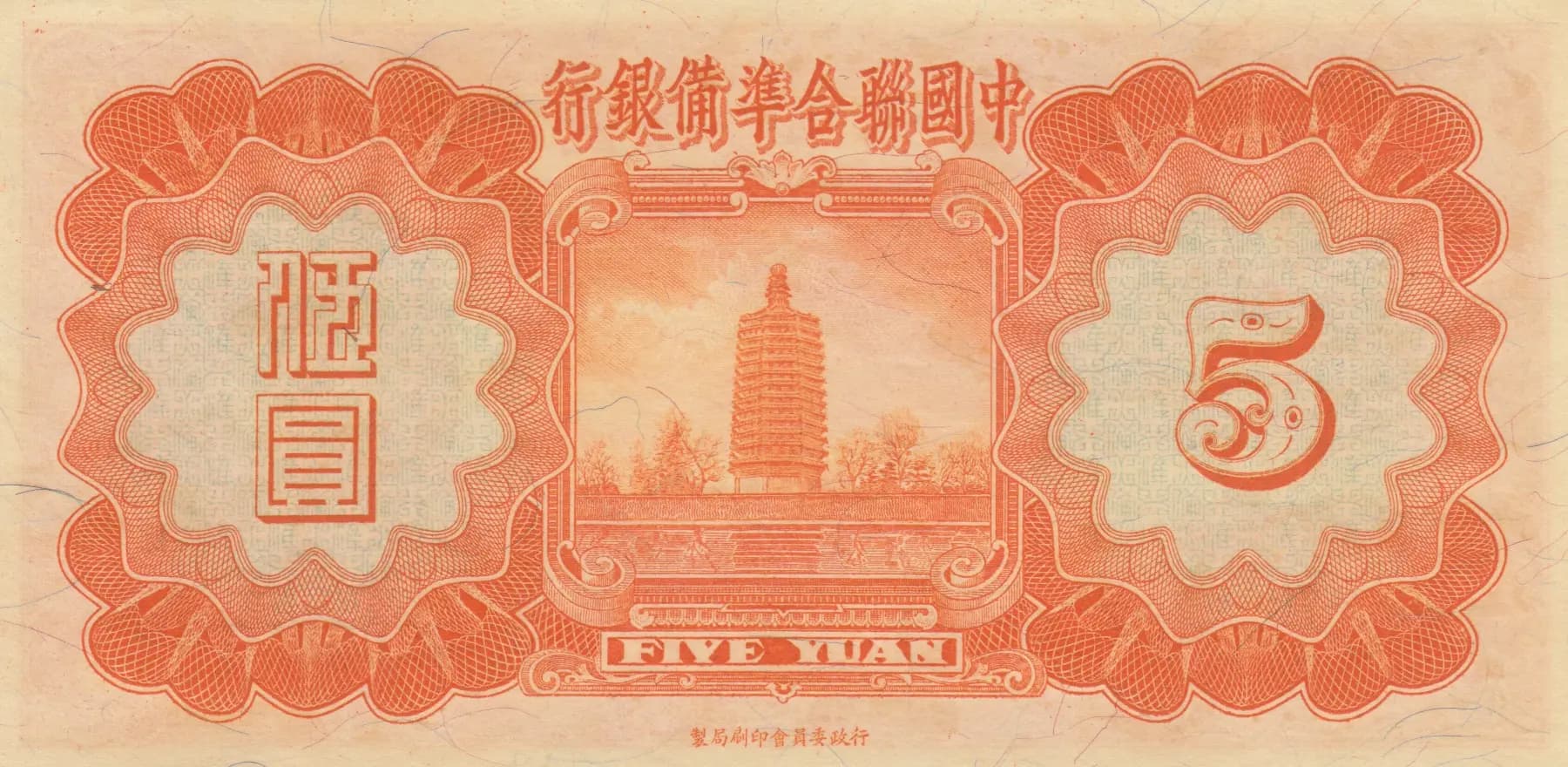
This 5 Yuan note from 1938 issued by the Federal Reserve Bank of China showcases classic Republican-era Chinese design with fine engraving throughout. The obverse features a dragon breathing clouds, a portrait of a dignitary in traditional dress within an ornate circular frame, and a dynamic scene of horsemen and soldiers, while the reverse displays a prominent multi-tiered pagoda flanked by decorative cartouches. The note exhibits light foxing, minor creasing, and scattered aging consistent with circulation, placing it in circulated condition rather than the UNC grade indicated in the catalog data.
Common. The Federal Reserve Bank of China issued 5 Yuan notes in substantial quantities during the 1938 period, and surviving examples remain readily available to collectors. While this particular note exhibits light circulation wear and aging, these are not factors that significantly enhance rarity—they are typical of surviving specimens from this era. No evidence suggests limited print runs or widespread recall for this Pick number.
This note was issued during the Second Sino-Japanese War period by the Federal Reserve Bank of China (中國聯合準備銀行), a quasi-central banking institution established to coordinate currency issuance among Chinese banks. The symbolism is deeply patriotic: the dragon represents imperial authority and Chinese sovereignty, while the equestrian military scene reflects the nation's mobilization during wartime. The pagoda on the reverse symbolizes traditional Chinese civilization and cultural continuity during a period of national crisis.
The obverse features a traditional dragon (symbol of imperial authority and Chinese power) in the upper left corner amid swirling clouds, with a portrait of a Nationalist-era dignitary or government official in traditional formal dress positioned on the right within an ornate, intricately-bordered circular frame. Below this portrait is a carefully engraved scene depicting mounted military personnel and cavalry soldiers in a landscape, representing national military strength. The reverse displays a prominent multi-tiered Chinese pagoda (likely representing a historical landmark) centrally positioned, with decorative cartouches on either side—one containing Chinese characters on the left and an ornamental '5' on the right. The entire design is framed by elaborate geometric and floral border patterns typical of Republican-era Chinese banknote production.
Front: '中國聯合準備銀行' (China United Reserve Bank), '五元' (Five Yuan), '中華民國七十二年' (Republic of China, Year 72 [1938]), serial number '0206919', and denomination marker '〈26〉'. Back: '中國聯合準備銀行' (China United Reserve Bank), '佰圓' (denomination marker), '5' (Arabic numeral), 'FIVE YUAN' (English denomination), and '製造副印省貨幣製行' (printed by currency manufacturing authority). The year notation corresponds to the ROC calendar system, confirming the 1938 date.
This note was produced using fine line engraving and intaglio printing techniques, as evidenced by the sharp detail visible in the portrait's circular border, the dragon's scale work, the intricate decorative patterns, and the precise architectural rendering of the pagoda. The consistent quality of line work across both sides indicates professional security printing by a government-contracted printer, typical of Federal Reserve Bank of China production standards during the 1930s.
The observed serial number is 0206919 with denomination marker '〈26〉'. The year notation uses the Republic of China calendar (Year 72 = 1938). Minor varieties in this series are typically distinguished by serial number prefixes and signature combinations; this specimen should be cross-referenced against Pick catalog listings for known signature varieties and serial number range variations for P-J62a to determine its exact variety designation.