5 yuan 1938
About This Note
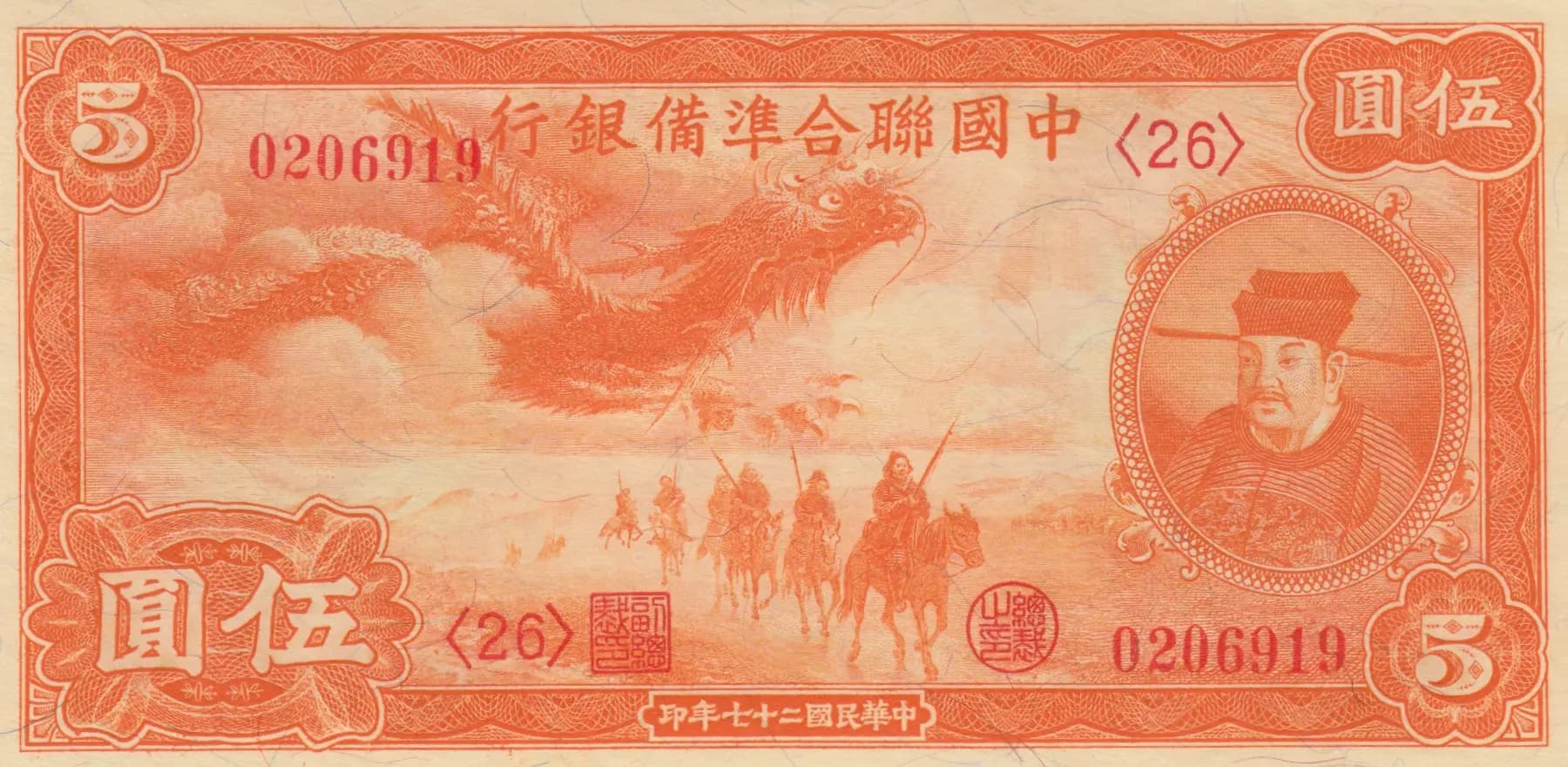
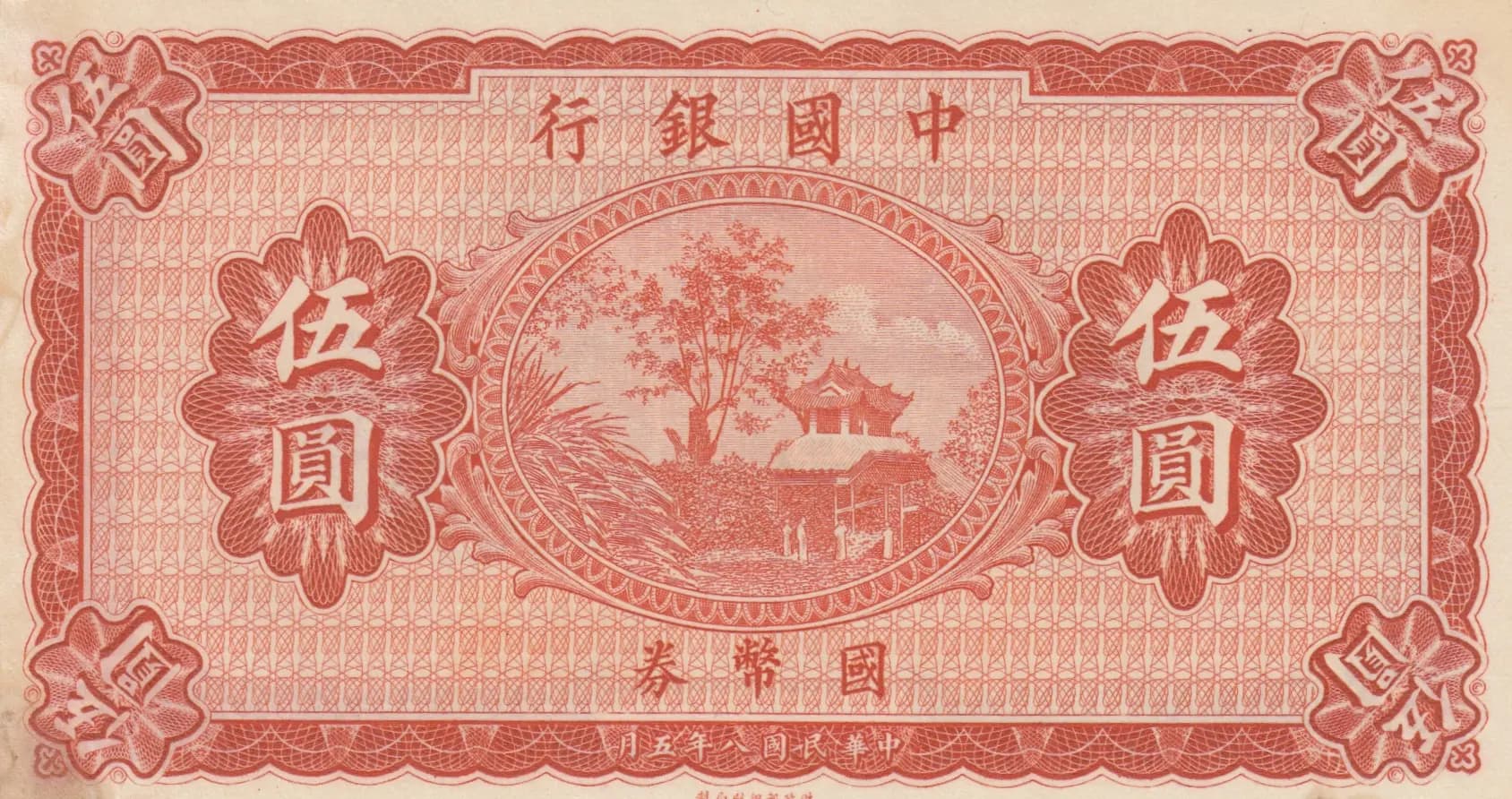
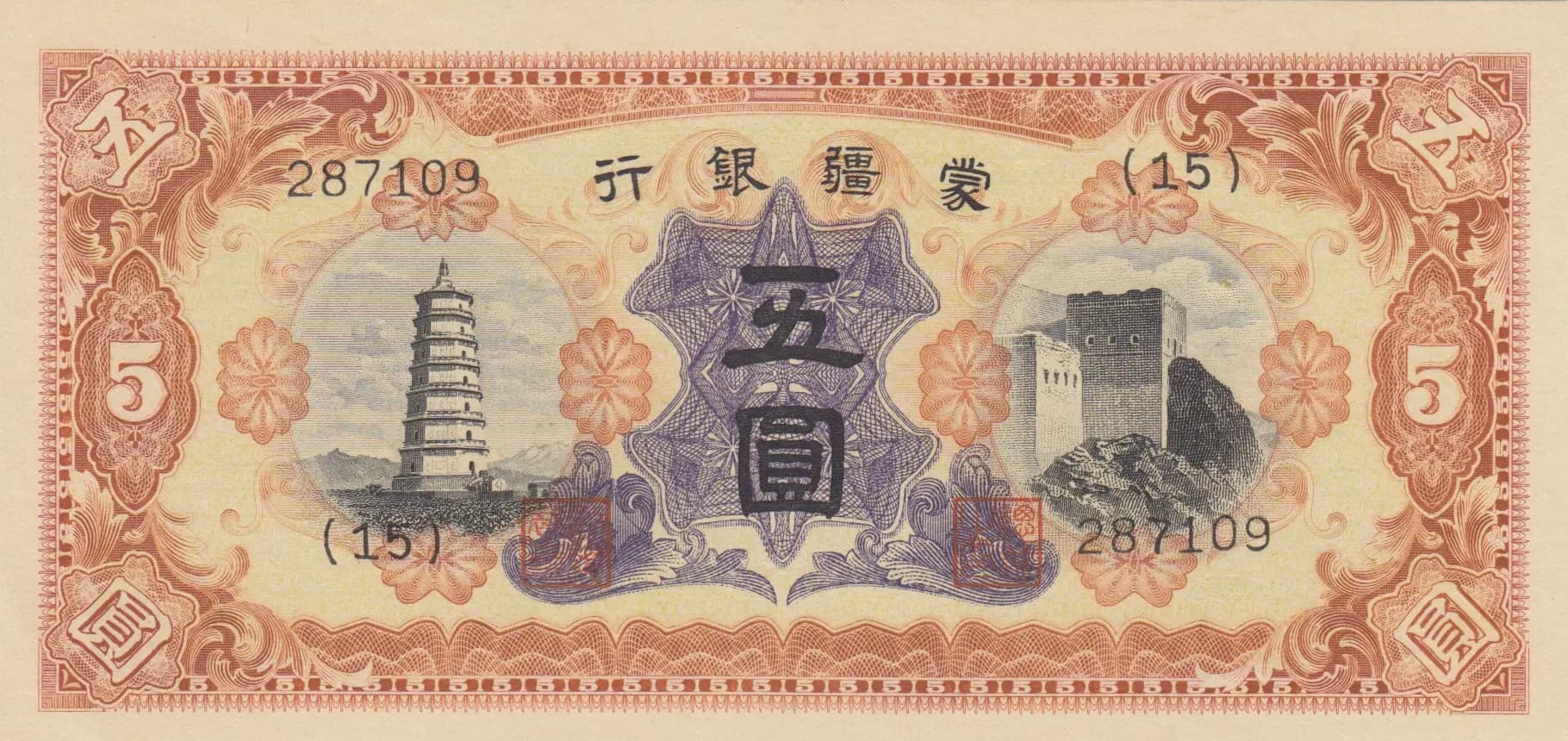
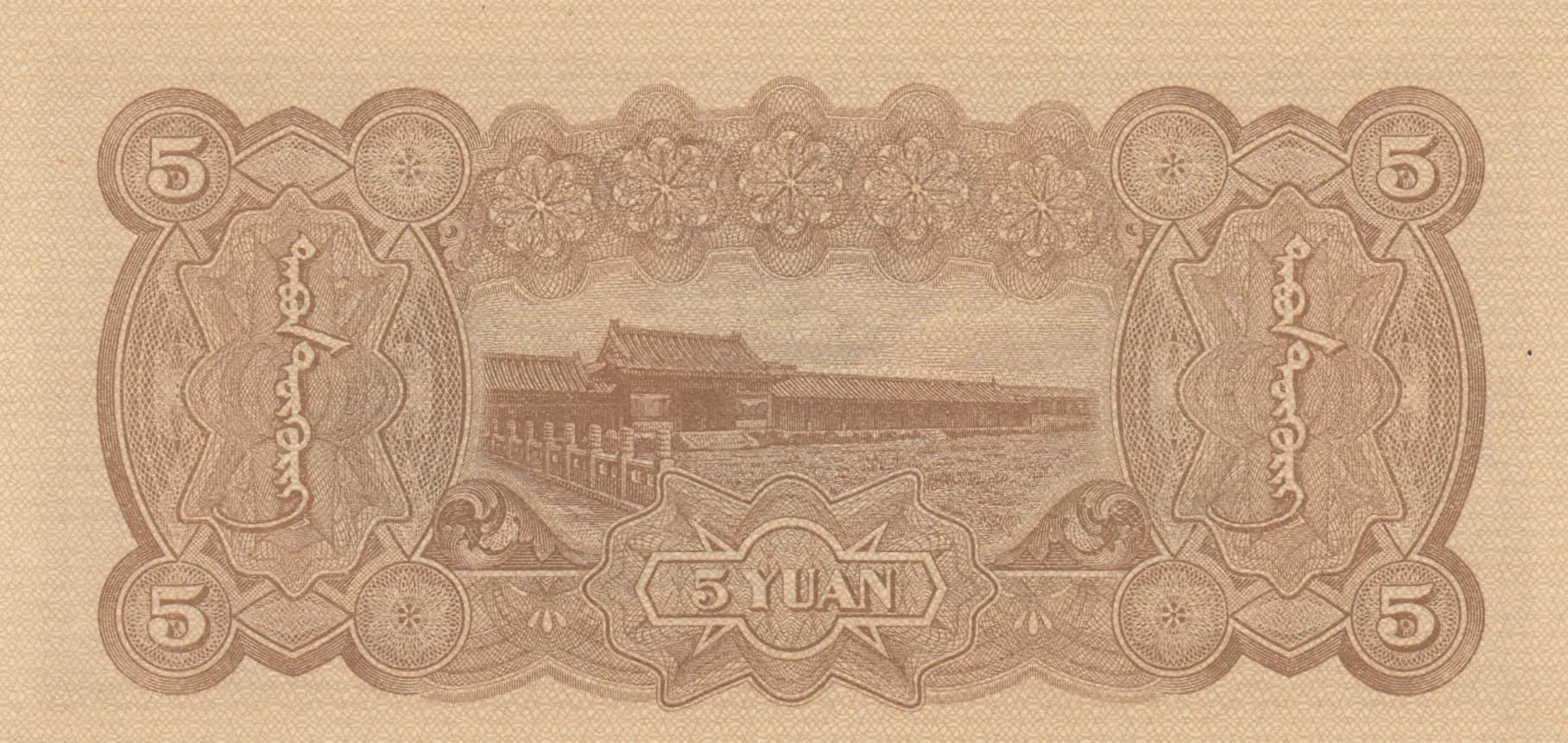
This is an exceptional Uncirculated example of the 1938 Mengchiang Bank 5 Yuan note (Pick J106), featuring pristine condition with no visible wear, folds, or stains. The note displays remarkable engraving detail with ornate reddish-brown decorative borders, a striking central circular emblem with geometric patterns in purple/blue containing Chinese characters, and symmetrical architectural landmarks—a multi-tiered pagoda on the left and a fortress/watchtower on the right. The reverse showcases a detailed landscape scene of a traditional Chinese architectural complex with open courtyard, framed by decorative corner medallions and scrollwork, making this an aesthetically compelling example of Japanese-occupation era Chinese currency.
Common. While Mengchiang Bank notes represent a historically significant and now-defunct issuing authority from Japanese occupation (1938-1945), the 5 Yuan denomination was produced in substantial quantities during its issued period. UNC examples remain available in the collector market at moderate prices, typically ranging from $15-40 USD depending on serial number appeal and specific variety. The note's accessibility in high grade reflects adequate historical preservation and circulation availability despite the political sensitivity of the issuer.
The Mengchiang Bank (蒙疆銀行) was established by Japan in 1938 to issue currency in the puppet state of Mengjiang during the Second Sino-Japanese War, representing Japan's attempt to control financial systems in occupied territories. The architectural imagery on this note—featuring traditional Chinese pagoda and fortress structures alongside administrative buildings—reflects the propagandistic design intent to legitimize Japanese occupation by appropriating Chinese cultural and architectural symbols. This 1938 denomination exemplifies the brief but significant period of Japanese-controlled banking in Inner Mongolia before the note series was superseded.
This banknote exemplifies the fusion of Japanese imperial design standards with Chinese cultural iconography characteristic of Mengjiang occupation currency. The front features a prominent central circular emblem with intricate purple/blue geometric patterns containing institutional Chinese characters, flanked by two significant architectural landmarks: the left depicts a multi-tiered traditional Chinese pagoda representing cultural heritage, while the right shows a fortress or watchtower structure suggesting administrative authority and control. The reverse presents a sweeping landscape scene of a traditional Chinese architectural complex—possibly representing a palace, temple, or major administrative building—with extensive courtyard or plaza, rendered in fine detail. The ornamental framework employs elegant scrollwork and medical caduceus staffs flanking corner medallions bearing the denomination numeral 5, creating a sophisticated, formally balanced composition reflective of high-security banknote design standards.
Front side: Serial numbers '287109' appear in upper left and lower right positions (Arabic numerals); central emblem contains Chinese characters '開銀農黨家' (reading order may vary, likely representing Mengchiang Bank institutional designation); designation number '(15)' appears as catalog reference. Back side: Denomination marking '5 YUAN' in English and Arabic numerals displayed in central cartouche; numeral '5' repeated in all four corner circular medallions.
Steel engraving and intaglio printing, evidenced by the intricate fine line work visible throughout the borders, the detailed architectural rendering on both front and reverse, and the precision of the geometric patterns in the central emblem. The depth and crispness of the engraved designs, particularly in the pagoda, fortress structure, and landscape scene, indicate professional security printing by a specialized banknote printer. The Mengchiang Bank notes were typically printed by Japanese imperial security printers (likely involving the Japanese Government Printing Bureau or similar contractors) as part of occupation-era currency production.
This specific example bears serial number 287109 and designation number (15), which may correlate to a specific printing plate or issue sequence within the 1938 Mengchiang Bank 5 Yuan series. Known varieties of Pick J106 include different serial number prefixes and occasional signature variations; the designation number notation suggests this may belong to a particular printing batch. Collectors should note that Mengchiang Bank notes frequently appear with varying serial number styles and prefix designations reflecting the emergency nature of occupation-era currency production and multiple printing runs throughout the 1938-1945 period.