5 yuan 1942
Market Prices
10 salesAbout This Note
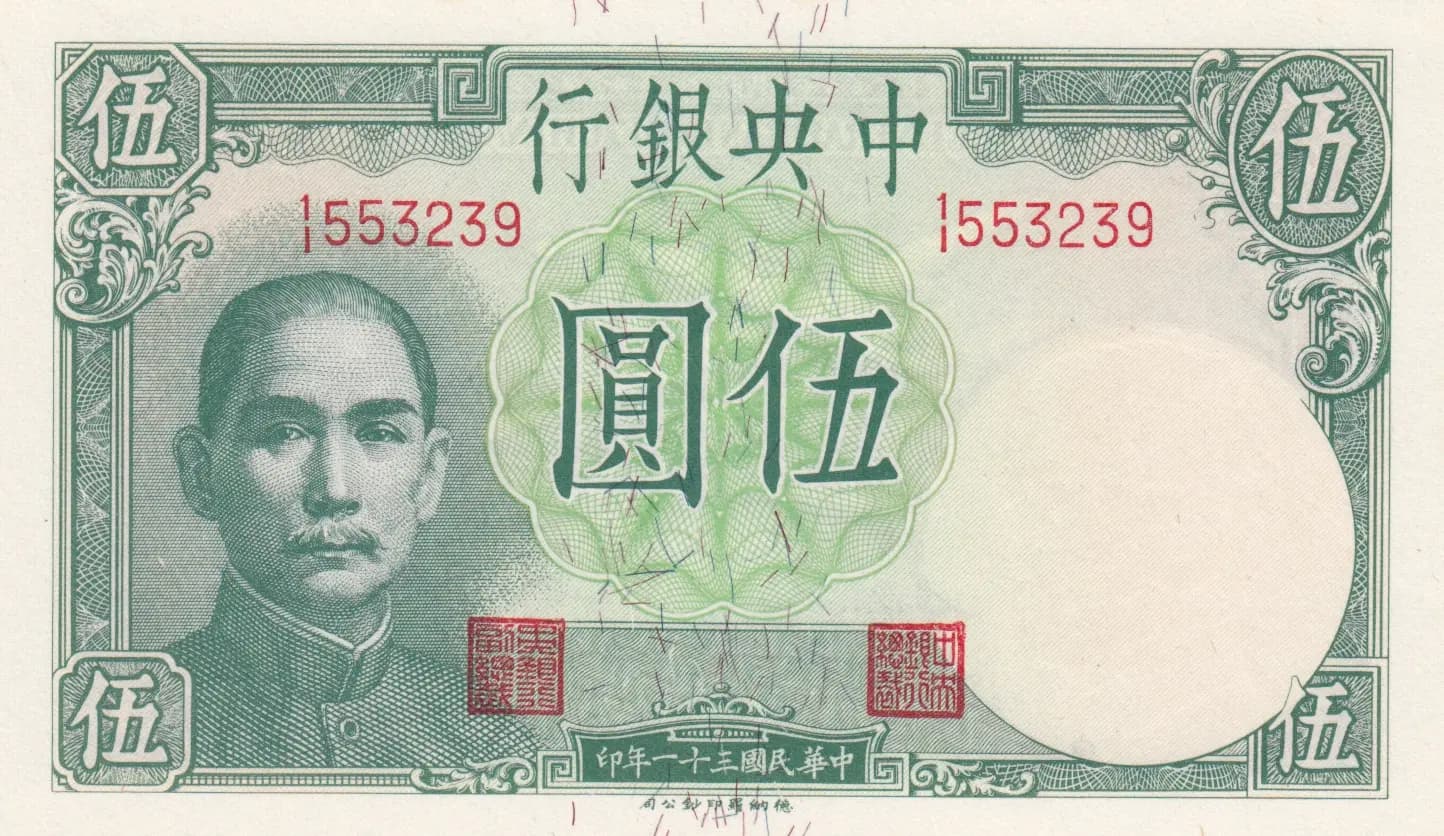
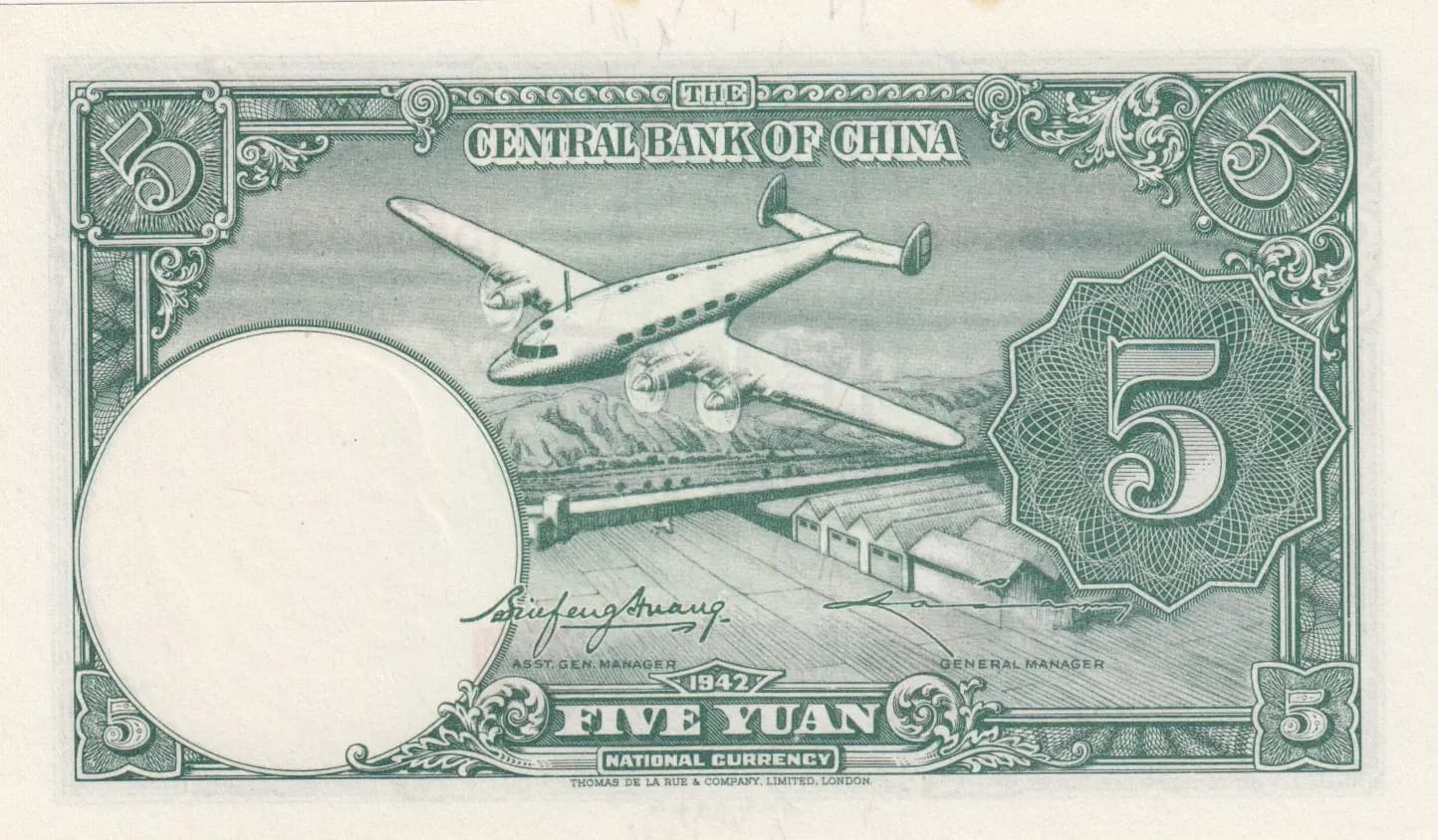
This is a 1942 Central Bank of China 5 yuan note (Pick P-244a) printed by Thomas De La Rue & Company in London, representing the wartime currency of the Republic of China during the Second Sino-Japanese War. The note displays the characteristic dual-language design with Chinese on the obverse and English on the reverse, featuring a portrait of a Chinese statesman on the front and a remarkable twin-engine aircraft in flight over mountainous terrain on the back—symbolizing China's modernization and military capability during this tumultuous period. The observed specimen shows moderate age-related wear with yellowing, creasing, and light staining consistent with 80+ years of storage or circulation, though the detailed engraving and design elements remain clearly visible.
Common. Despite the historical significance and wartime context, this Pick P-244a variety remains relatively common in the collector market. eBay sales data shows consistent circulation across multiple condition grades: UNC specimens sold for $57.11 (2013) and PMG 66 graded examples brought $212.50 (2025), while lesser grades (F-EF) sold for $8.50-$51.77. The 2016 catalogue value of $30 in UNC confirms mainstream collector availability. Print runs from the Central Bank of China for this denomination during this period were substantial, and the note was not subject to recall or withdrawal. The observed specimen's worn condition places it in the lower-value range typical of circulated examples.
Issued during 1942, when China was engaged in full-scale war with Japan (1937-1945), this note represents the Central Bank of China's efforts to maintain currency stability and project national sovereignty during occupation and territorial fragmentation. The aircraft depicted on the reverse—a symbol of modern military power—reflects the Chinese government's aspirations to modernize its armed forces, while the mountainous landscape and agricultural imagery emphasize the nation's resource wealth. The bilingual English/Chinese design was standard for Chinese currency of this era, facilitating international trade and lending credibility to the Central Bank's authority during a period of severe political and military upheaval.
The obverse features a three-quarter portrait of a Chinese statesman (likely a government official of the Republic of China period) positioned on the left side, rendered in fine cross-hatched engraving with distinctive mustache and formal dress. The center is dominated by a large decorative circular cartouche containing Chinese characters and red official seals below, suggesting governmental authority and authenticity. Ornate corner medallions with scrollwork, Greek key pattern borders, and floral designs frame the composition in the traditional style of Thomas De La Rue security printing. The reverse depicts a twin-engine transport aircraft (likely a Douglas DC-3 or similar contemporary model) photographed from a dramatic below angle, flying over a landscape of agricultural terraced fields and mountains with structures/buildings below—symbolizing modernization and national development. The reverse is entirely English-language, reinforcing the international character of the currency.
FRONT: 中央銀行 (Central Bank); 國五 (Five Yuan); 中華民國二十三年 (Twenty-third Year of the Republic of China [1934 in Western calendar, though this refers to the dating system]); Serial number i553239 (appears twice in red). BACK: THE CENTRAL BANK OF CHINA; FIVE YUAN; NATIONAL CURRENCY; 1942; ASST.GEN.MANAGER; GENERAL MANAGER; THOMAS DE LA RUE & COMPANY, LIMITED, LONDON (printer); Soifeng Duang (signature, romanized Chinese name).
This note was produced by Thomas De La Rue & Company, Limited, London, using steel-plate intaglio (engraving and recess printing), the premier security printing method of the era. The fine line engraving visible throughout—particularly in the portrait's cross-hatching, the aircraft's detail work, the intricate border designs, and the architectural elements—is characteristic of high-security banknote production. The use of multiple colors (green, red, and cream) required separate printing passes and careful registration. No modern security features are present, reflecting 1942 technology standards.
This is Pick P-244a, the standard 1942 issue. No major varieties are noted in the visual analysis. The serial number visible (i553239) appears in red on both sides, which is consistent with the standard series printing. Signature varieties may exist (Soifeng Duang is identifiable on the reverse), but without comparison to other examples, it cannot be determined if this represents a scarce signature combination. The note's denomination, date, printer, and bilingual design are all consistent with the catalogued P-244a specification.