5 dollars 1924
Market Prices
About This Note
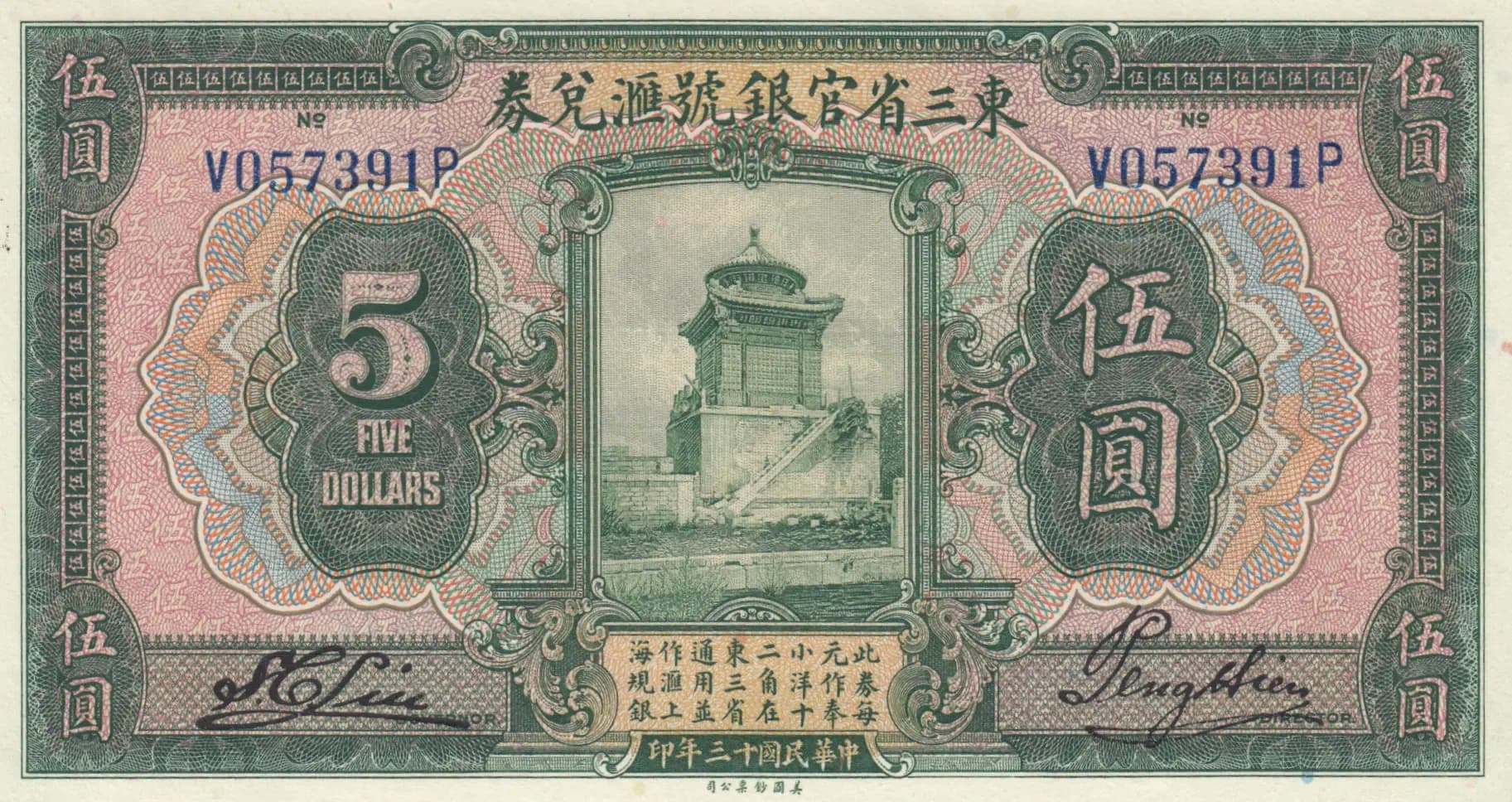
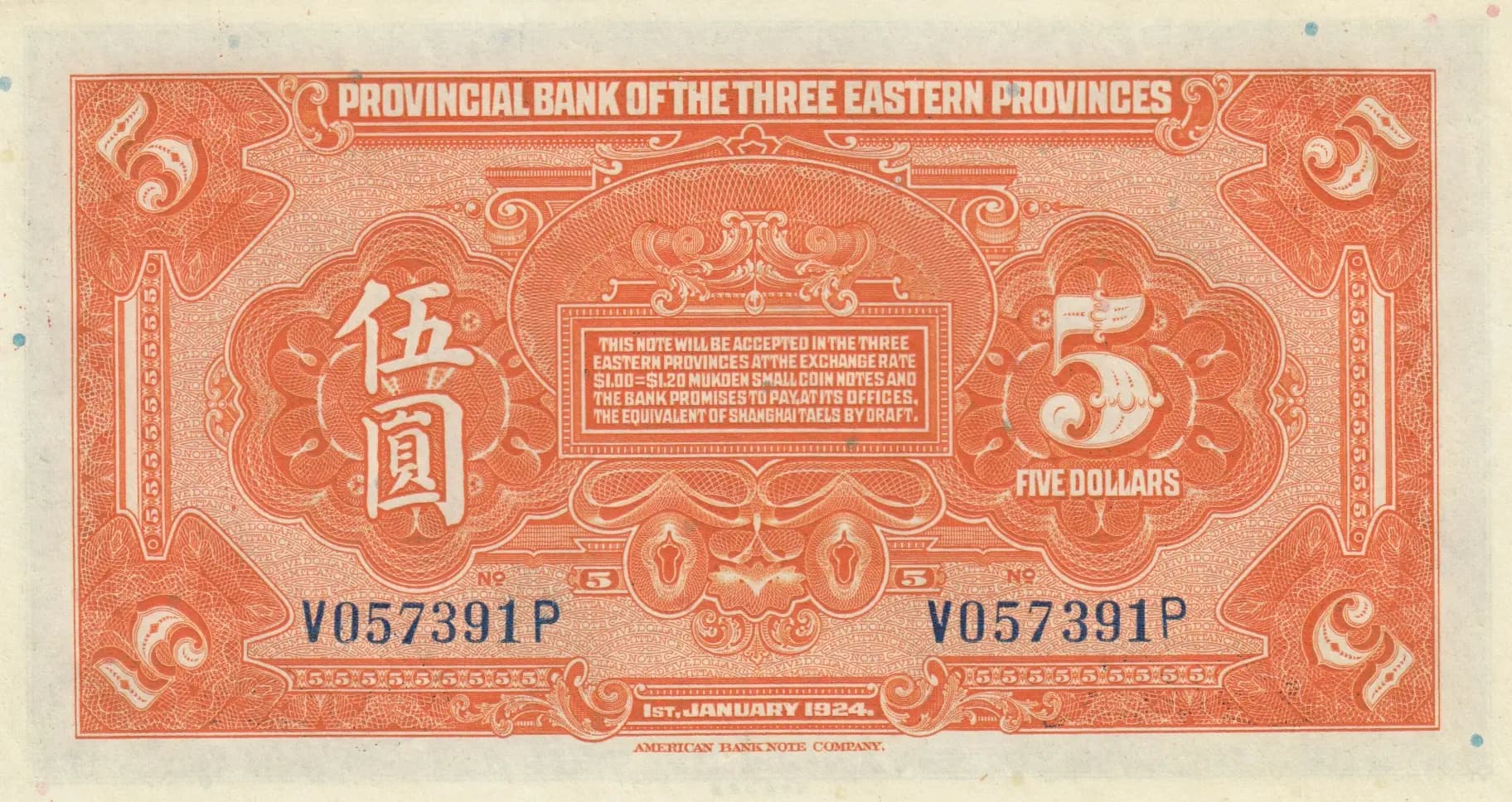
This is an uncirculated 1924 Provincial Bank of the Three Eastern Provinces 5 Dollar note, printed by the American Bank Note Company. The note features exceptional quality with crisp printing throughout, displaying a distinctive pink/mauve front with a classical pagoda vignette and an orange/red reverse with ornate scrollwork. The pristine condition and sharp engraving make this an excellent example of early Republican-era Chinese provincial currency.
Common. The eBay price tracking data shows consistent availability with prices ranging from $6.99 to $75.00 USD, with multiple UNC examples listed, indicating substantial circulation in the numismatic market. The note was produced by the American Bank Note Company, a major printer with large production capacity. While these regional Chinese notes have collector interest, this particular issue does not show characteristics of scarcity—multiple examples in UNC condition are regularly available, and prices well under $100 for premium condition suggest a common issue despite its historical significance.
Issued in January 1924, this note represents a critical period in Chinese financial history when regional banks operated with significant autonomy during the warlord era. The Provincial Bank of the Three Eastern Provinces (Manchuria) issued this currency to facilitate commerce in the northeastern provinces, with the promise of redemption in Shanghai taels reflecting the complex monetary system of the Republic of China. The note's bilingual design and American Bank Note Company printing underscore foreign involvement in Chinese financial modernization during the early 20th century.
The obverse features a classical East Asian pagoda or tower structure as the central vignette, rendered in fine detail with traditional architectural elements including a domed top and columned entrance. Ornamental cartouches containing the numeral '5' flank the central design on both left and right sides, surrounded by elaborate scrollwork and flourishes typical of early 20th-century engraved currency. The color scheme of pink/mauve background with green ornamental borders creates a distinctive aesthetic. The reverse displays purely decorative elements without portraiture or additional landmarks, instead emphasizing the bank's name and redemption promise in a rectangular frame surrounded by white ornamental scrollwork on an orange/red background. The bilingual (Chinese and English) text throughout reflects the note's dual audience in Republican China.
FRONT SIDE: '東三省官銀號' (Bank of the Three Eastern Provinces); '五圓' (Five Yuan/Dollars); 'FIVE DOLLARS'; 'V057391P' (Serial Number); '中華民國二十年印' (Printed in Year 20 of the Republic of China, i.e., 1924). BACK SIDE: 'PROVINCIAL BANK OF THE THREE EASTERN PROVINCES'; 'FIVE DOLLARS'; '五圓' (Five Yuan/Dollars); 'EST. JANUARY 1924' (Established January 1924); 'THIS NOTE WILL BE ACCEPTED IN THE THREE EASTERN PROVINCES AT THE EXCHANGE RATE S1.00=C$1.20 UNDER SMALL COIN NOTES AND THE BANK PROMISES TO PAY AT ITS OFFICES THE EQUIVALENT OF SHANGHAI TAELS BY DRAFT.' (Exchange and redemption terms); 'AMERICAN BANK NOTE COMPANY.' (Printer); 'V057391P' (Serial Number).
This note was produced using intaglio engraving (line engraving), the primary security printing method for high-value banknotes of the era. The fine line engraving is evident throughout both sides, with intricate ornamental border patterns and detailed architectural elements. Multiple color printing layers were employed—pink/mauve and green on the obverse, orange/red and white on the reverse—characteristic of American Bank Note Company's sophisticated production standards for international clients.
The observed serial number is V057391P. This note was printed in January 1924 (Year 20 of the Republic of China calendar). Known varieties for Provincial Bank of the Three Eastern Provinces notes typically include different serial number prefixes and possible variations in signature blocks, though the visual analysis does not reveal detailed signature characteristics. The Pick catalog number S2952 indicates this is the standard issue for the 5 Dollar denomination from this bank and year. Further variety documentation would require comparison with other examples to identify specific signature combinations or serial number prefix variations.