5 dollars 1929
Market Prices
About This Note
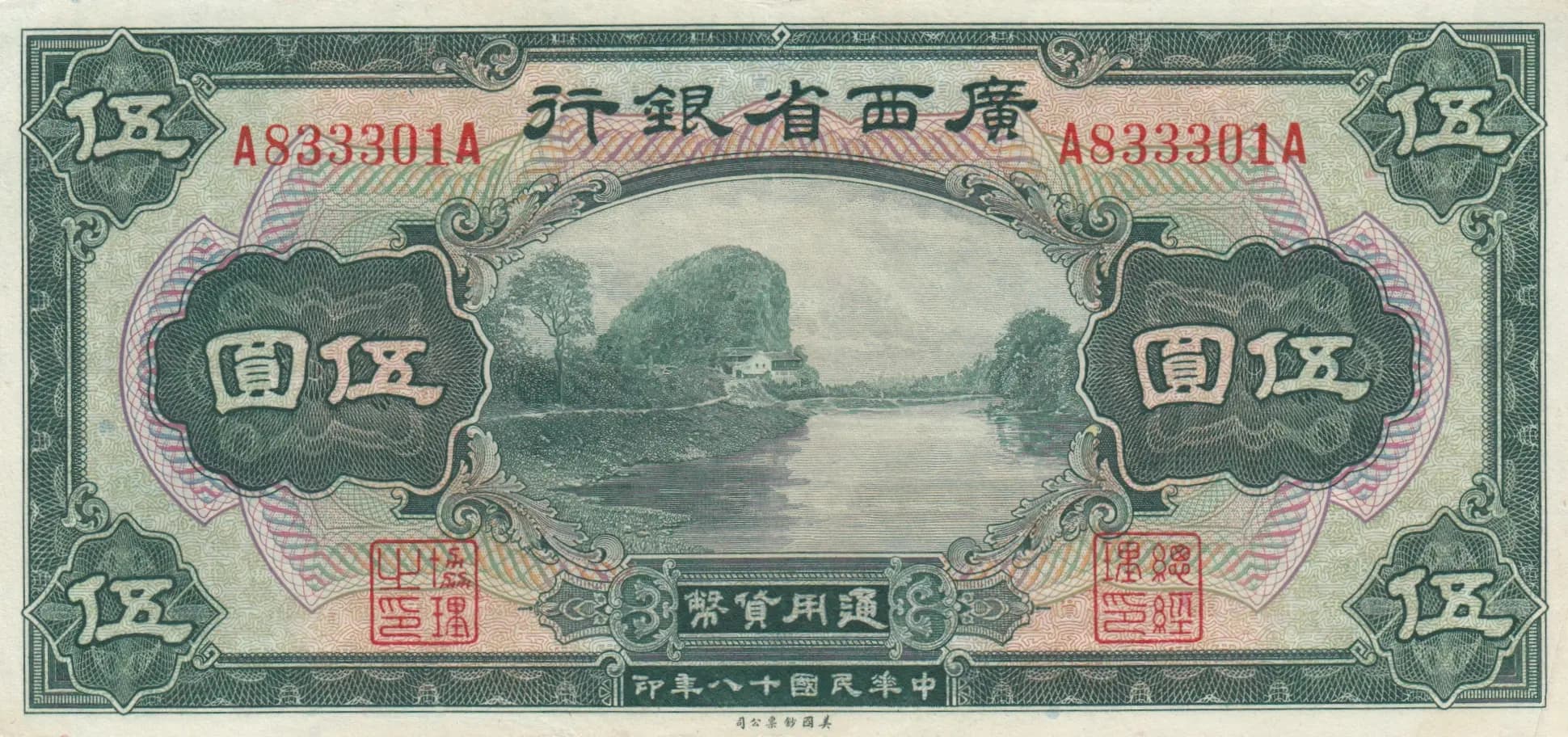
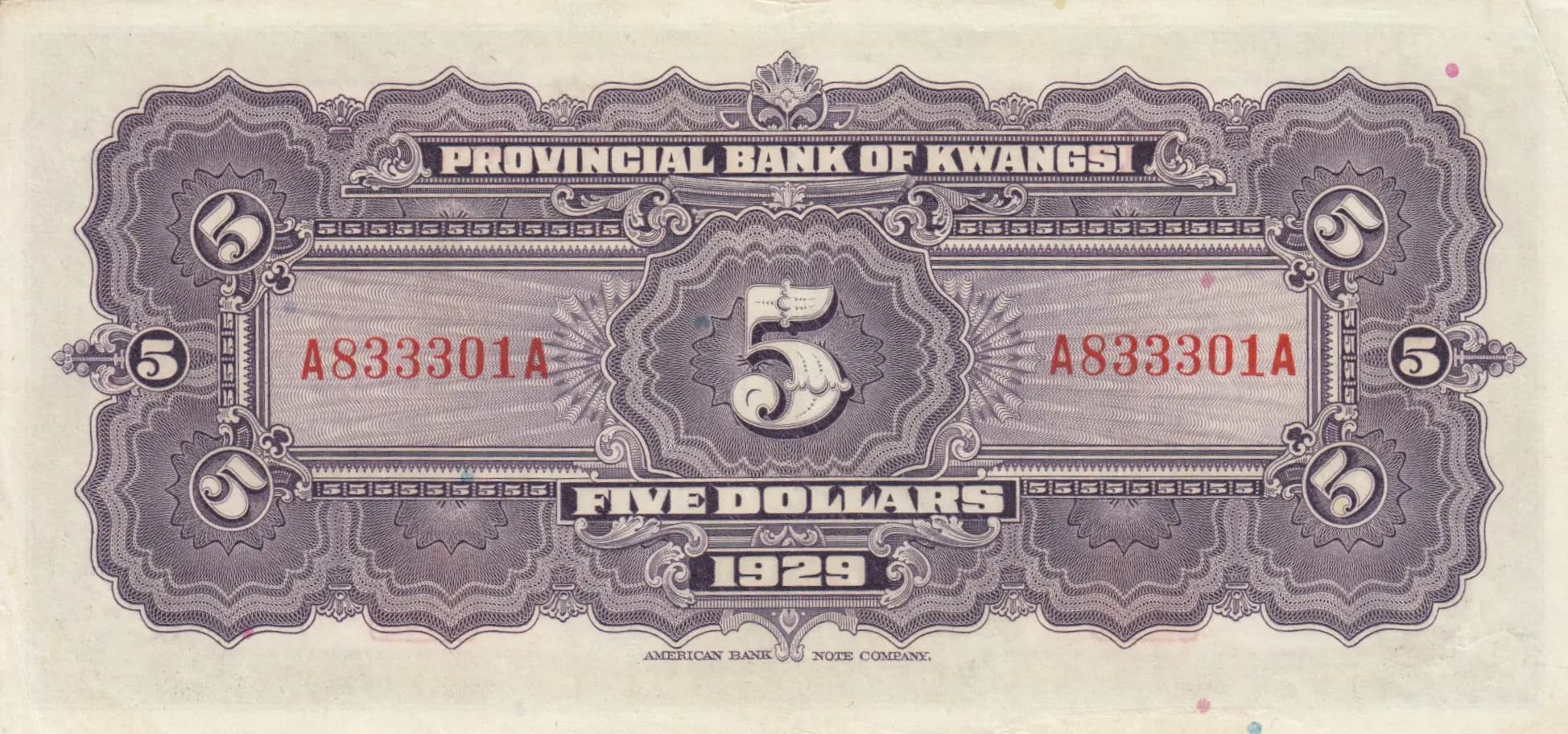
A handsome example of the Provincial Bank of Kwangsi's 1929 Five Dollar note in AU condition, featuring bilingual design with Chinese traditional characters on the obverse and English text on the reverse. The note displays vibrant original colors—green and pink borders on the front with an intricate river landscape vignette, and purple/lavender tones on the back—with crisp printing and no visible circulation wear, making it an attractive specimen for collectors of Chinese provincial currency or early 20th-century Asian banking history.
Common. The eBay market data shows consistent sales in the $55–$145 USD range across multiple condition grades (F, VF, AU, XF), with AU specimens selling for approximately $111–$120 USD on average. This price range and steady availability indicate healthy collector demand but substantial extant quantities. The note was issued by a provincial bank during a period of relative stability (pre-1932), and no evidence suggests a limited print run or extraordinary rarity. Remainder notes (as noted in the catalog) were often produced in larger quantities than circulating notes, further supporting a common assessment.
Issued in 1929 (the 18th year of the Republic of China era, corresponding to the Nationalist period under the Kuomintang), this note represents the Provincial Bank of Kwangsi's attempt to establish regional monetary authority during a period of political fragmentation and warlordism in southern China. The bilingual design—Chinese on the obverse depicting a peaceful river landscape with mountains and vegetation, and English on the reverse—reflects the international commercial context of the treaty port era and appeals to foreign traders operating in Guangxi province. The note bears the approval mark of the National Government, indicating an effort to legitimize provincial currency under the nominal authority of Chiang Kai-shek's nascent Nationalist state.
The obverse features a peaceful landscape vignette as the central motif, depicting a river scene with mountains in the background, trees and vegetation lining the waterway, and a small building or structure on the right bank—imagery suggesting the natural prosperity and commerce of Guangxi province. The design is framed by ornate decorative borders in green with pink floral patterns and cloud-like ornamental flourishes in the corners, rendered in the European Art Nouveau style popular on contemporary Chinese provincial notes. The reverse presents a more formal, austere design centered on a large ornate numeral '5' surrounded by geometric patterns and scrollwork, with the institution name and denomination stated in English for the foreign commercial audience. Serial number A8333014 appears in both upper corners on both sides.
Front: '廣東省銀行' (Provincial Bank of Guangdong—note: catalog lists as Kwangsi, but inscription reads Guangdong); '圓五' (Five dollars, repeated); '中華民國二十年印' (Printed in the 20th year of the Republic of China); '據發用準國民政府' (Approved for issuance by the National Government); Serial number A8333014. Back: 'PROVINCIAL BANK OF KWANGSI'; 'FIVE DOLLARS' and '1929'; 'AMERICAN BANK NOTE COMPANY'; Serial number A8333014 (repeated).
Intaglio engraving with multicolor letterpress or chromolithographic printing, as evidenced by the crisp fine-line detail in the landscape vignette and geometric borders, the precise registration of multiple color separations (green/pink on obverse, purple on reverse), and the identification of American Bank Note Company as the printer. ABNC was the premier security printer for Chinese provincial notes and employed traditional engraved plate techniques with hand-colored separation for this period.
This is a remainder note (unissued stock, per catalog designation), which accounts for its pristine AU condition and absence of circulation wear. The serial number prefix 'A' and serial number A8333014 should be documented for variety purposes. Collectors should note the discrepancy between the catalog designation 'Provincial Bank of Kwangsi' and the front inscription reading '廣東省銀行' (Guangdong), which may indicate either a printing error, regional variant, or cataloging note; verification against other examples of Pick S2340r would clarify whether this is the standard inscription for this Pick number or a specific variety.