5 dollars 1923
Market Prices
2 salesAbout This Note
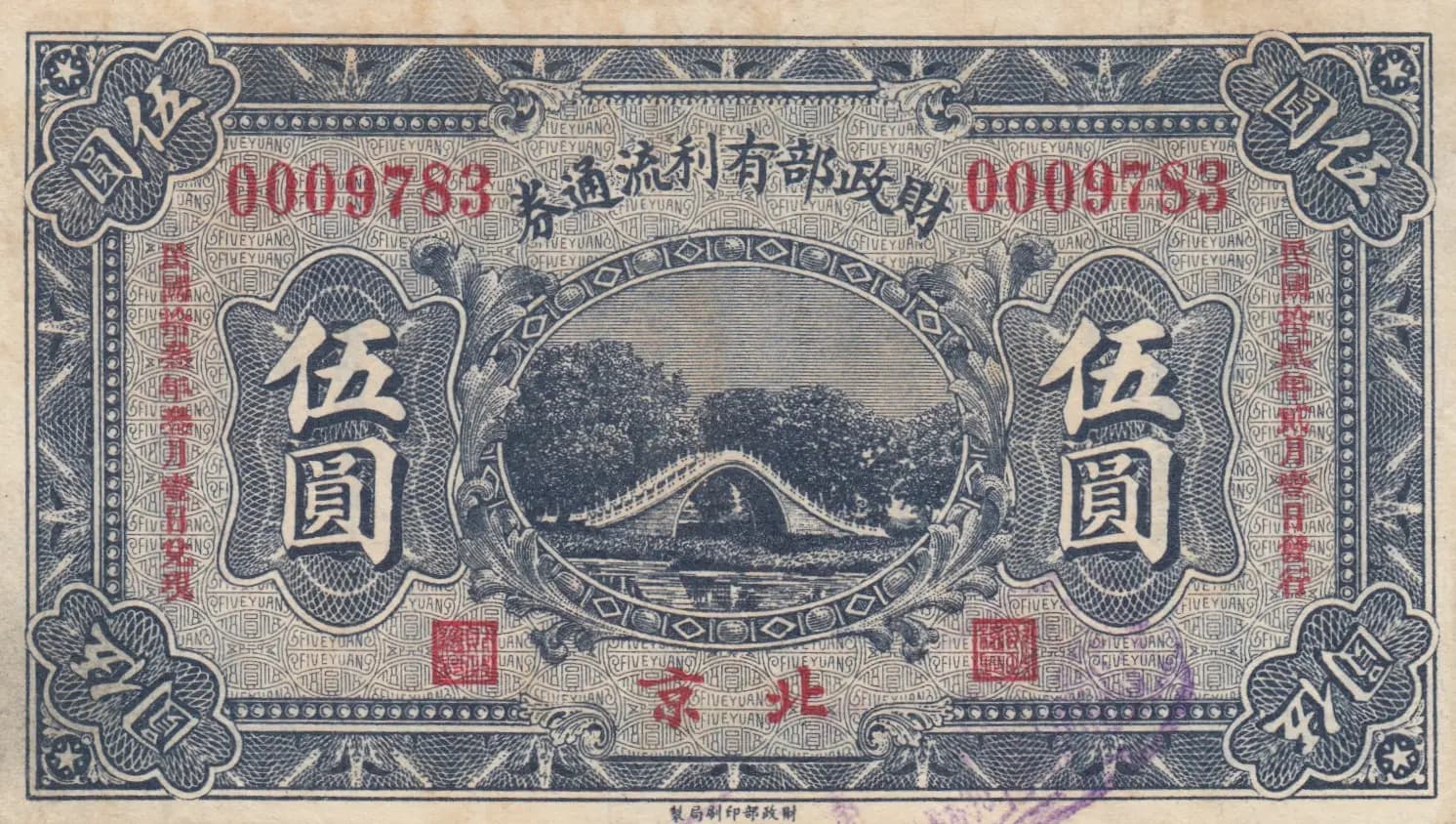
This 1923 Chinese 5 Yuan Interest Bearing Circulating Note (Pick 642) represents a fascinating example of early Republican-era financial instruments. The note features an elegant landscape vignette of an arched bridge over water with ornate blue and cream coloring, accompanied by a red security overprint. In VF condition, the note exhibits moderate circulation wear with creasing and light foxing, yet remains structurally sound and displays the intricate engraving typical of this issue.
Common. The eBay market data provided shows consistent pricing well below $20 for this note ($7.25 catalog value in VF condition, with AUNC examples selling for $24.50-$43), indicating this is a regularly encountered issue with reasonable circulation. While Interest Bearing Circulating Notes represent a specific subcategory of Chinese Republican currency, Pick 642 itself shows no evidence of limited printing, short-lived issuance, or collector scarcity. The existence of multiple sales records and established catalog values further confirms common circulation status. This note's value derives from its historical interest and design quality rather than rarity.
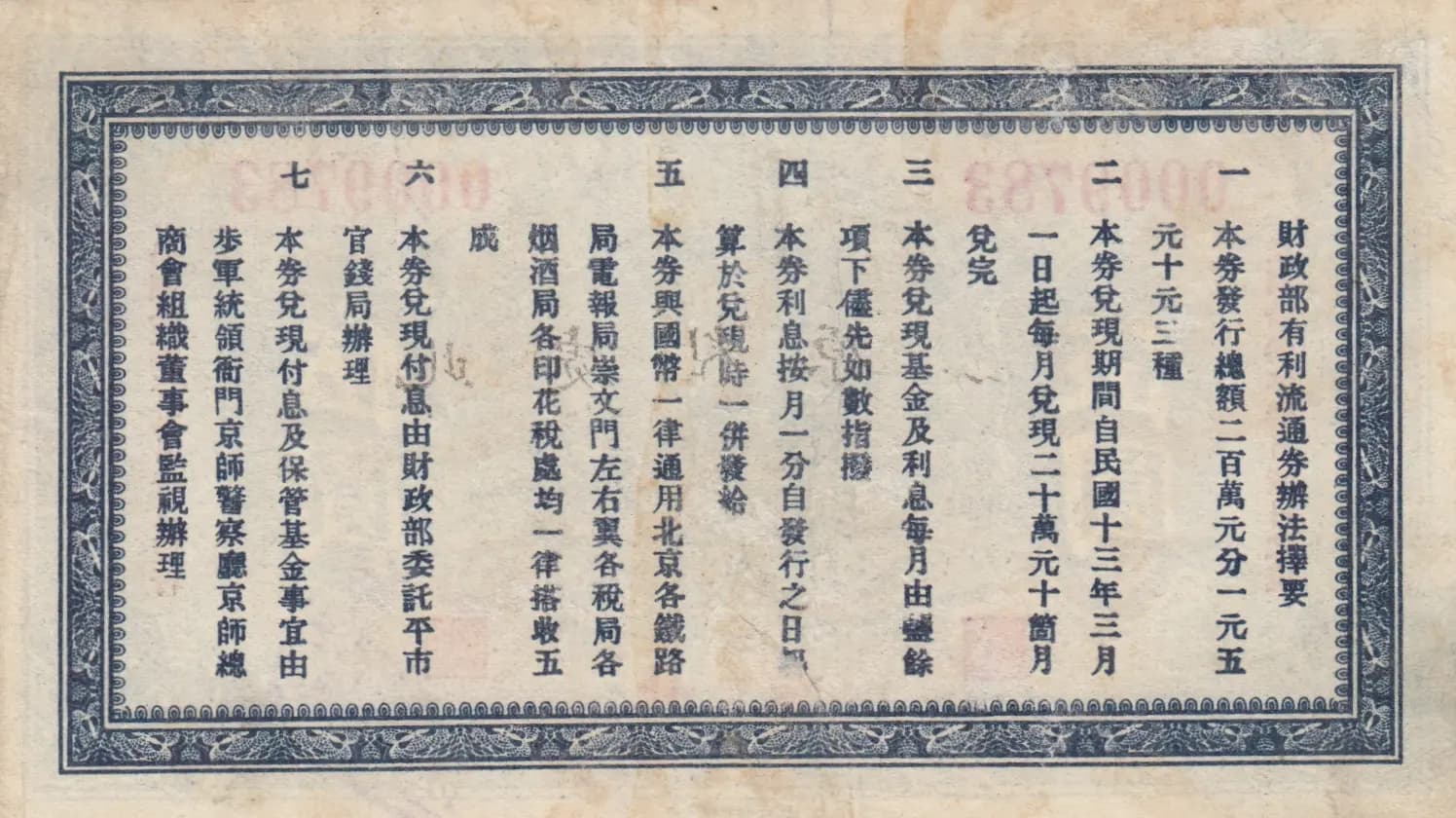
Issued during Year 12 of the Republic of China (1923), this interest-bearing note reflects the financial innovations of the early Republican period when the government sought alternative funding mechanisms through securities-based currency. The dense regulatory text on the reverse, detailing a 24% annual interest rate and redemption procedures from March Year 13 to Year 15 (1924-1926), illustrates the transitional economic policies of the Nanjing-based government during a period of significant political and financial reorganization. The arched bridge landscape symbolizes the modernization aspirations of the Republican era, depicted in the traditional Chinese artistic style that characterized this transitional coinage and currency period.
The obverse features a classical Chinese landscape vignette as its central motif—a gracefully arched stone bridge spanning a water body with forested mountains or tree-covered hills in the background, rendered in the refined artistic tradition of early 20th-century Chinese engraving. This landscape symbolizes both natural harmony and the infrastructure development aspirations of the Republican government. The denomination 'Five Yuan' appears in large traditional Chinese characters (五圓) within ornamental cartouches positioned on the left and right sides, each framed within decorative shield-shaped borders. The design employs an extensive ornamental border system featuring geometric patterns and traditional Chinese floral motifs in the corners, characteristic of security printing conventions. A red overprint appears across the top center of the note, serving as a security marking and validation stamp. The reverse side eschews figurative imagery in favor of dense legal and regulatory text arranged in traditional right-to-left vertical columns, organized into numbered sections. This legal documentation approach transforms the back of the note into an official government document, with an ornamental frame border and structured layout that served both informational and anti-counterfeiting purposes. The color palette throughout is restrained and elegant: dark blue/navy for primary printing, cream or beige paper stock, and red for the security overprint.
FRONT SIDE: The denomination appears as '五圓' (Five Yuan) in decorative cartouches on both sides. The date inscription reads '民國十二年' (Year 12 of the Republic, corresponding to 1923). English romanization reads 'OF FIVE YUAN.' Serial number: 00049735 (appears twice). BACK SIDE: The note is identified as '本票係中華民國財政部有償發行之國債證券' (This note is a government bond security issued by the Ministry of Finance of the Republic of China). Validity period: '自民國十三年三月十二日起至民國十五年三月十一日止' (From March 12, Year 13 to March 11, Year 15 of the Republic). Interest terms: '本票利息按年息百分之二十四計算,按月支付之' (Interest shall be calculated at an annual rate of 24 percent, payable monthly). Redemption: '每月二十日起現' (Redeemable commencing on the 20th of each month). Administrative authority: '南京徵税組織監督辦理' (Supervised by the Nanjing Tax Collection Organization) and '京師督辦總督衛門署' (Beijing Superintendent's Office). Additional conditions note that '本票免兌現' (This note is not immediately redeemable) and holders must present proper documentation with tax bureau seals.
This note was produced using intaglio/engraved line printing, evidenced by the fine line engraving visible in the ornamental borders, the detailed bridge landscape vignette, and the precise character definition observed in the visual analysis. The multiple layers of fine line engraving, particularly visible in the geometric and floral border patterns, are characteristic of high-security banknote production standards of the 1920s. The red overprint was applied as a separate security printing operation, visible as somewhat faded in the observed example. Based on the Pick catalog attribution and the quality of engraving, this note was likely produced by a foreign security printer contracted by the Chinese Ministry of Finance, following the common practice of the period. The specific printer attribution for Pick 642 is not definitively established in standard references, though Chinese financial instruments of this era frequently employed European security printers such as Waterlow & Sons or similar firms.
The observed serial number 00049735 appears twice on the note, which is standard for this issue. No significant varieties are documented for Pick 642 in standard references; however, potential varieties may include different red overprint colors or intensities, serial number prefixes, and printing dates. The visible fading of the red overprint in this example may represent aging rather than a distinct variety. Detailed variety information specific to this Pick number would require comparison with multiple examples across different production batches. The date of Year 12 (1923) with interest accrual through Year 15 (1926) is consistent with documented issuance parameters for this series.