30 copper coins 1926
Market Prices
About This Note
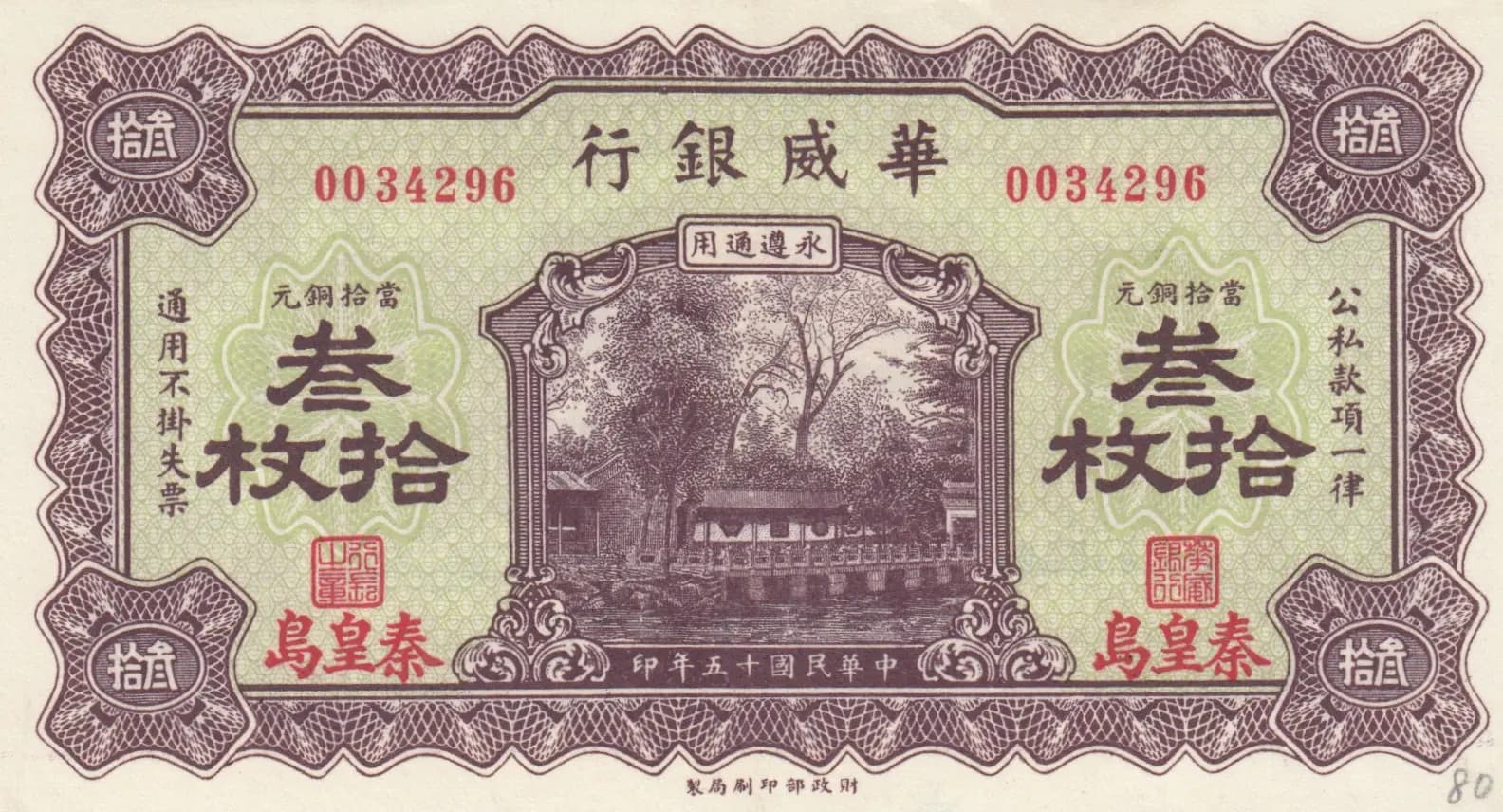
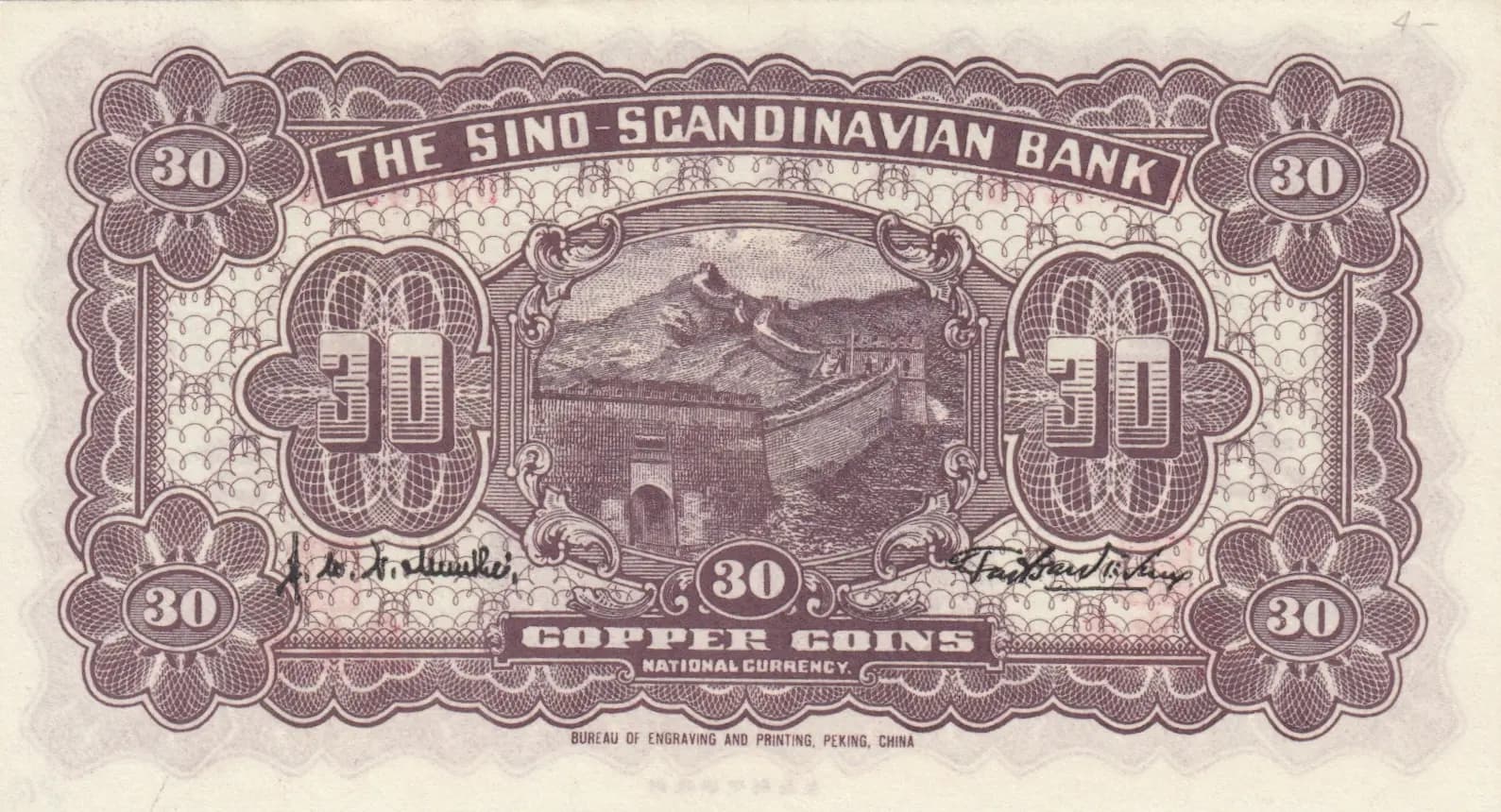
This is an exceptional UNC example of the Sino-Scandinavian Bank's 30 Copper Coins note from 1926, displaying crisp printing and pristine condition throughout. The note features a striking bilingual design with traditional Chinese landscape imagery on the obverse and English inscriptions on the reverse, reflecting the bank's international character during the early Republic period. With eBay market data showing UNC specimens commanding $350 USD, this represents a desirable mid-range Chinese banknote from the period.
Uncommon. While eBay pricing data shows UNC examples at $350 USD (a solid mid-range price), this note was issued by a specific foreign bank during a limited period of China's Republican era. The Sino-Scandinavian Bank had more restricted circulation than major domestic banks, and colonial-era Chinese banknotes in UNC condition are not commonly encountered. The combination of the specific issuer, denomination, and pristine condition places this above 'common' but not into the rare category given available market evidence.
The Sino-Scandinavian Bank operated during the turbulent warlord era of the Chinese Republic, when foreign-backed financial institutions played a crucial role in China's modernization. The note's imagery—featuring a traditional pagoda and fortified structure—symbolizes the tension between China's classical heritage and Western economic influence during this transitional period. The bilingual English-Chinese presentation and the notation of 'National Currency' reflect the bank's position as a bridge between Chinese and Scandinavian commercial interests in the 1920s.
The obverse features an ornate border of intricate geometric patterns in purple/maroon and cream tones, framing a classical Chinese landscape vignette. The central scene depicts a traditional pagoda-style structure beside water with graceful willow trees, evoking classical Chinese artistic traditions. Decorative floral medallions in all four corners display the character 拾 (ten), though the denomination is identified as 30 on the reverse. The reverse presents the same ornamental border treatment but shifts focus to an English-language design, with a central fortification or defensive structure on a hillside rendered in fine engraving. Large decorative medallions in all four corners display the numeral '30,' and the bilateral presentation (Chinese obverse, English reverse) underscores the note's position as currency for international commercial transactions.
FRONT SIDE: The Chinese characters 華華銀行 appear to reference the bank name. The character 拾 (ten) appears in corner medallions. Additional inscriptions include 元銅拾壹 (copper denomination), 用通遠永 (currency notation), 中華民國五十國民 (Republic of China marking), and 東局刷印部政府 (government printing bureau notation). Serial number 0034296 is printed in red. BACK SIDE: 'THE SINO-SCANDINAVIAN BANK' appears prominently across the top in English. The denomination is clearly marked as '30 COPPER COINS' at the bottom. Additional English inscriptions include 'NATIONAL CURRENCY' and 'BUREAU OF ENGRAVING AND PRINTING, PEKING, CHINA,' indicating the note was produced by the Chinese government's official printing facilities.
Intaglio engraving with fine line work, as evidenced by the crisp geometric patterns, intricate border designs, and sharp detail throughout both sides. The Bureau of Engraving and Printing in Peking produced this note using high-quality engraved steel plates, a technique that enabled the fine detail visible in the landscape vignettes and security pattern backgrounds. The multi-color printing (purple/maroon, cream, black, and red) was achieved through sequential passes of the engraved plates.
Pick catalog number S584 identifies this as a standard issue from the Sino-Scandinavian Bank. Serial number 0034296 (observed in red on the obverse) represents one specific printing sequence; variations in serial number prefixes and ranges may exist. No overprints or significant varieties are evident in this specimen. The note appears to be from the primary 1926 issue without subsequent modifications or regional variants.