3 yuan 1953
Market Prices
10 salesAbout This Note
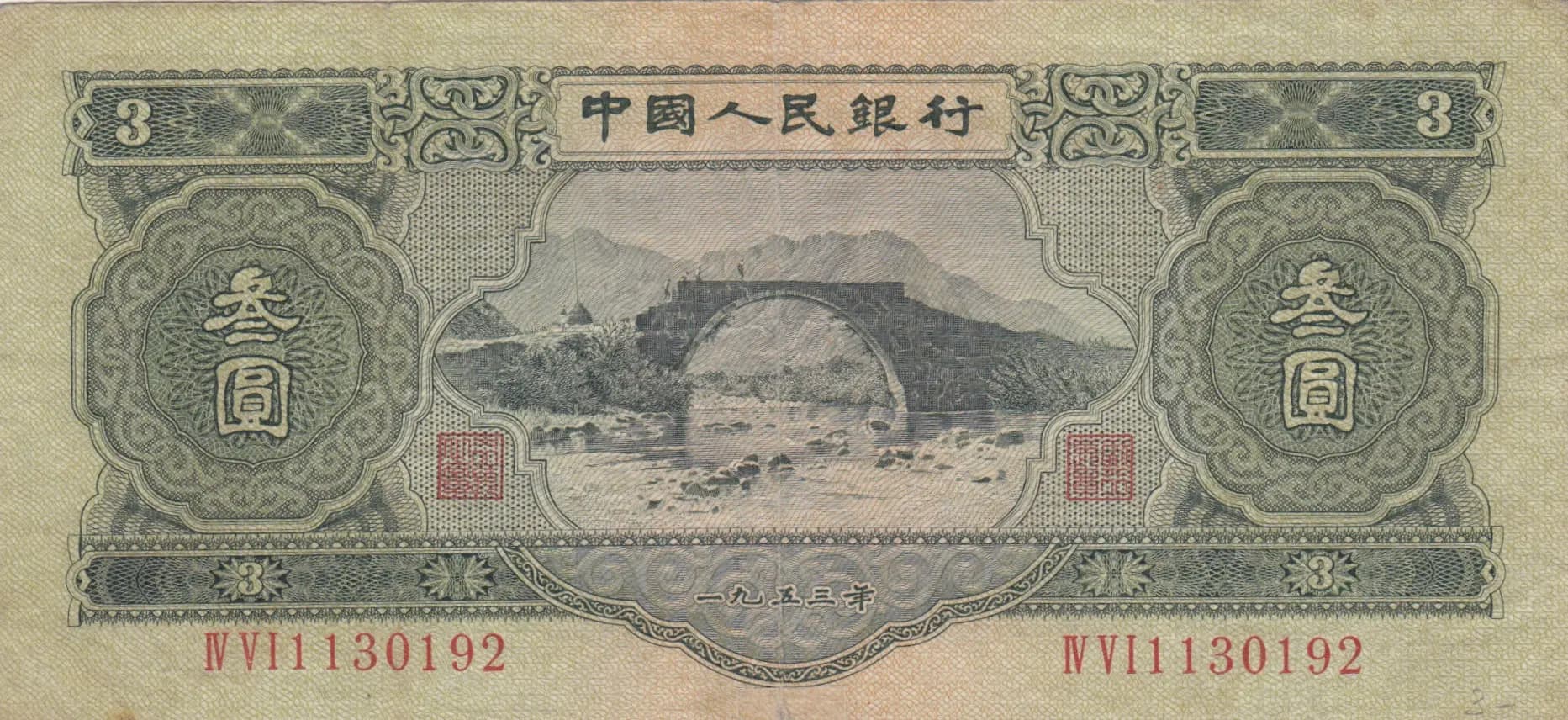
This 1953 Chinese 3 Yuan note presents an excellent example of early People's Bank of China currency from the post-revolutionary period. The obverse features a striking central vignette of a traditional stone arch bridge in landscape setting, rendered in green and black on light orange underprint with ornamental Chinese character cartouches flanking the design. In VF condition, the note exhibits expected aging with yellowing and patina consistent with seven decades of storage, while maintaining good structural integrity without major tears.
Uncommon. While the 1953 3 Yuan (Pick 868) is not exceptionally rare, it is considerably less common than many other early PRC issues. eBay market data shows consistent sales activity with VF-graded examples realizing $1,000-$1,300 historically, and even lower-grade PMG 45-58 examples fetching $300-$2,938. The 2016 catalog valuation of $400 for VF is substantially below recent realized prices, suggesting collector demand has increased. The combination of historical significance (early PRC issue), multi-ethnic design elements, and moderate scarcity in high grades places this in the uncommon category rather than common.
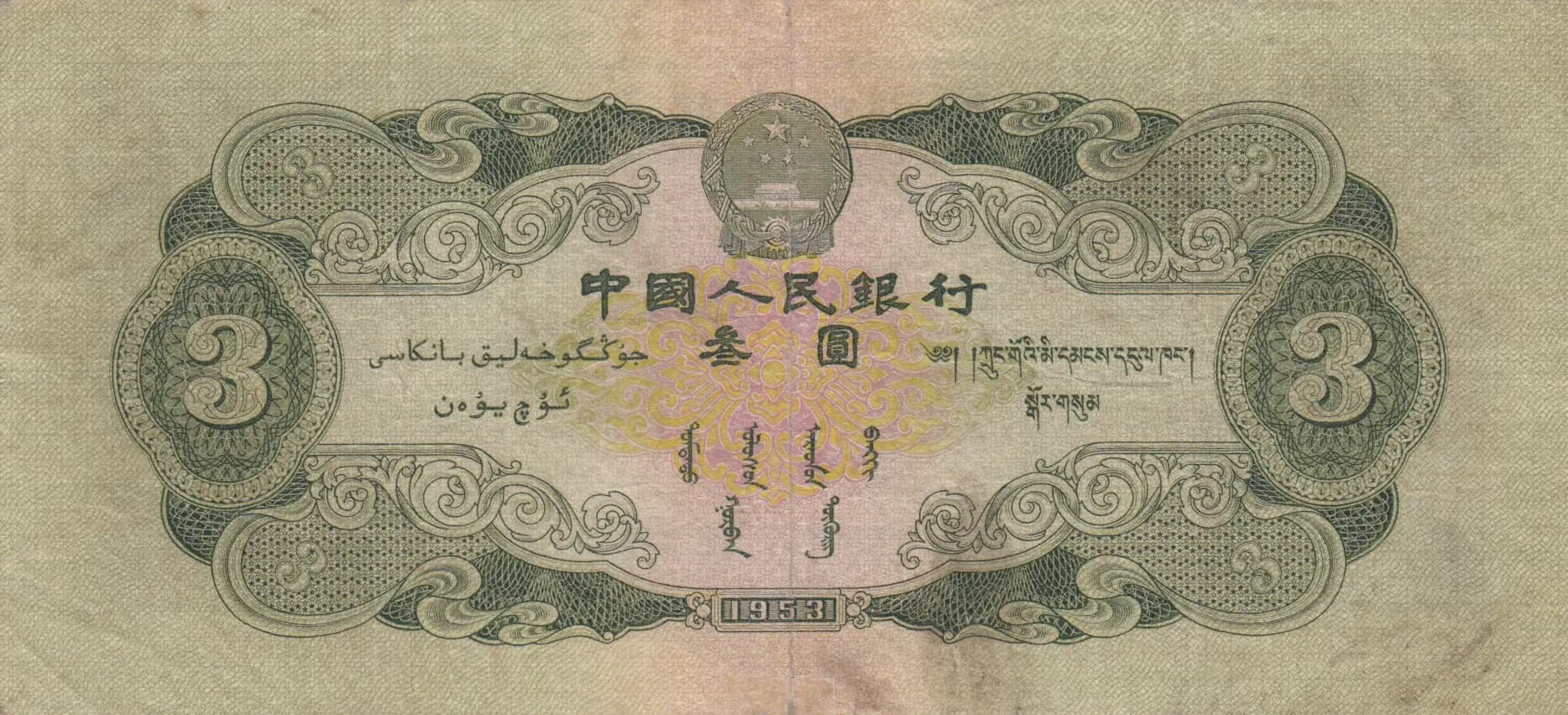
Issued in 1953, just four years after the founding of the People's Republic of China, this banknote reflects the consolidation of the new communist government's monetary authority under the People's Bank of China. The bridge imagery represents traditional Chinese architectural heritage, while the elaborate multi-script design (Chinese, Arabic, and Tibetan) on the reverse demonstrates the early PRC's ideological commitment to representing the diverse ethnic composition of the Chinese nation, particularly the Muslim and Tibetan populations incorporated into the new state.
The obverse depicts a multi-arched stone bridge spanning a waterway with mountainous terrain in the background, a romanticized representation of traditional Chinese engineering and landscape. The bridge is surrounded by ornamental border frames containing Chinese characters in decorative cartouches positioned on the left and right sides. Large denomination numerals '3' appear in the top corners. The reverse displays a highly symmetrical design dominated by elaborate scrollwork and cloud-like decorative motifs in traditional Chinese artistic style, with a circular national emblem (likely the state seal or five-starred emblem of the PRC) centered in a medallion. Large ornamental '3' characters in decorative frames anchor both left and right sides. The multi-script inscription on the reverse—combining Standard Chinese, Arabic, and Tibetan—served both as a security feature and as a statement of inclusive governance.
Front side: '中國人民銀行' (People's Bank of China), '圓' (Yuan), '一九五三年' (Year 1953), 'IVIII130192' (serial number in Latin characters, appearing twice). Back side: '中國人民銀行' (People's Bank of China), '叁圓' (Three Yuan in traditional characters), 'ثلاثة يوان' (Three Yuan in Arabic script), 'དངུལ།' (Currency/Money in Tibetan script), '11953' (year reference in Arabic numerals).
This note was produced using traditional intaglio (engraved) printing combined with letterpress techniques, typical of mid-20th century currency production. The fine line work visible in the ornamental borders and the depth of color saturation in the green and black inks are characteristic of intaglio printing. The multi-script design was executed as a unified engraved plate, demonstrating advanced printing technology. The People's Bank of China's primary security printer during this period was the China Banknote Printing and Minting Corporation, though detailed attribution would require examination of printer marks or archival documentation.
The visual analysis confirms this as S/M number C283-12 per the catalog reference. The serial number observed (IVIII130192) indicates the Latin-character serial variety. The red serial number printing distinguishes this from other print runs that may feature different colors. Without additional comparison examples or printer documentation visible in the images, the specific printing period or printer variety cannot be definitively determined, but the condition and patina suggest this is from an original circulation batch rather than a later reissue. No overprints or obvious secondary varieties are apparent.