250 custom gold units 1930
Market Prices
6 salesAbout This Note
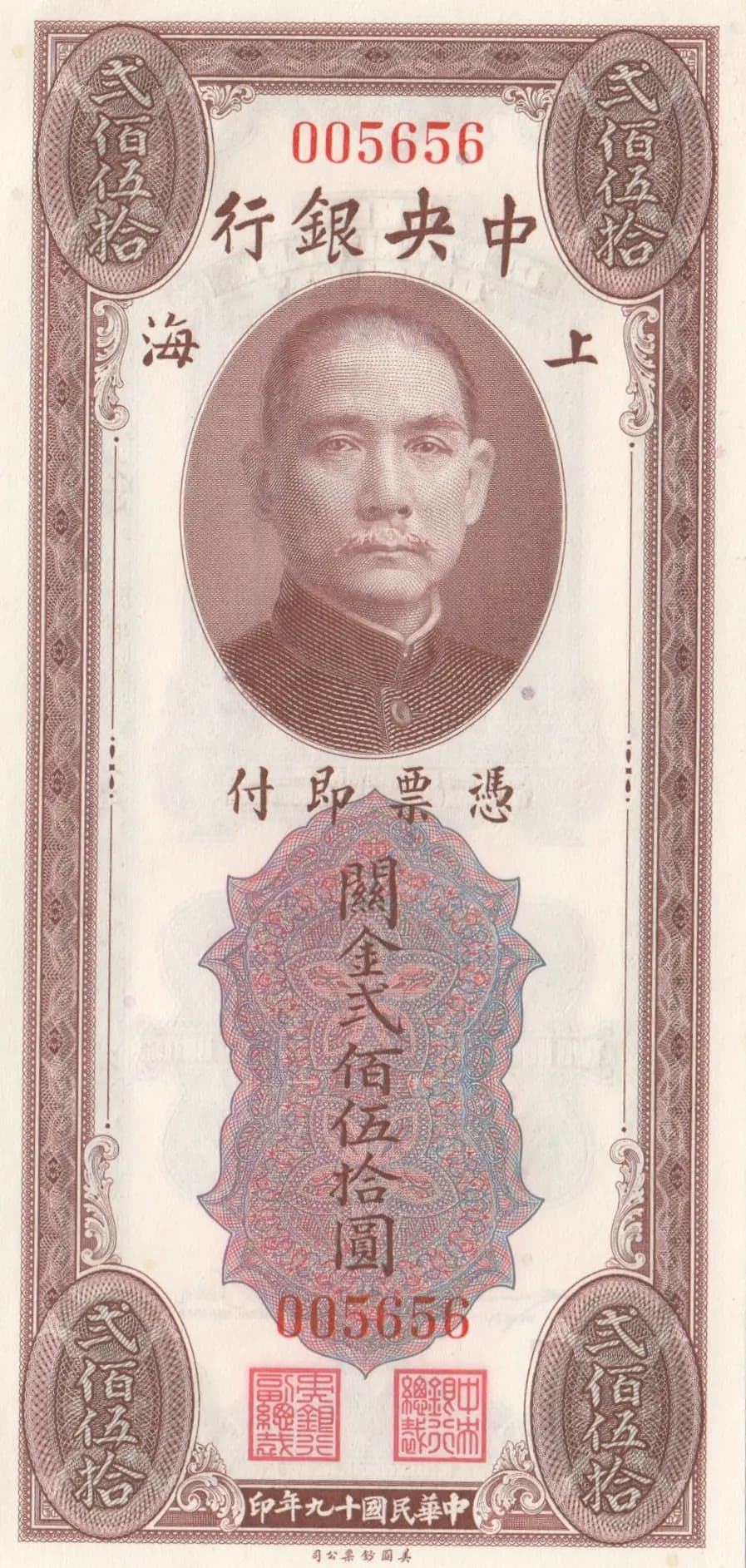
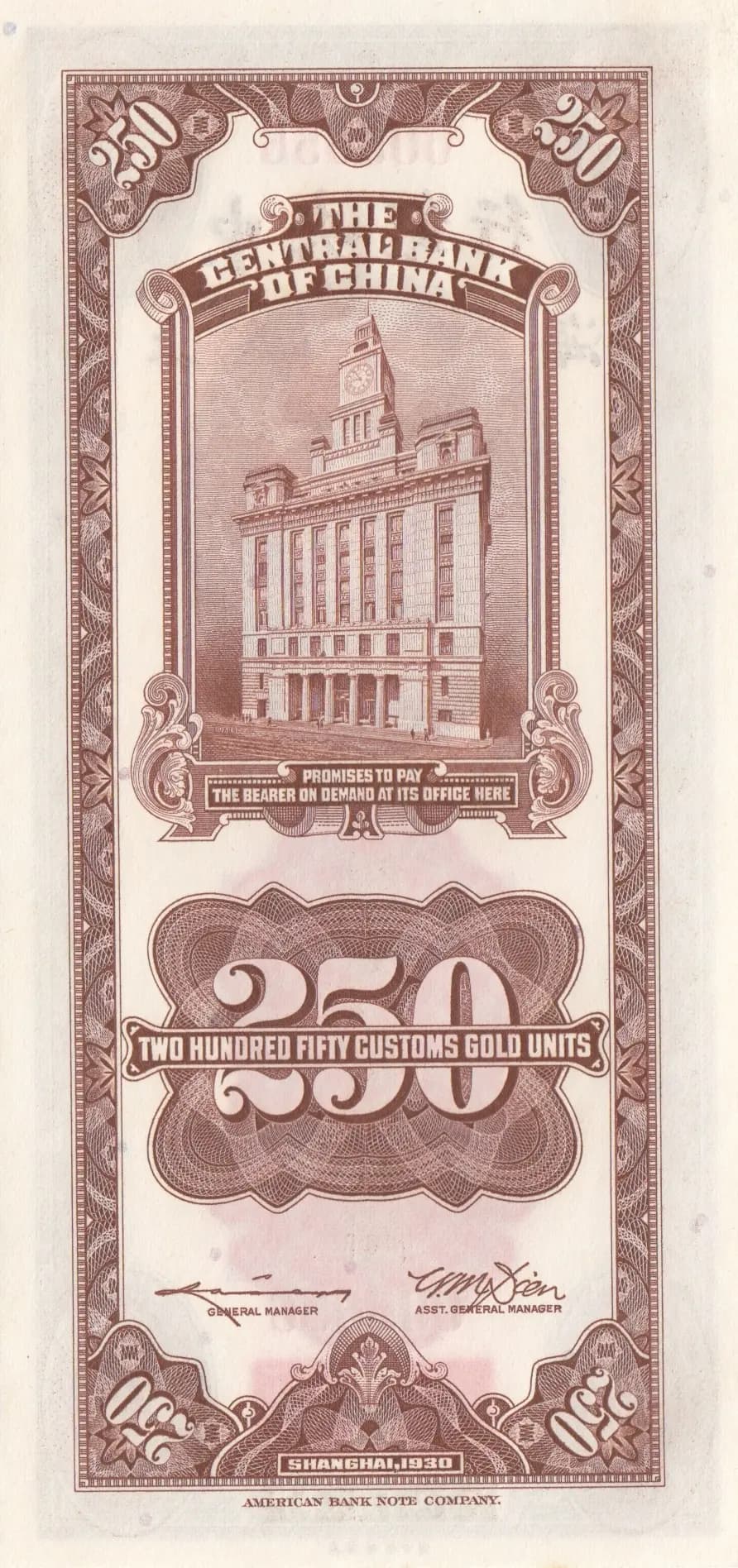
This is a beautifully preserved 1930 Central Bank of China 250 Customs Gold Units note (Pick P-331) in uncirculated condition, printed by the American Bank Note Company. The obverse features a portrait of Sun Yat-sen in traditional formal Chinese dress within a centered oval, surrounded by intricate guilloche patterns and decorative corner medallions, while the reverse displays the imposing headquarters building of the Central Bank in Shanghai with a prominent clock tower. The sharp printing quality, vibrant brown and red color scheme, and complete absence of wear make this an excellent example of early Republican-era Chinese currency design.
Common. While this is a specialized denomination (Customs Gold Units) from a specific year and issuer, the eBay market price data provided demonstrates consistent trading in the $18-93 range depending on condition grade, with UNC examples selling for approximately $35-71 as of 2015-2021. The relatively large number of documented sales over multiple years (at least 6 separate sales recorded) and the affordable price points across all grades indicate this note was printed in sufficient quantity and circulates with moderate frequency in the collector market. The UNC condition grade observed does not command a premium inconsistent with normal supply and demand for early Republican-era Chinese notes of this type.
Issued in 1930 by the Central Bank of China during the early Republic period (marked as Year 20 of the Republic of China, corresponding to 1931 in the Western calendar), this note reflects the modernization efforts of Republican China and its adoption of Western banking practices. The depiction of the Central Bank's Shanghai headquarters on the reverse symbolizes the importance of Shanghai as China's financial center during this era, while the portrait of Sun Yat-sen (the founder of the Republic) on the obverse reinforces the legitimacy and national identity of the issuing authority. The denomination in 'Customs Gold Units' indicates this was part of China's system of currency standardization based on international gold valuation standards during the pre-war Republican period.
The obverse features a formal portrait of Sun Yat-sen (1866-1925), the founding father of the Republic of China, depicted as a middle-aged man with a thin mustache and goatee, wearing formal traditional Chinese clothing with a mandarin collar, positioned centrally within an ornate oval frame. The design is surrounded by symmetrical decorative elements including circular medallions in all four corners containing Chinese characters, fine line guilloche patterns, and ornamental scrollwork typical of ABNC's classical banknote design aesthetic. The reverse showcases the Central Bank of China's headquarters building in Shanghai—a multi-story structure featuring classical Western architectural style with a prominent central clock tower and spire, large arched windows, and an imposing main entrance, rendered in fine architectural detail. The building is presented as a symbol of institutional stability and Western-influenced modernization within the Republican government.
OBVERSE: Central Bank (中央銀行), Shanghai (上海), Currency Note (想票), Republic of China Year 20 (中華民國二十年), Serial Number 005656 (in red, top and bottom). REVERSE: The Central Bank of China, Two Hundred Fifty Customs Gold Units (250), 'Promises to Pay the Bearer on Demand at Its Office Here', General Manager and Assistant General Manager (signature lines), Shanghai, 1930, American Bank Note Company. The note employs both Chinese characters on the obverse and English on the reverse, reflecting the bilingual nature of official Republican-era Chinese currency.
Intaglio (line engraving) on a steel or copper plate, the standard method employed by the American Bank Note Company (ABNC) for high-security currency production. The visual analysis confirms characteristic features of intaglio printing: fine line work throughout, intricate guilloche patterns, precise portraiture with subtle tonal gradations achieved through line density variation, detailed architectural rendering with dimensional depth, and the sharp, crisp impression visible in both the portrait and building elements. Red serial numbers were applied as a separate operation, likely through letterpress or secondary intaglio printing. The multicolor composition was achieved through multiple plate passes or color separation techniques standard to ABNC's operations in this period.
Based on the visual analysis, this note exhibits serial number 005656 in red ink on both obverse and reverse, indicating it is an early issue from the printing run (low serial numbers, though not the absolute lowest). The specific variety characteristics—Shanghai location, 1930 date, English/Chinese bilingual design, and ABNC imprint—align with the standard P-331 designation. No major varieties (such as overprints, signature variations, or date variants) are apparent from the visual inspection. The note represents the standard printing of this denomination without known scarce varieties documented in the Pick catalog for this specific issue.