250 0000 custom gold units 1948
Market Prices
About This Note
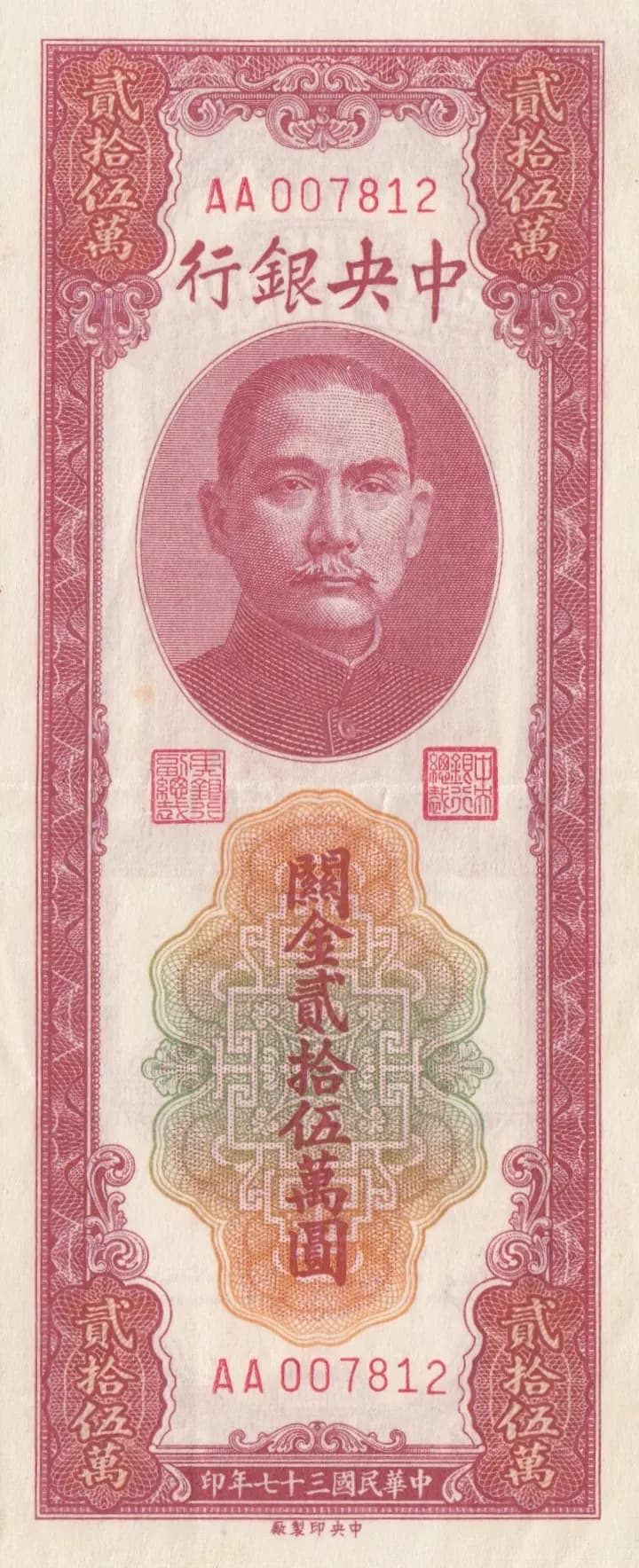
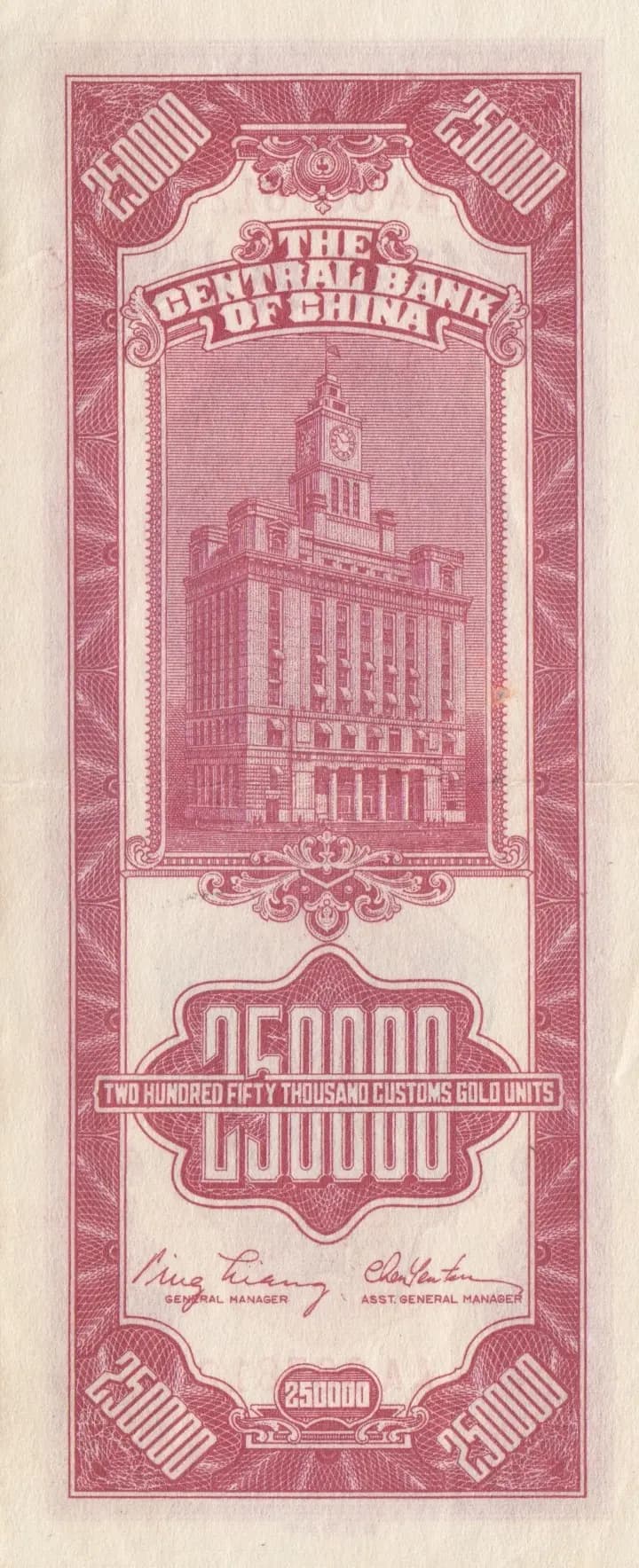
This is a stunning example of the Central Bank of China's 250,000 Customs Gold Units note from 1948, presented in exceptional uncirculated condition with sharp printing and pristine surfaces. The note features a dignified portrait of Sun Yat-sen in the center of the obverse, surrounded by ornate pink and cream decorative elements, while the reverse showcases the classical architecture of the Central Bank building. This particular specimen exhibits no wear, creases, or stains, making it an attractive example of late-period Chinese currency from the turbulent final years of the Republic era.
common
Issued in 1948 during the final year of the Chinese Republic before the Communist takeover, this note represents a period of extreme hyperinflation and currency instability in China. The denomination in 'Customs Gold Units' reflects an attempt by the Central Bank to stabilize currency by backing notes with gold equivalents, though such efforts ultimately proved futile as the currency collapsed within months. The prominence of the Central Bank building on the reverse and the formal bilingual English/Chinese inscriptions demonstrate China's international banking aspirations during this era, even as the political situation rapidly deteriorated.
The obverse features a formal oval portrait of Sun Yat-sen (founder of the Chinese Republic), rendered in traditional engraving style, positioned centrally and surrounded by ornamental scrollwork, floral motifs, and red square seals bearing Chinese characters on either side. The design employs a vertical format with elaborate corner ornaments and traditional Chinese geometric border patterns. The reverse depicts the Central Bank of China's institutional building—a multi-story structure with classical Western architectural features including distinct window arrangements and formal entrance—rendered as the central focal point. Large decorative cartouches frame the denomination numerals '250000' at bottom, with the entire composition unified by the pink/rose and cream color scheme and fine line engraving throughout, creating an aesthetically balanced and professionally executed banknote design.
OBVERSE: '中央銀行' (Central Bank) appears at top; serial number 'AA007812' at top and bottom in red; '閏金壹拾萬圓國' (Gold Units, denomination text) in traditional Chinese characters; '民國七十二年' (Year 72 of the Republic, corresponding to 1948 in the Chinese calendar). REVERSE: 'THE CENTRAL BANK OF CHINA' in English at top; '250000' (denomination numeral) appears twice; 'TWO HUNDRED FIFTY THOUSAND CUSTOMS GOLD UNITS' in English specifying the denomination; 'GENERAL MANAGER' and 'ASST. GENERAL MANAGER' indicate signature lines for bank officials.
This note was produced using intaglio (recess engraving) printing, evident from the fine line work visible in both the portrait, building illustration, and decorative borders. The multiple color printing (pink, cream, red, and black) indicates sequential multi-plate color intaglio printing, a standard security printing technique of the era. The precise registration and sharp definition of all design elements, combined with the intricate geometric patterns and fine linescreen details, are characteristic of professional security printing by China's central bank printing facilities during the 1948 period.
The serial number prefix 'AA007812' in red indicates a standard issue specimen. No overprints, date variations, or signature varieties are visible on this example that would distinguish it as a rare variety. The note appears to be a standard printing of the regular 1948 issue with no evidence of emergency measures, military overprints, or regional variants that would create a distinct cataloged variety.