2000 yuan 1942
Market Prices
24 salesAbout This Note
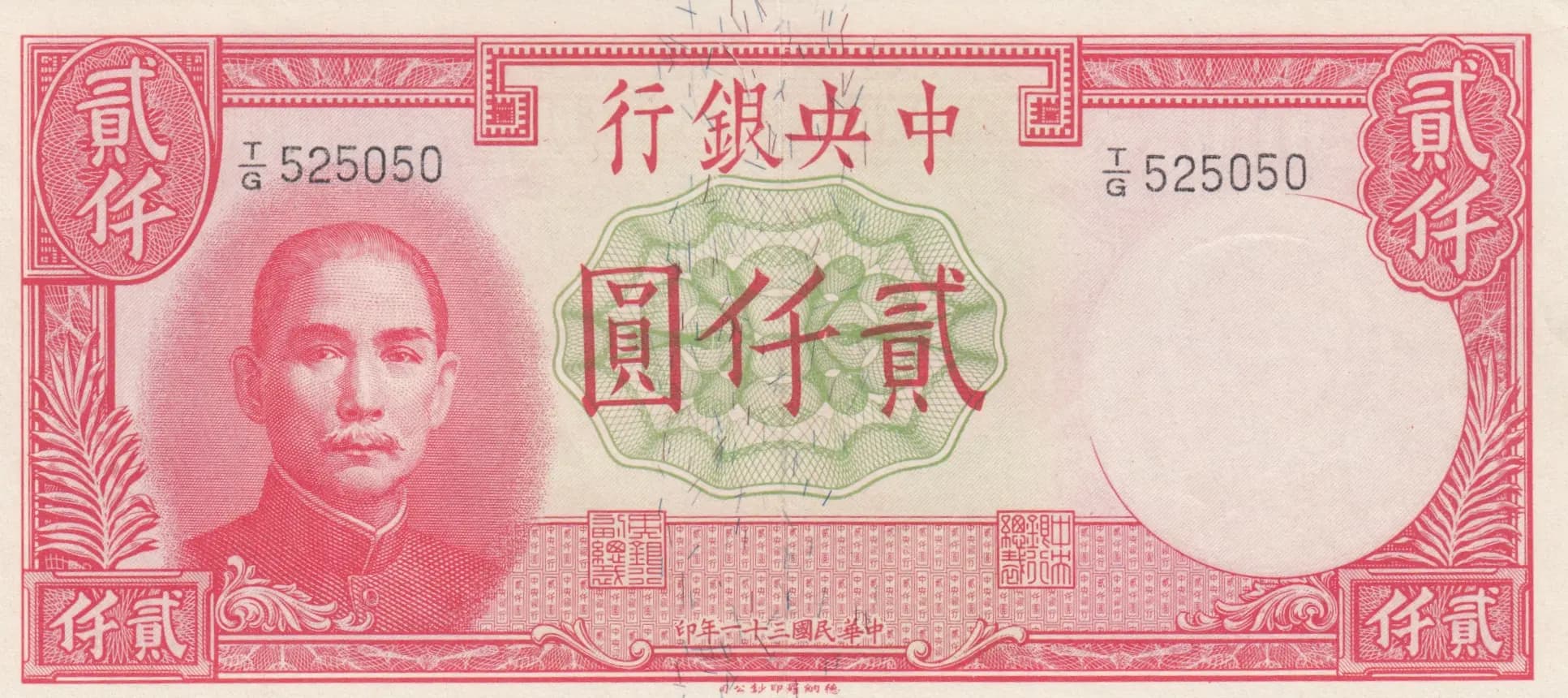
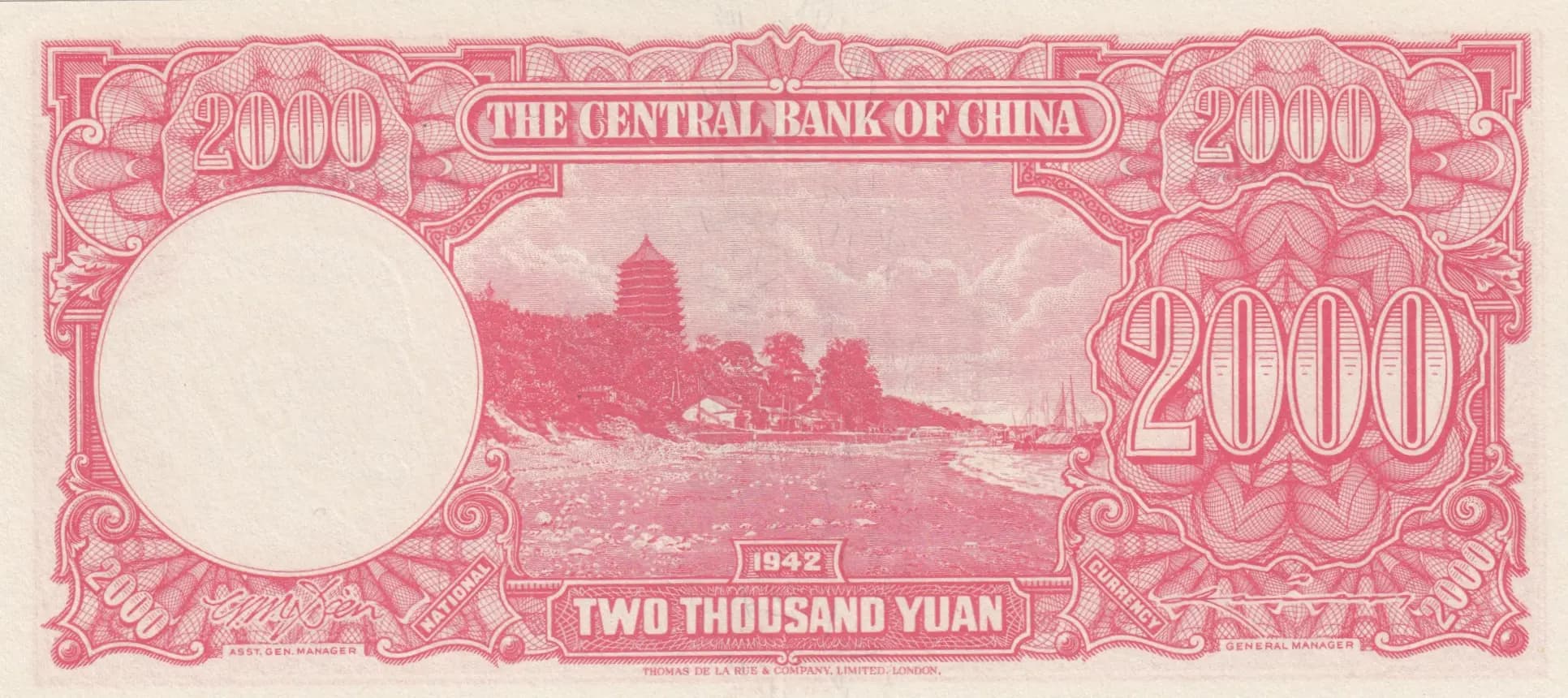
This is a China Central Bank 2000 Yuan note from 1942 (Pick P-253), graded in Extremely Fine condition. The note displays vibrant pink-red coloring with intricate engraving throughout, featuring a portrait of a dignitary on the obverse and a scenic pagoda landscape on the reverse. While some handling marks and pencil annotations are visible on the front, the overall preservation is excellent with sharp detail and strong color retention typical of high-grade examples of this denomination.
Common. Despite its historical significance and wartime origin, this denomination and Pick number appear regularly in the market. eBay sales data spanning from 2010 to 2026 shows consistent availability across all condition grades, with EF-grade examples selling in the $5-$13 range and UNC examples reaching $44-$46. The catalog value for UNC is listed at only $8, and the consistent supply of examples in the secondary market indicates this was a standard issue with adequate print runs. No evidence of rarity or recall status appears in available numismatic records.
This 2000 Yuan note was issued during Japan's occupation of China in World War II, representing the Central Bank of China's continued monetary authority in Nationalist-controlled territories. The pagoda depicted on the reverse serves as a symbol of Chinese cultural heritage and architectural tradition, while the formal portraiture on the obverse reflects the governmental authority attempting to maintain financial stability during wartime. The English-language text and London printer attribution (Thomas De La Rue & Company) illustrate the international banking relationships maintained by the Chinese government during this turbulent period.
The obverse features a formal portrait of a Chinese governmental official in military-style dress uniform with high collar, positioned at the left side of the note. The figure is surrounded by ornate decorative elements including oval medallions bearing Chinese characters in all four corners, floral and plant motifs along the lateral edges, and an elaborate framing system with guilloche patterns. The center is dominated by a green cartouche containing red characters denoting the denomination. The reverse depicts a scenic landscape with a traditional Chinese pagoda structure positioned on a hillside overlooking a water body, with vegetation and ancillary buildings rendered in fine detail. The borders on both sides feature repeated denomination numerals and intricate decorative scrollwork characteristic of British security printing standards.
Front: '中央銀行' (Central Bank of China), '國民政府' (National Government), '貳仟圓' (Two Thousand Yuan), Serial number 'G 525050' (appearing twice). Back: 'THE CENTRAL BANK OF CHINA', 'TWO THOUSAND YUAN', '2000' (denomination numerals, repeated in corners), '1942' (issue year), 'GENERAL MANAGER', 'ASST.GEN.MANAGER' (signature titles), 'THOMAS DE LA RUE & COMPANY, LIMITED, LONDON' (printer attribution).
This note was produced using intaglio engraving and multi-color letterpress printing techniques by Thomas De La Rue & Company, Limited, of London—one of the world's premier security printers. The fine line engraving is evident throughout the design, particularly in the portrait detail, landscape rendering, and elaborate guilloche border work. The color separation technique employed results in the distinctive pink-red base color with green accents on the obverse, demonstrating the sophisticated multi-plate printing capabilities of the era.
The observed specimen displays serial number 'G 525050' and appears to be from a standard printing run. No overprints, red/blue seals, or other known major varieties are evident in the visual analysis. The signature lines for 'General Manager' and 'Assistant General Manager' positions are present but specific signatory identification would require specialist knowledge. Standard varieties for this Pick number may include different serial number prefixes or signature combinations, but the provided visual analysis does not indicate deviation from the regular type.