200 yuan 1949
Market Prices
11 salesAbout This Note
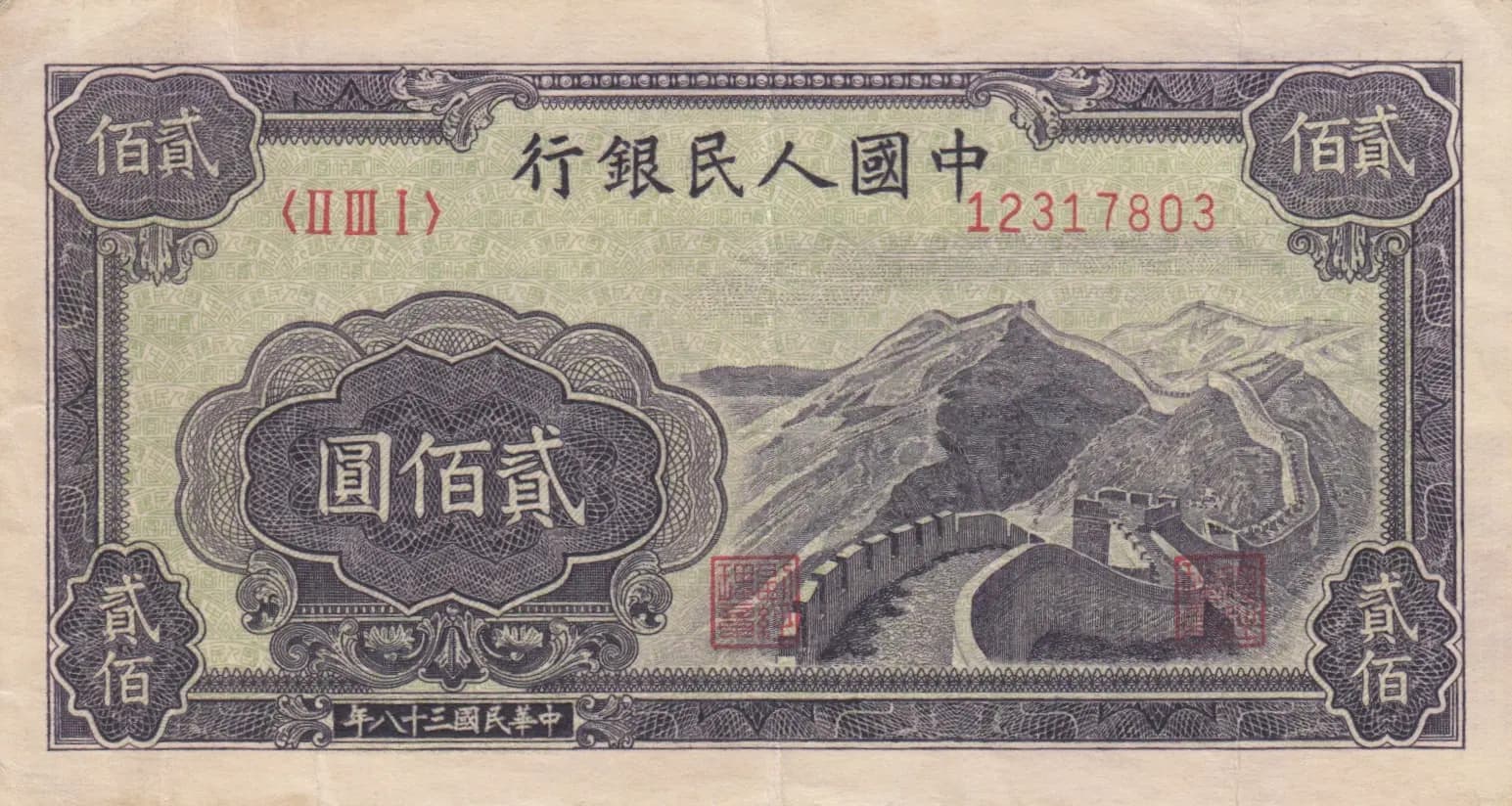
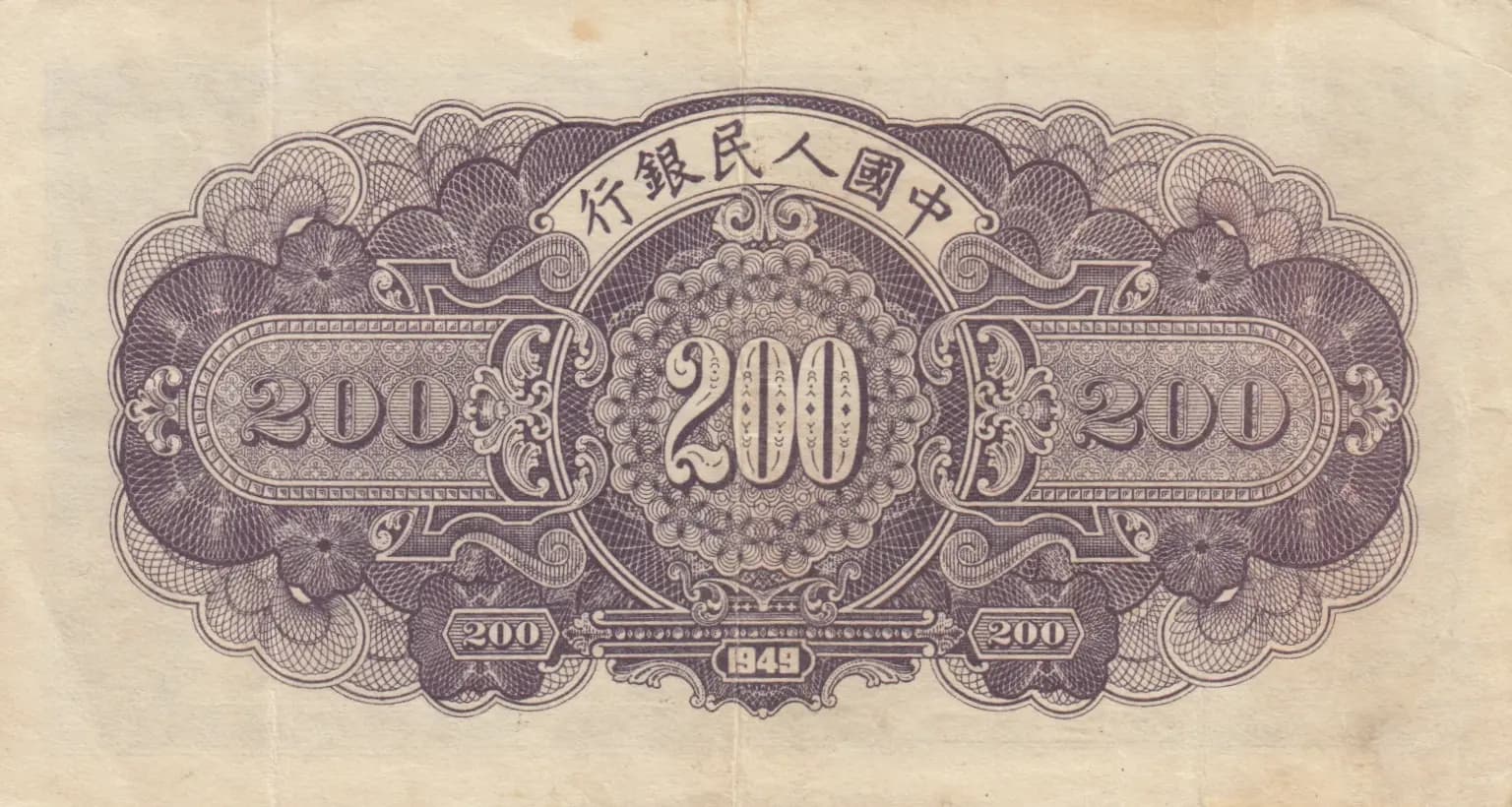
This is a 200 Yuan note from 1949 issued by the People's Bank of China, featuring the iconic Great Wall depicted across a mountainous landscape on the obverse. The note displays excellent preservation with sharp engraving detail, ornate baroque-style decorative elements, and the characteristic purple-on-cream color scheme typical of early PRC currency. In VF condition, this note represents a significant piece of early Communist Chinese numismatic history, with the reverse displaying an ornate medallion prominently featuring the denomination.
Common. Despite being from 1949, this denomination appears regularly in the collector market based on eBay transaction data showing consistent sales activity across multiple grade levels from 2015-2022. Current catalog valuations (2016) position VF examples at $70, with even lower grades (VG at $15) indicating substantial production volumes. The note is not from a recalled series, a short-lived issuer, or known to have had limited print runs. eBay price data shows regular availability with 3-55 bids per sale, typical of common collectible banknotes.
Issued in 1949, this banknote represents the earliest currency of the newly established People's Republic of China under Communist control. The prominent depiction of the Great Wall—a symbol of Chinese national identity and strength—served as a powerful nationalist symbol for the new regime. The inscriptions in Traditional Chinese characters and the design aesthetic reflect the transitional period between the Republic of China era and the consolidation of PRC monetary authority.
The obverse features a detailed engraved landscape of the Great Wall of China winding through mountainous terrain with fortification buildings and peaks, rendered in purple and dark gray tones on a cream background. A large ornate cloud-shaped cartouche in the center-left contains Chinese characters within a decorative frame, flanked by baroque-style corner ornaments and elaborate scrollwork border patterns throughout. The reverse displays a symmetrical design with a prominent central oval medallion containing fine-line engraving, with the denomination '200' repeated in rectangular cartouches on both sides and additional baroque floral and scrollwork ornamentation. The overall aesthetic combines traditional Chinese decorative motifs with Western baroque design elements characteristic of early PRC currency design.
Front Side: '中國人民銀行' (People's Bank of China), '壹佰圓' (One Hundred Yuan - note this appears to be a discrepancy with the catalog denomination of 200 Yuan), '中華民國四十二年' (Republic of China Year 42, corresponding to 1953 in the ROC calendar), '(II III I)' (Series designation), '12317803' (Serial number). Back Side: '中國人民銀行' (People's Bank of China), '200' (Arabic numeral denomination appearing three times in prominent cartouches), '1949' (Year designation).
Intaglio engraving (line engraving) is the primary printing method, evidenced by the intricate fine-line work visible throughout both sides, the complex decorative border patterns with sharp detail, and the crisp quality of the engraving noted in the condition observations. This was the standard security printing technique employed by the People's Bank of China for early banknote production. The specific printer for this Pick number is not documented in the available catalog data, though early PRC notes were produced by domestic and Soviet-assisted printing facilities.
Series designation '(II III I)' is noted on the obverse. Serial number 12317803 is visible. The note carries the Pick catalog number P-838A, with the 'A' suffix indicating a specific variety within the 200 Yuan 1949 issue. Early PRC 200 Yuan notes are known to exist in multiple series variants, and this particular serial number range may help identify the specific printing batch or security printer used. No overprints or other modifications are noted in the visual analysis.