20 coppers 1936
Market Prices
About This Note
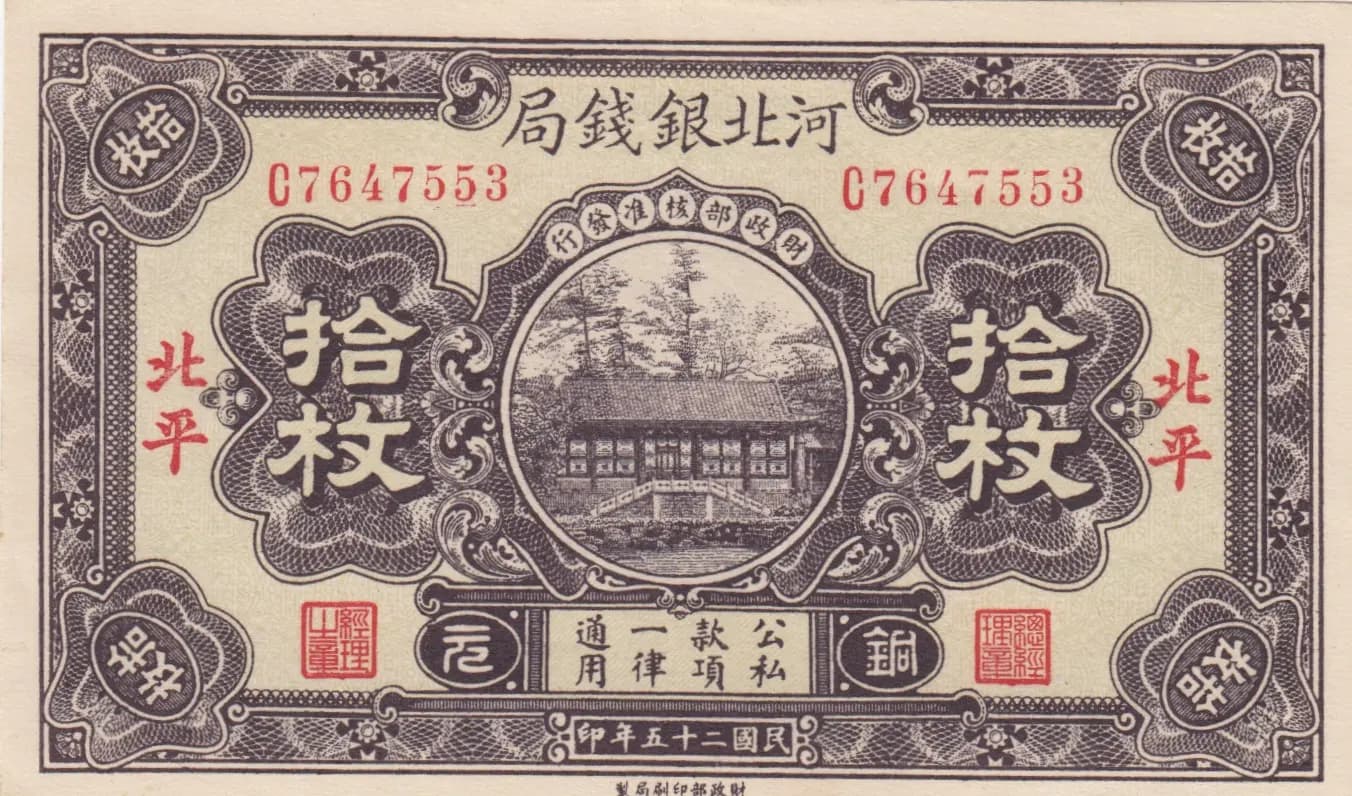
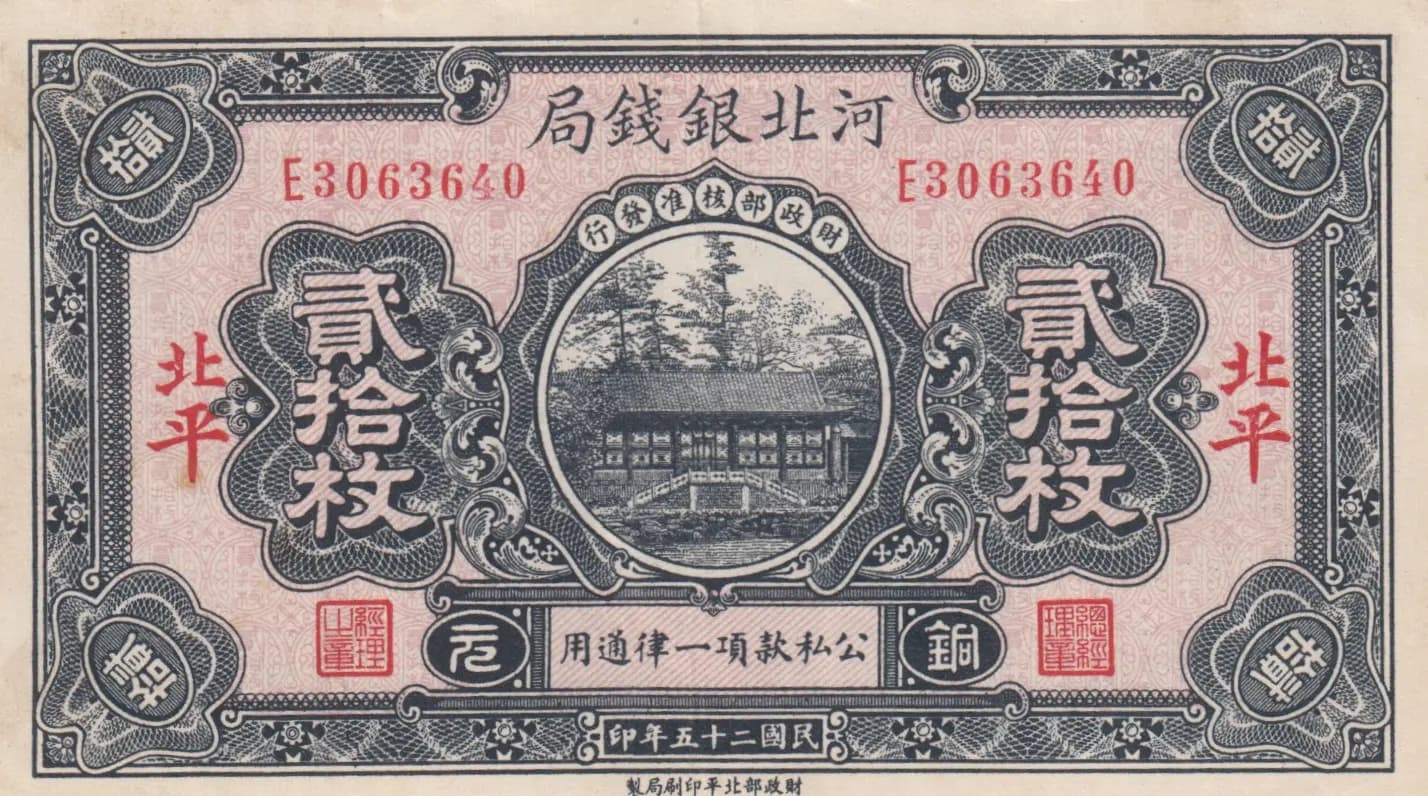
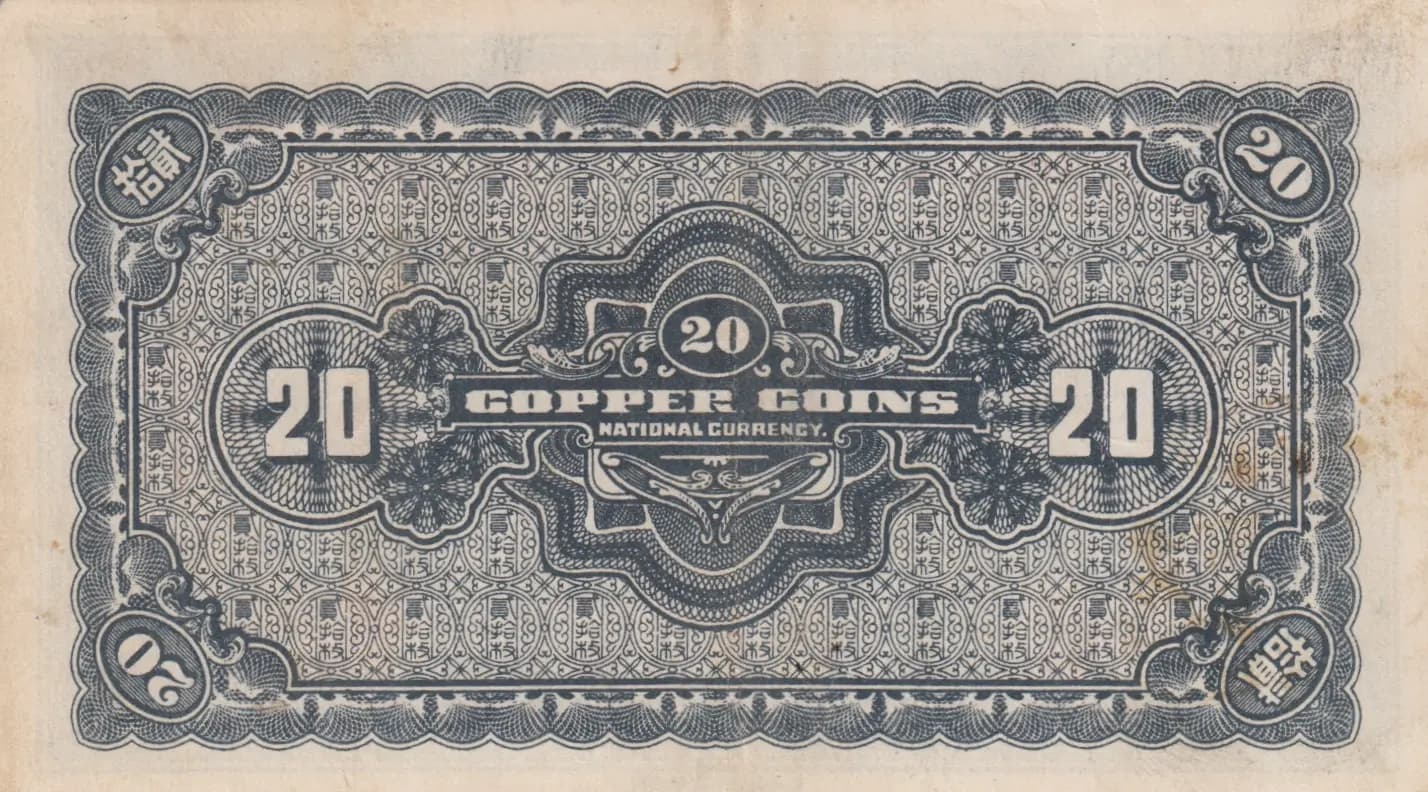
A handsome example of the 1936 Hopei Metropolitan Bank 20 Coppers note in EF condition, featuring an elegant light pink obverse with intricate dark engraving and a central circular vignette of a traditional East Asian pavilion structure. The reverse presents a sophisticated all-over repeating pattern design in black on cream, with prominent denomination numerals and bilingual English-Chinese inscriptions. This note showcases the refined aesthetic standards of early Republican-era Chinese regional banking currency and remains well-preserved with intact margins and only light age-related toning.
Common. While the eBay pricing data shows considerable range ($49.99 to $950.00), the majority of sales cluster in the $60–$200 range across multiple condition grades (F, VF, AU). The EF-graded examples shown ($148 AU pricing) fall well within typical market activity for this standard regional issue. The Hopei Metropolitan Bank was a legitimate and relatively substantial issuer for its region, and this denomination was produced in sufficient quantities to remain accessible to collectors. The wide price range reflects normal market volatility and variation by precise condition grade rather than inherent scarcity.
Issued during the waning years of the Republic of China's early period (the inscription references year 52 of the Republic, corresponding to 1936), this note represents the Hopei Metropolitan Bank's authority to issue local currency in the Beijing region during a period of significant political fragmentation. The depicted traditional architectural structure and formal design reflect the cultural continuity maintained during this transitional era, while the bilingual English-Chinese inscriptions underscore the modernizing financial standards of early 20th-century Chinese banking institutions.
The obverse features a classical ornamental border with four corner coin designs (circular motifs with square centers characteristic of traditional Chinese coinage symbolism) and elaborate scrollwork framing. The central vignette depicts a traditional Chinese pavilion or temple structure with multi-tiered roofing and surrounding landscaping elements, rendered in fine line engraving. Red official seals flank the bottom, signifying authorization. The reverse employs a dense, all-over repeating pattern of small circular emblems with Chinese characters as a background security measure, flanked by ornamental fan or palm frond designs containing the denomination. The scalloped decorative border frames the composition professionally, with English and Chinese text clearly denoting the denomination and legal tender status.
FRONT: 河北银钱局 (Hopei Metropolitan Bank / Hebei Bank of Coins Bureau); 北平裁定 (Beijing Decision/Approval); 民國五十二年印製 (Printed in Year 52 of the Republic [1936]); 公欠款一項律通用 (Public Debt, Legal Tender); 銅幣 (Copper Coins); Serial number E3063640 in red. BACK: '20' (denomination, bilateral); 'COPPER COINS' (English denomination); 'NATIONAL CURRENCY' (English legal tender designation); 圓 (Yuan, currency unit).
Intaglio engraving (recess printing), characteristic of security printing for currency of this era. The BEPP printer (identified in catalog reference as S/M #H63-21) employed traditional steel plate engraving for both obverse and reverse, evidenced by the fine line work, ornamental detailing, and the deeply impressed nature of the designs visible in the images. The precise reproduction of repeating security patterns on the reverse demonstrates the sophisticated capabilities of early 20th-century Chinese currency printing facilities.
The observed serial number E3063640 places this note within the documented production range for this issue. No obvious overprints, date variations, or signature variants are evident in the visual analysis. The Pick catalog assignment P-S1710E indicates this is the standard regular-issue variety. The note matches the cataloged description (dark blue on pink obverse, black reverse) and bears all expected design elements for the standard type. No unusual serial number prefixes or specialized varieties appear to be present in this example.