10 coppers 1936
Market Prices
1 saleAbout This Note
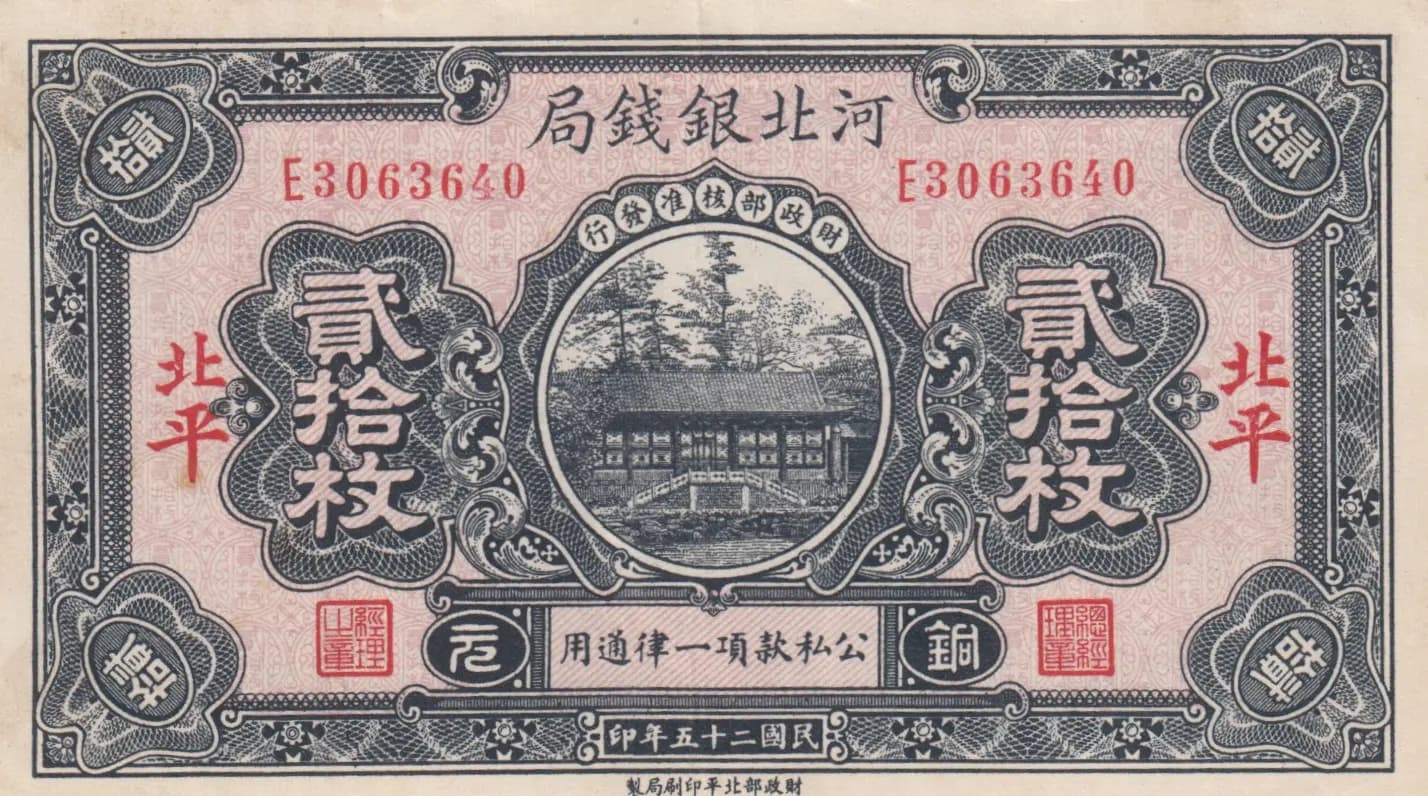
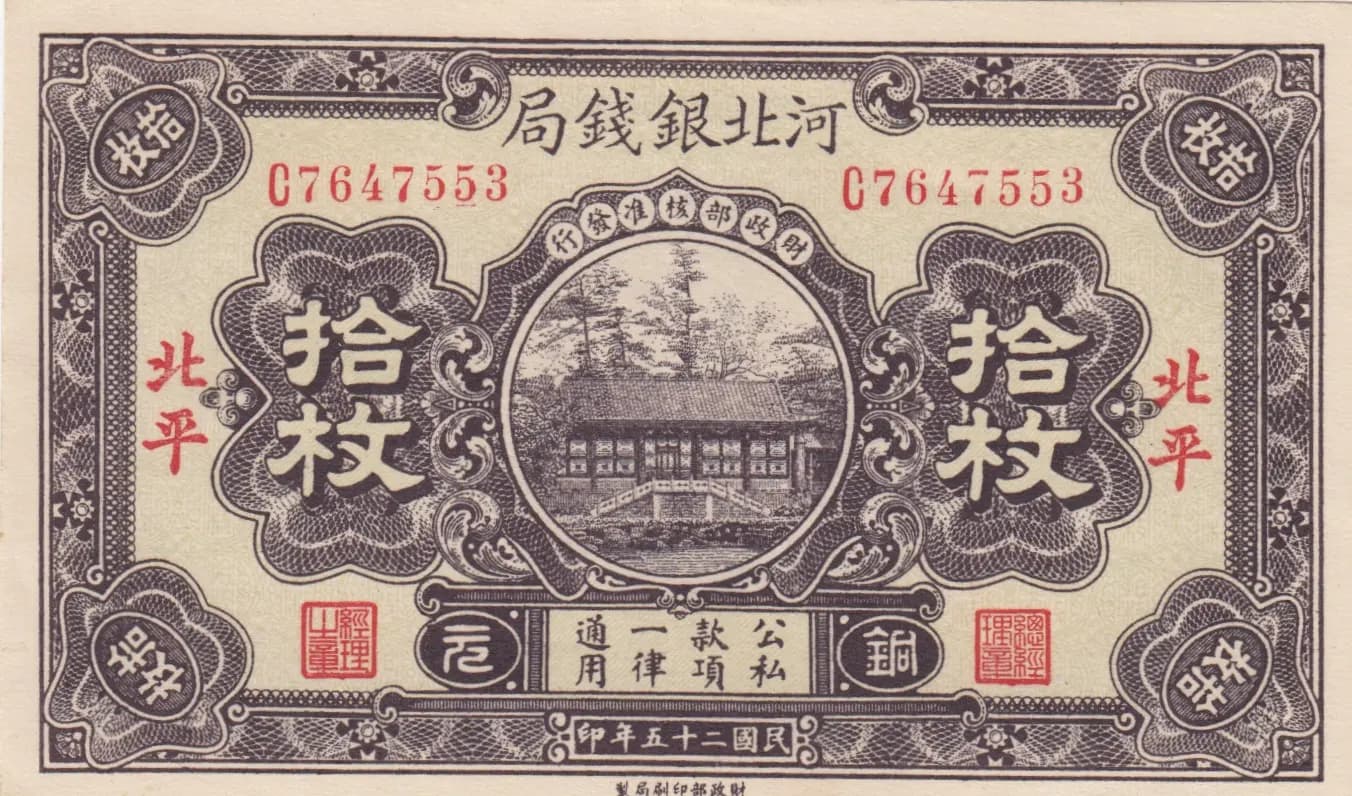
This is an exceptionally preserved example of the 1936 Hopei Metropolitan Bank 10 Coppers note (Pick S1710D) in UNC condition. The note features an ornate traditional Chinese design with a central architectural vignette of a tea house behind a bridge, rendered in purple ink on a cream/beige background with elaborate decorative borders incorporating floral and geometric patterns. The pristine state with sharp printing, no creases or foxing, and vibrant color retention makes this an excellent example of early Chinese regional currency from the Republican period.
Common. The eBay market data shows a VF specimen sold for $29 in May 2025, indicating modest collector interest and steady availability. While regional Chinese banknotes from this period have niche collector appeal, this particular note from the Hopei Metropolitan Bank does not appear in standard references as having a severely restricted print run or short issuance period. UNC examples command a modest premium over circulated grades, but the denomination and issuer remain within normal market availability for early Republican-era regional currency. No evidence of recall, emergency issue status, or extreme rarity appears in the catalog data or market activity.
Issued in 1936 by the Hopei Metropolitan Bank during the Chinese Republic (民國) period, this note reflects the era of regional banking autonomy before Japanese occupation and the Second Sino-Japanese War. The imagery of Beiping (Beijing/北平) and the depiction of traditional architecture emphasizes local civic identity and cultural continuity, while the bilingual English-Chinese inscriptions indicate the cosmopolitan commercial environment of 1930s northern China. The note's relatively modest denomination in copper coins represents the fractional currency tier essential for daily commerce in an economically developing region.
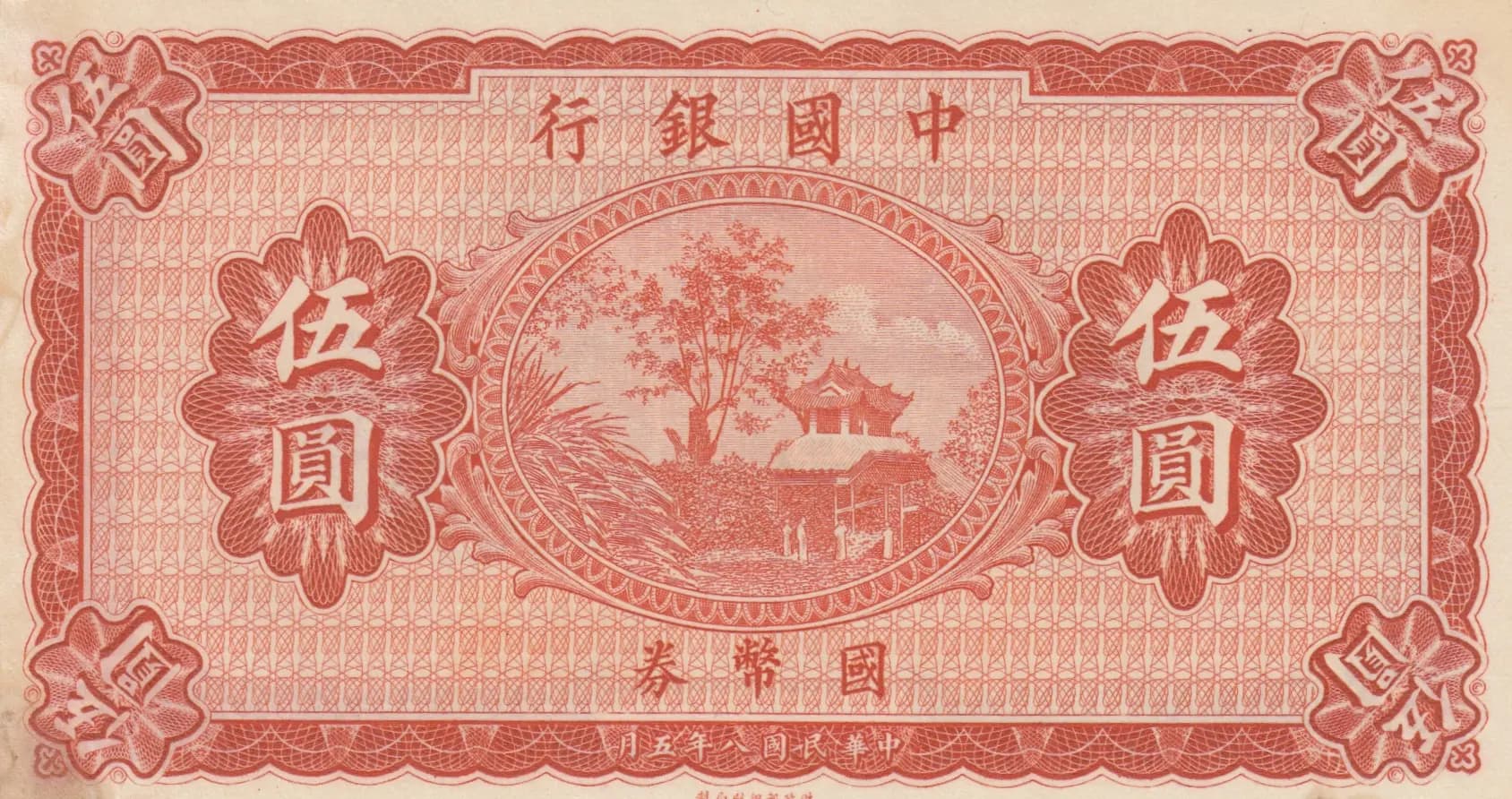
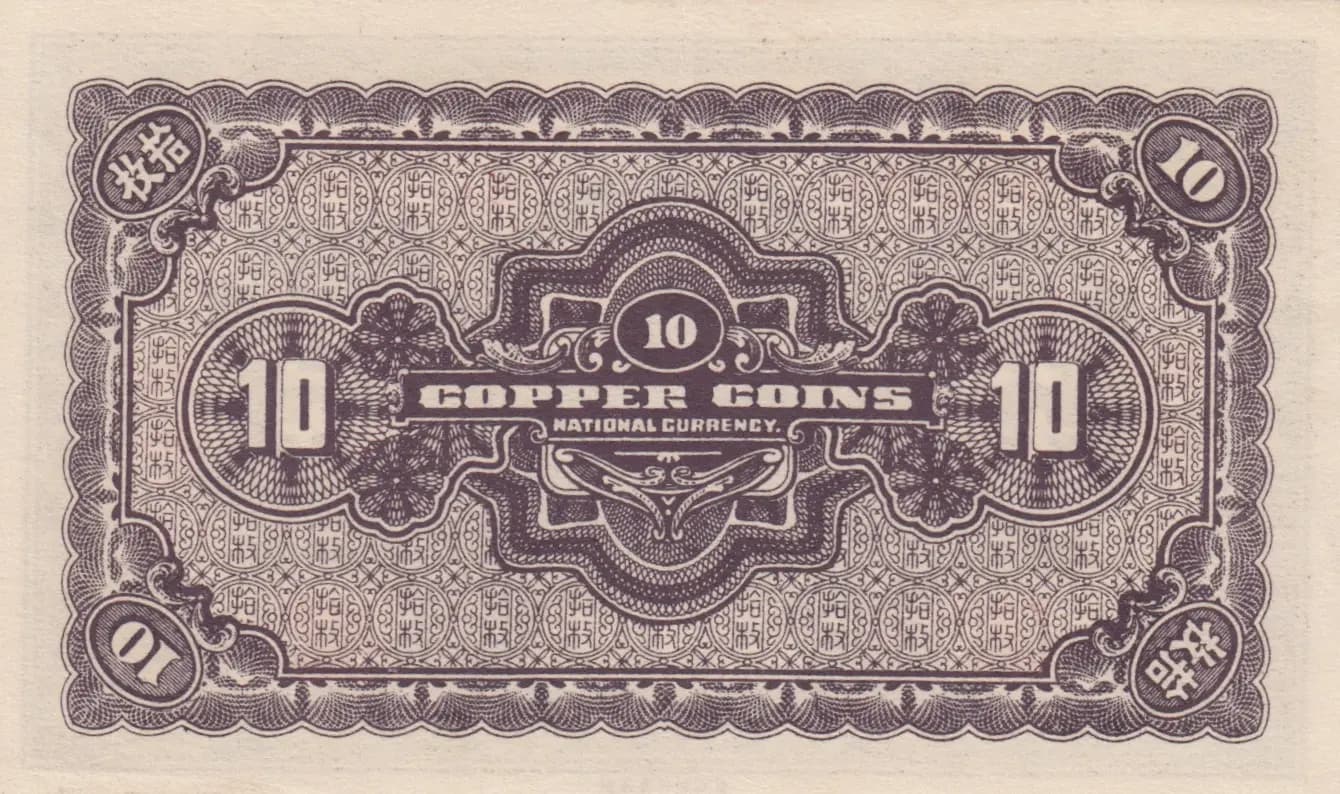
The obverse features a symmetrical, ornate design centered around a circular vignette depicting a traditional Chinese tea house structure with multiple windows and a central entrance, positioned behind an arched bridge—a romanticized representation of Beiping's cultural heritage. The composition is framed by elaborate scalloped and geometric border work in traditional Chinese style, with decorative circular floral emblems positioned in all four corners. Red square seals bearing Chinese characters and red serial numbers in the upper portion provide authentication elements. The reverse maintains strict symmetry with large decorative fan or shell-shaped corner motifs, a repeating background pattern of circular emblems containing Chinese characters, and a central cartouche containing the bilingual denomination '10 COPPER COINS' and 'NATIONAL CURRENCY' in English. Throughout both sides, fine scrollwork, stylized cloud patterns, and traditional ornamental flourishes demonstrate the high decorative standards of early 20th-century Chinese note design.
Front side: 河北銀行局 (Hebei Bank Bureau/Hopei Metropolitan Bank); 北平 (Beiping/Beijing); 十 and 拾 (both meaning 'ten'); 通用 (general use/in circulation); 私公 (public and private); Serial number: 07647553; Republican dating reference visible. Back side: '10 COPPER COINS' (English denomination); 'NATIONAL CURRENCY' (English authority); Chinese character 華 visible in corner medallions. The front also contains regulatory text referencing the 'ten items regulation' (一款十律項) and 'Republic year 52' (國民五十二印, corresponding to 1936 in the Chinese Republican calendar).
This note was produced using intaglio/engraved line printing, as evidenced by the exceptionally fine detail visible in the border work, geometric patterns, and architectural vignette. The catalog reference identifies BEPP (Beijing Engraving and Printing Plant or similar Beijing-based security printer) as the printer. The multi-color effect (purple/dark brown on cream/beige) with red accent printing for serial numbers and seals suggests a multi-pass printing process typical of high-security banknote production of the 1930s. The intricate background patterns, fine line work, and complex ornamental details are characteristic of engraved security printing designed to prevent counterfeiting.
The specific variety can be identified as Pick S1710D (as cataloged), with serial number 07647553 visible on this example. The note exhibits the standard design of this issue with no apparent overprints, watermark variants, or signature varieties visible in the visual analysis. The printer attribution to BEPP and the denomination designation (S/M #H63-20 per RealBanknotes reference) provide precise identification. No secondary varieties (such as different printer marks, date variants, or signature combinations) are evident from the images provided; this appears to be a standard production example from the single main printing of this denomination and issuer.