20 cents 1935
Market Prices
About This Note
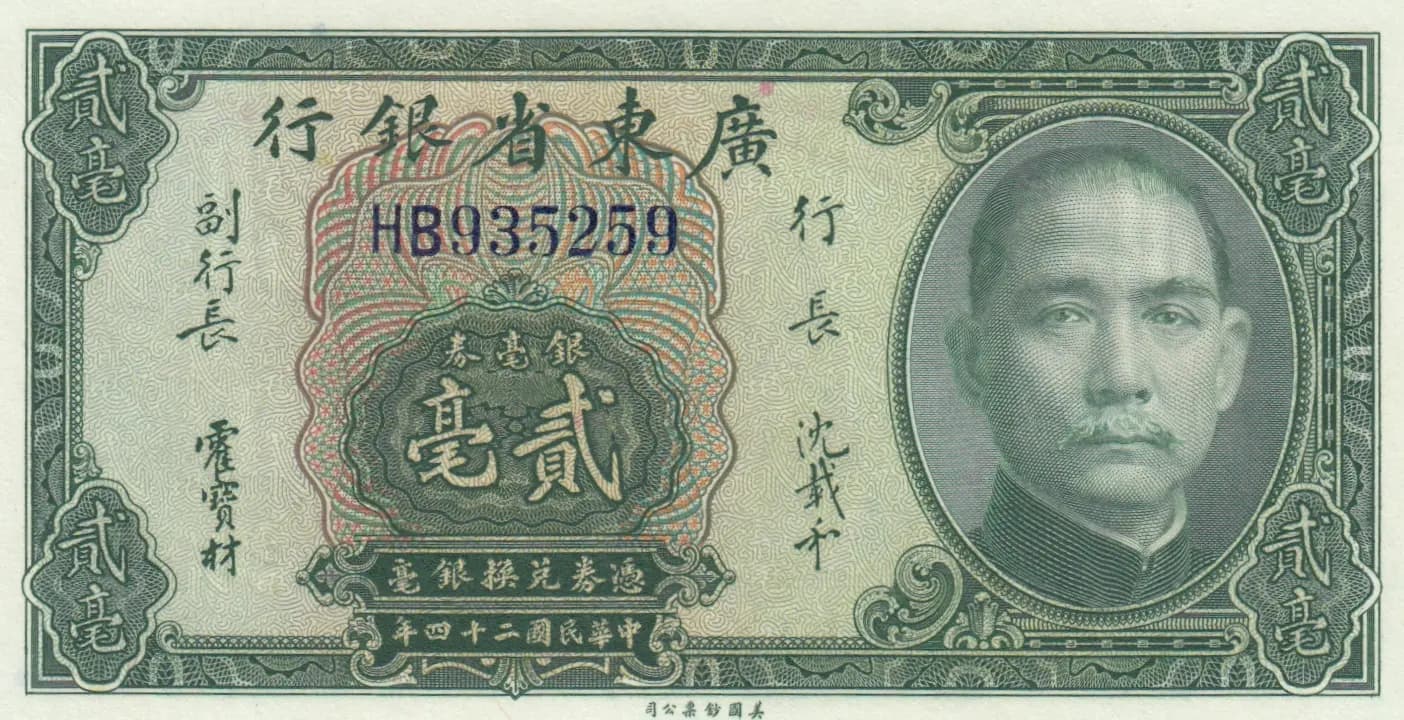
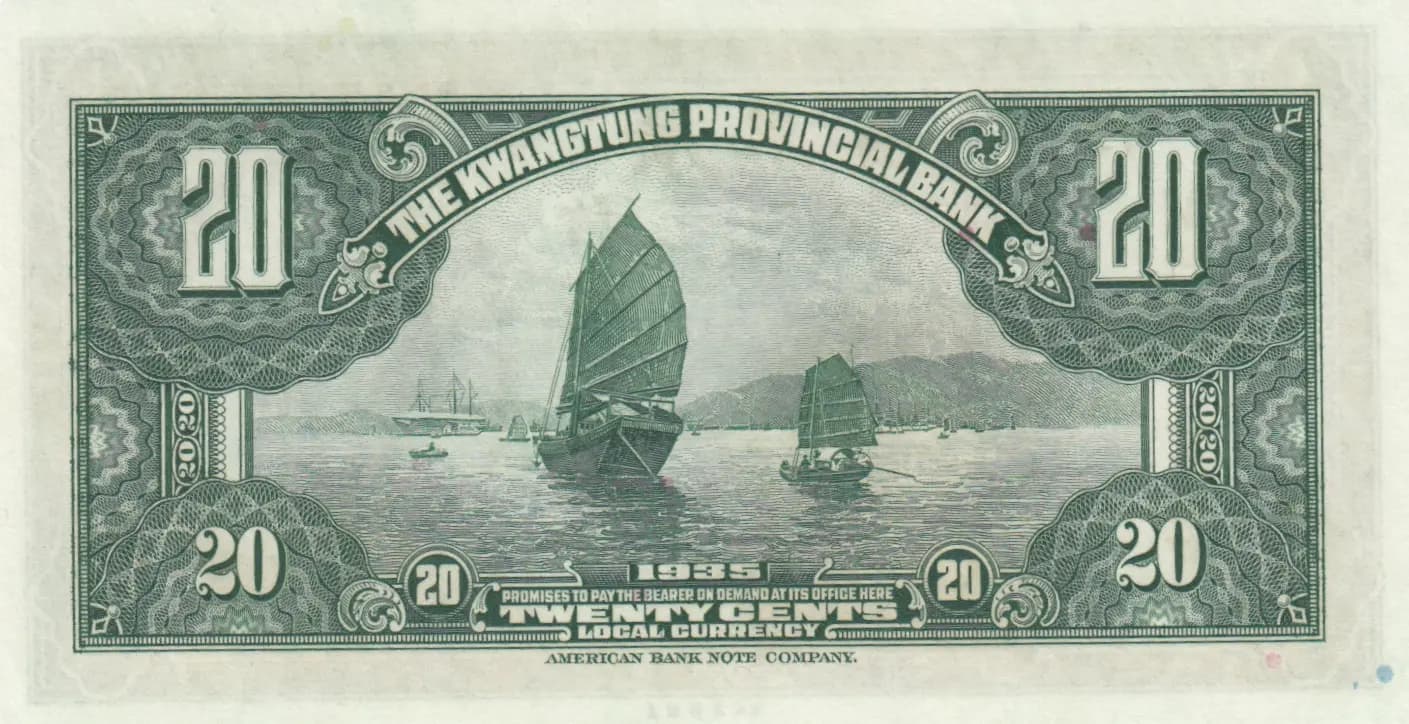
This is a Kwangtung Provincial Bank 20 cents note from 1935, presented in uncirculated condition with exceptional eye appeal. The obverse features vibrant green and multicolor printing with an ornate cartouche in red and green tones, while the reverse showcases a detailed engraved maritime scene of Chinese junks in a harbor setting. This note exemplifies early 20th-century Chinese provincial banking and represents a scarce regional issue from the pre-war Republican period.
Common. While this is a provincial issue from a specific period, the Kwangtung Provincial Bank's 20-cent denomination was produced in sufficient quantity to remain widely available to collectors. The eBay price tracking data shows consistent sales with UNC specimens averaging approximately $33.35 USD, indicating steady market supply at moderate price points. The note is not from a recalled series, a short-lived issuer, or known to have had restricted print runs. Condition-sensitive pricing (VF examples ranging $8-$150 depending on eye appeal) reflects normal market dispersion rather than underlying scarcity of the denomination itself.
Issued during the Chinese Republic era (1912-1949), this note from the Kwangtung (Guangdong) Provincial Bank reflects the period of regional monetary autonomy before full central bank consolidation. The junk vessels depicted on the reverse symbolize Guangdong's maritime heritage and commercial significance, while the bilingual English/Chinese inscriptions demonstrate the influence of foreign banking practices and international trade in treaty-port China. This 1935 issue predates the Japanese invasion of 1937 and represents a transitional period in Chinese numismatic history.
The obverse displays a formal portrait of a man with facial hair in late 19th/early 20th-century formal attire positioned at the right side of the note, identified from context as a bank official (likely Sun Yat-sen or another period figure representative of Guangdong leadership). The central cartouche with red and green ornamental borders contains the denomination and bank identification in Chinese characters. Decorative corner panels with elaborate scrollwork and floral geometry frame currency denomination characters in all four corners. The reverse features a detailed maritime harbor scene with two prominent Chinese junk sailboats equipped with traditional rectangular sails, accompanied by what appears to be a modern steamship in the middle distance, set against mountainous coastline—a symbolic representation of Guangdong's strategic coastal position and commercial importance. Large '20' denomination numerals appear in all four corners with matching ornamental corner designs.
FRONT: 廣東銀行 (Bank of Guangdong / Kwangtung Provincial Bank) | 中華民國二十四年 (Year 24 of the Republic of China, corresponding to 1935) | 貳拾圓 (Twenty dollars/yuan) | 副行長 (Vice bank manager/director) | 香港銀行 (Bank of Hong Kong) | Serial number: H89352259. BACK: THE KWANGTUNG PROVINCIAL BANK | 20 (denomination) | 1935 (issue year) | PROMISES TO PAY THE BEARER ON DEMAND AT ITS OFFICE HERE | LOCAL CURRENCY | AMERICAN BANK NOTE COMPANY (printer attribution).
Steel engraving and letterpress printing executed by the American Bank Note Company (ABNC), one of the world's premier currency printers. The fine line work visible throughout the borders, the crisp portrait rendering, and the detailed maritime scene demonstrate the high-quality intaglio engraving characteristic of ABNC production. Multi-color printing with separate passes for green and red inks was employed to achieve the vibrant hues observed, with the red cartouche overlay on the obverse requiring precise register work. The security signature in green ink (noted as S/M #K56-32a in reference catalogs) adds an additional layer of anti-counterfeiting measures.
This specimen corresponds to Pick S2437b, identifying it as variant 'b' of the 1935 issue. The green signature (S/M #K56-32a) and serial number H89352259 are consistent with documented examples. Varieties of this note typically relate to signature combinations of bank officials and minor serial number prefix variations, which were common among provincial Chinese banks. The presence of the ABNC printer attribution and bilingual inscriptions (English on reverse, Chinese on obverse) is standard for this Pick number. No overprints or unusual varieties are evident in the visual analysis of this specimen.