100 yuan 1943
About This Note
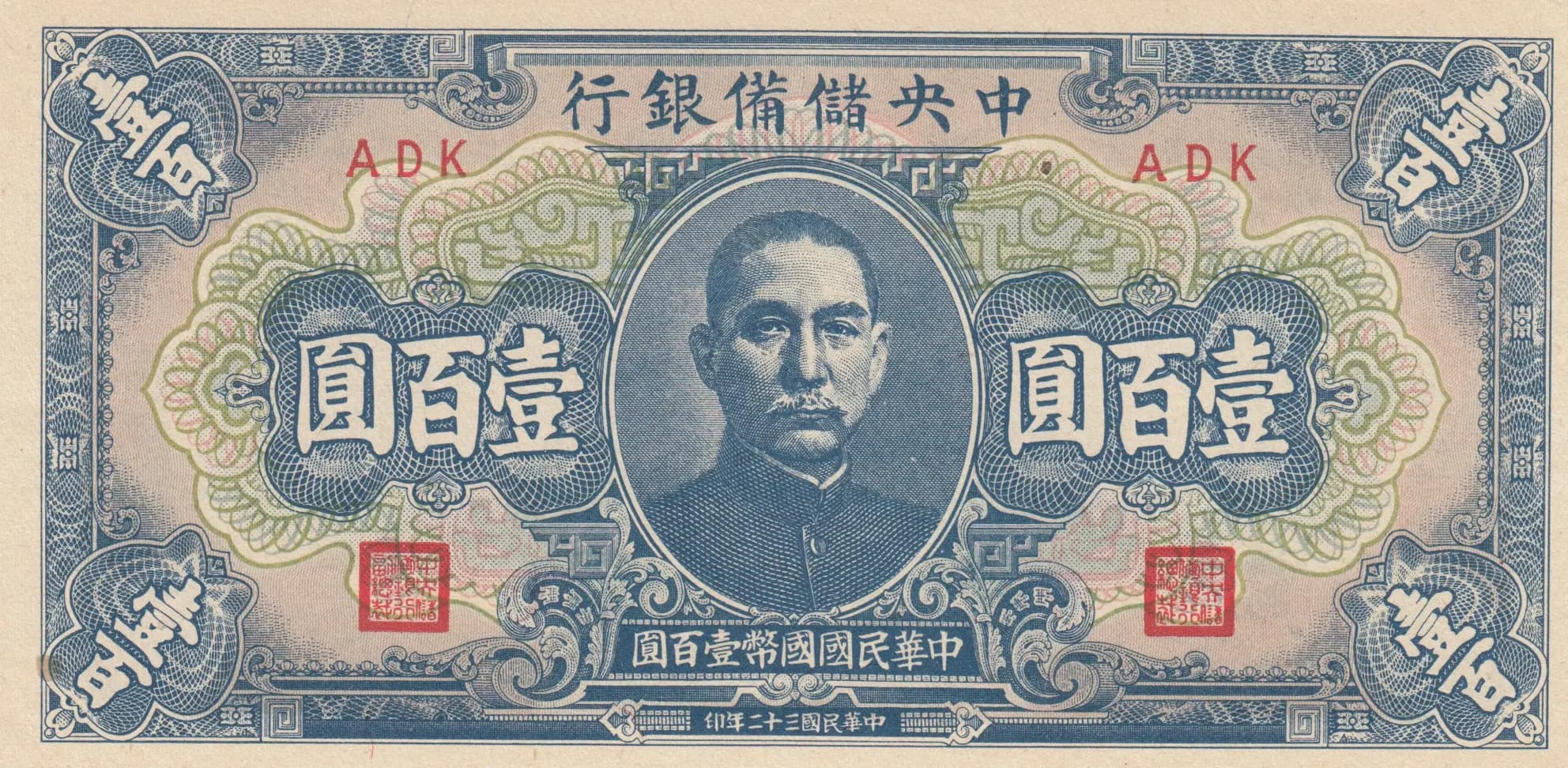
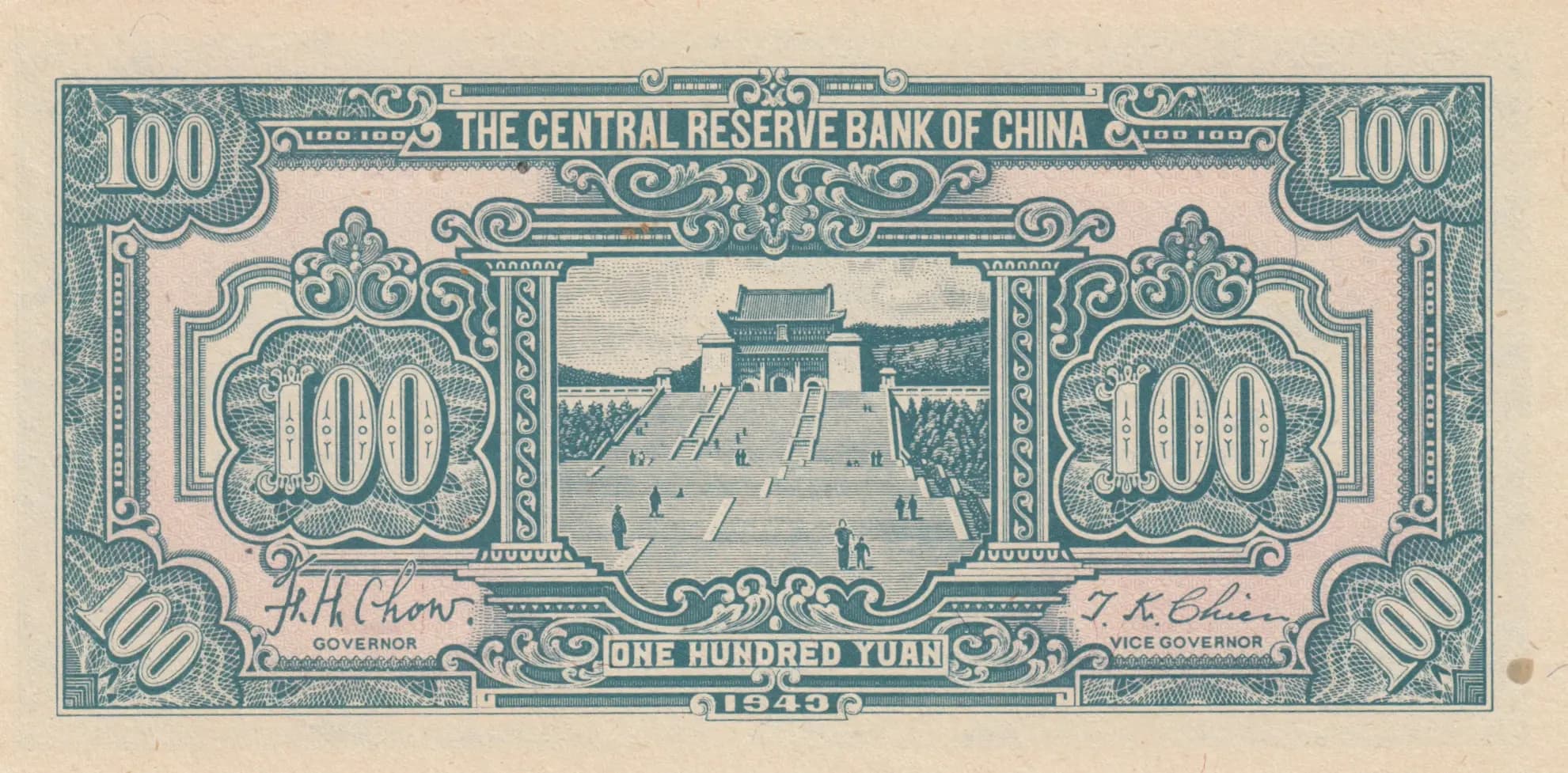
This is an AU-grade 1943 Central Reserve Bank of China 100 yuan note (Pick J23a) featuring exceptional engraving quality and preservation. The obverse displays a formal portrait of a dignitary within an ornate oval frame against a cream background with teal ornamental designs, while the reverse showcases a classical Chinese architectural gateway with grand staircase—characteristic iconography of nationalist China during the Republican period. The note exhibits minimal wear consistent with AU condition, with only light aging and a minor foxing spot visible.
Common. Central Reserve Bank of China notes from the 1943 period, while historically significant, were produced in substantial quantities and remain relatively available to collectors. AU-grade specimens are not unusual for this issue. The Pick J23a designation indicates this is a cataloged standard type without known significant rarity factors, and examples appear with reasonable frequency in the collector market. No evidence of limited print run, recall, or extreme scarcity exists for this particular variety.
Issued by the Central Reserve Bank of China in 1943, during the final years of the Second Sino-Japanese War and the Chinese Civil War, this banknote represents the monetary authority of the Republic of China (ROC) under the Nationalist government. The classical Chinese architectural landmark depicted on the reverse likely represents a significant nationalist or cultural monument, while the formal portraiture on the obverse reflects the official imagery of ROC leadership during this turbulent period. The bilingual inscriptions (Chinese and English) underscore China's international diplomatic positioning and the Central Reserve Bank's role in maintaining financial credibility amid wartime conditions.
The obverse features a frontal portrait bust of a man with distinctive mustache rendered in formal attire, centered within an ornate oval medallion frame. The portrait is positioned centrally with symmetrical cloud-shaped cartouches containing Chinese numerals flanking it on either side. The reverse displays a grand classical Chinese architectural structure—a multi-tiered gateway with prominent grand staircase, decorative balustrades, and surrounding landscape with trees, rendered in fine detail typical of commemorative nationalist imagery. Both sides employ elaborate classical Chinese ornamental borders with geometric patterns, scrollwork, and corner ornaments. Red square seals with Chinese characters appear symmetrically on the obverse. The color palette throughout consists of cream/beige backgrounds with teal, dark blue, and green ornamental designs.
FRONT: Chinese traditional text reading 'Central Reserve Bank' (中央銀行備儲), 'One Hundred Yuan' (壹佰圓), and 'Republic of China Currency' (中華民國貨幣帝國中華民國); Roman letters 'ADK' (printer or engraver mark). BACK: English text 'THE CENTRAL RESERVE BANK OF CHINA' at top, 'ONE HUNDRED YUAN' as denomination text, Arabic numeral '100' in decorative cartouches, official signatures 'H.H Chow' (Governor) and 'J.K Chao' (Vice Governor) with titles, and serial number reference '11949'.
Intaglio engraving (line engraving), executed with fine line work and intricate guilloche patterns serving both aesthetic and security functions. The uniformity of impression, fine detail in portraiture and architectural rendering, and consistent ornamental borders are characteristic of high-quality steel plate engraving typical of 1940s banknote production. The security features include fine line engraving throughout and complex geometric patterns used as anti-counterfeiting measures. This note was likely printed by the American Bank Note Company or similar Western security printer contracted by the Central Reserve Bank, as evidenced by the 'ADK' marking visible on the obverse.
Pick J23a is the catalog designation for this specific type. The note exhibits signatures of H.H Chow (Governor) and J.K Chao (Vice Governor), with serial number reference 11949 visible on the reverse. Varieties of 1943 Central Reserve Bank 100 yuan notes may exist with different signature combinations or serial number prefixes, though without additional comparative specimens, the specific variety classification beyond Pick J23a cannot be further refined from visual analysis alone. The 'ADK' mark on the obverse may indicate the engraver or security printer identification.