100 yuan 1942
About This Note
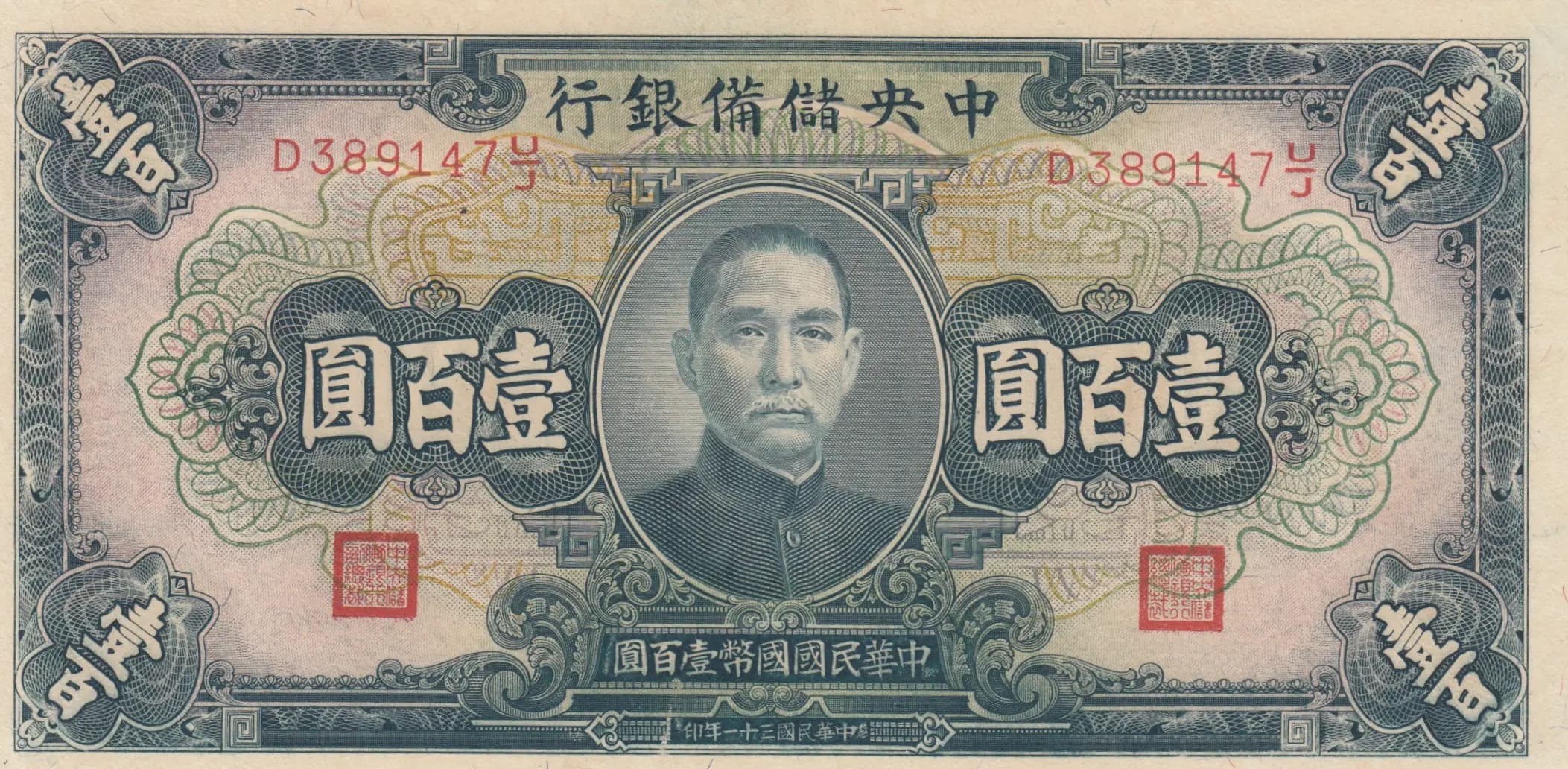
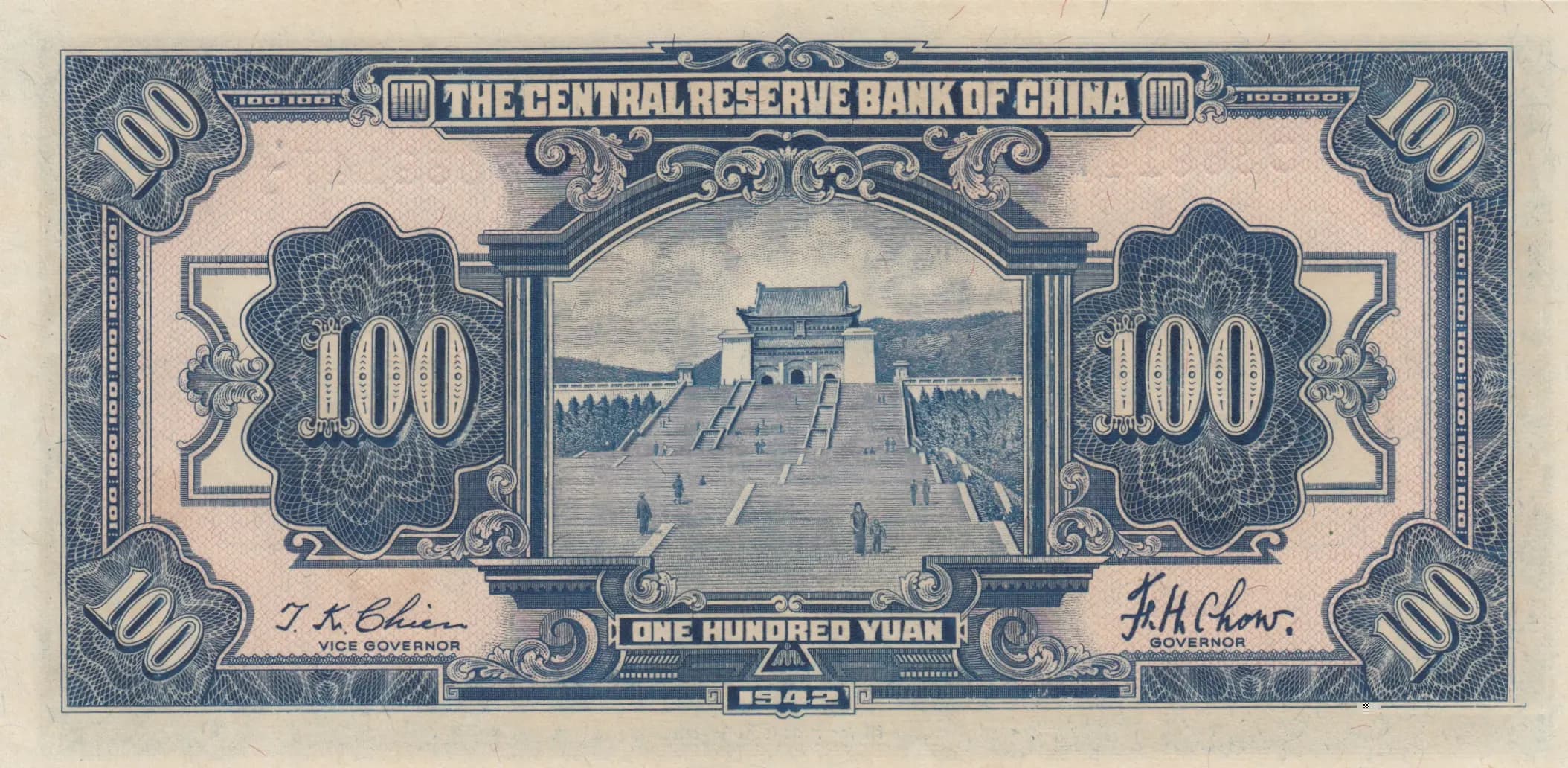
This is an exceptional example of the Central Reserve Bank of China's 1942 100 yuan note (Pick J14), displaying the characteristic dual-language design and fine engraving that defined wartime Chinese currency. The obverse features an ornate portrait medallion in green and pink tones with traditional Chinese decorative scrollwork, while the reverse showcases an impressive landscape vignette of a monumental Chinese gateway structure with mountains beyond. Graded UNC, this note exhibits minimal wear with only light aging evident, making it a desirable specimen for collectors of Republic of China currency during the Japanese occupation period.
common
Issued during 1942, this note represents the Central Reserve Bank's continued monetary operations during the Second Sino-Japanese War, when Japanese-occupied territory fragmented China's financial system. The 1942 date and bilingual English-Chinese design reflect both the internationalized nature of Chinese banking institutions and the period's geopolitical complexity. The ornamental gateway structure depicted on the reverse likely represents a significant Chinese architectural landmark, symbolizing national heritage during a period of foreign military occupation.
The obverse features a formal portrait of a dignified male figure in Western formal dress, centered within an ornate circular medallion frame rendered in green and blue-gray tones with elaborate Chinese cloud scrollwork and decorative cartouches in the corners. Red serial numbers (D3891 47甲) appear in the upper corners with red official seals positioned in the lower quadrants. The reverse displays a grand architectural vignette of a traditional Chinese monumental gateway or ceremonial tower structure with symmetrical design, ornamental roofing, and flanking walls set against a mountainous landscape with scattered figures, enclosed within an elaborate decorative border. Large ornamental denomination cartouches containing '100' occupy all four corners. The note employs a predominantly blue and cream color palette on the reverse, contrasting with the obverse's warmer green-pink tones.
{"front":{"Chinese":{"壹佰圓":"One Hundred Yuan","中央備儲銀行":"Central Reserve Bank","中華民國備儲銀行中華民國":"Republic of China Reserve Bank of the Republic of China"},"serialNumber":"D3891 47甲 (appears in upper left and right corners in red)"},"back":{"English":{"100":"Denomination (appears in all four corner cartouches)","1942":"Date of issue","THE CENTRAL RESERVE BANK OF CHINA":"The Central Reserve Bank of China","ONE HUNDRED YUAN":"One Hundred Yuan","GOVERNOR":"Governor (H.H. Chow signature)","VICE GOVERNOR":"Vice Governor (T.K. Chien signature)"}}}
Intaglio engraving with multiple color lithography. The fine line work, intricate background pattern fills, decorative security borders, and the complexity of the portraiture and architectural vignette indicate professional bank note production using traditional engraving plates. The multiple color printing technique—particularly the distinct color separation between obverse (green, pink, blue-gray) and reverse (blue, cream, gray)—suggests coordination between engraving and color lithography departments typical of high-security banknote production by international security printers of the era.
This specimen exhibits the signature variety with H.H. Chow (Governor) and T.K. Chien (Vice Governor) signatures on the reverse, and carries the serial number D3891 47甲 in red ink. The 1942 date is fixed for this issue. Varieties for Pick J14 are primarily distinguished by signature combinations and serial number prefixes; this example's D-prefix with the 47甲 designation represents a standard variety within the 1942 issuance range.