100 yuan 1938
About This Note
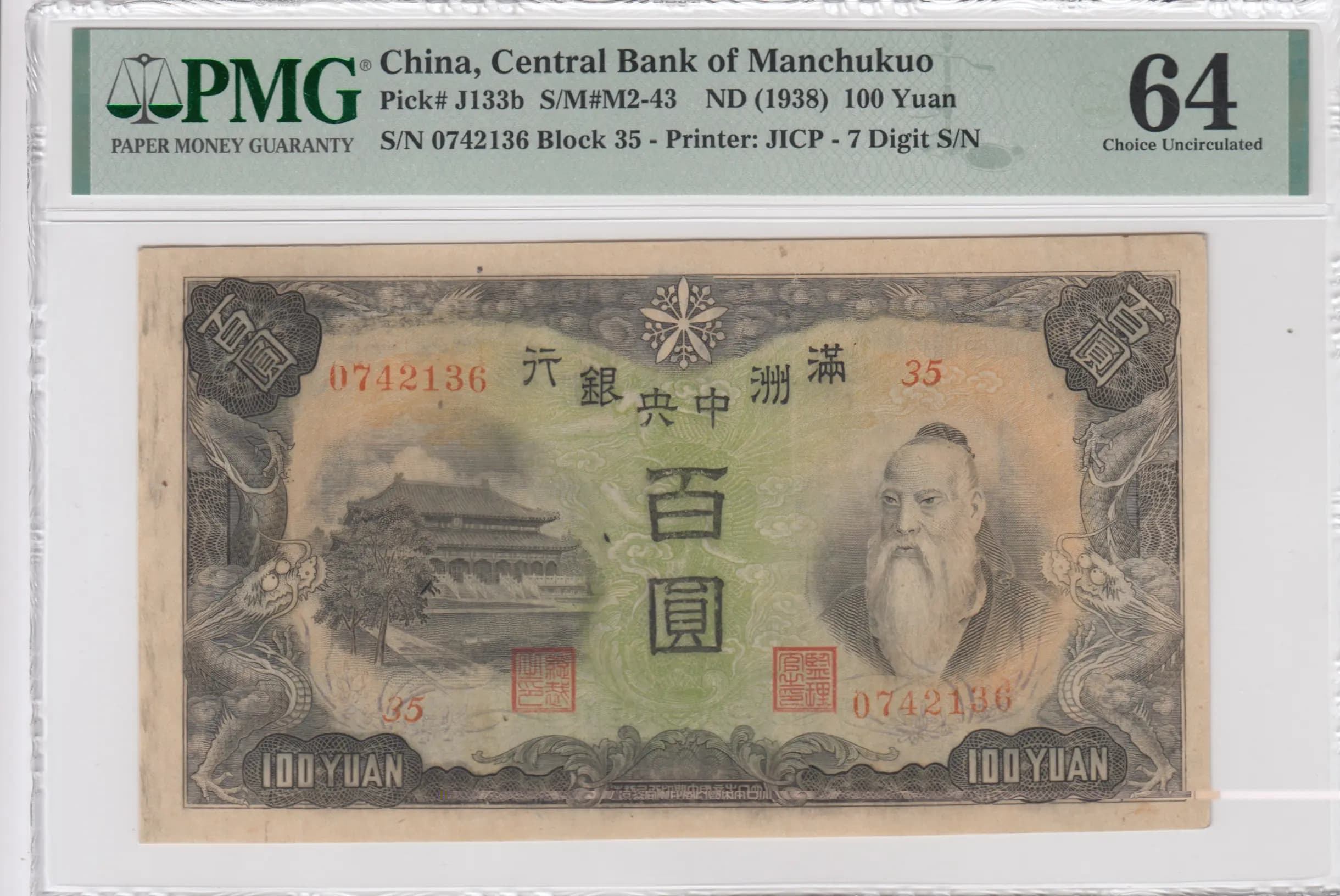
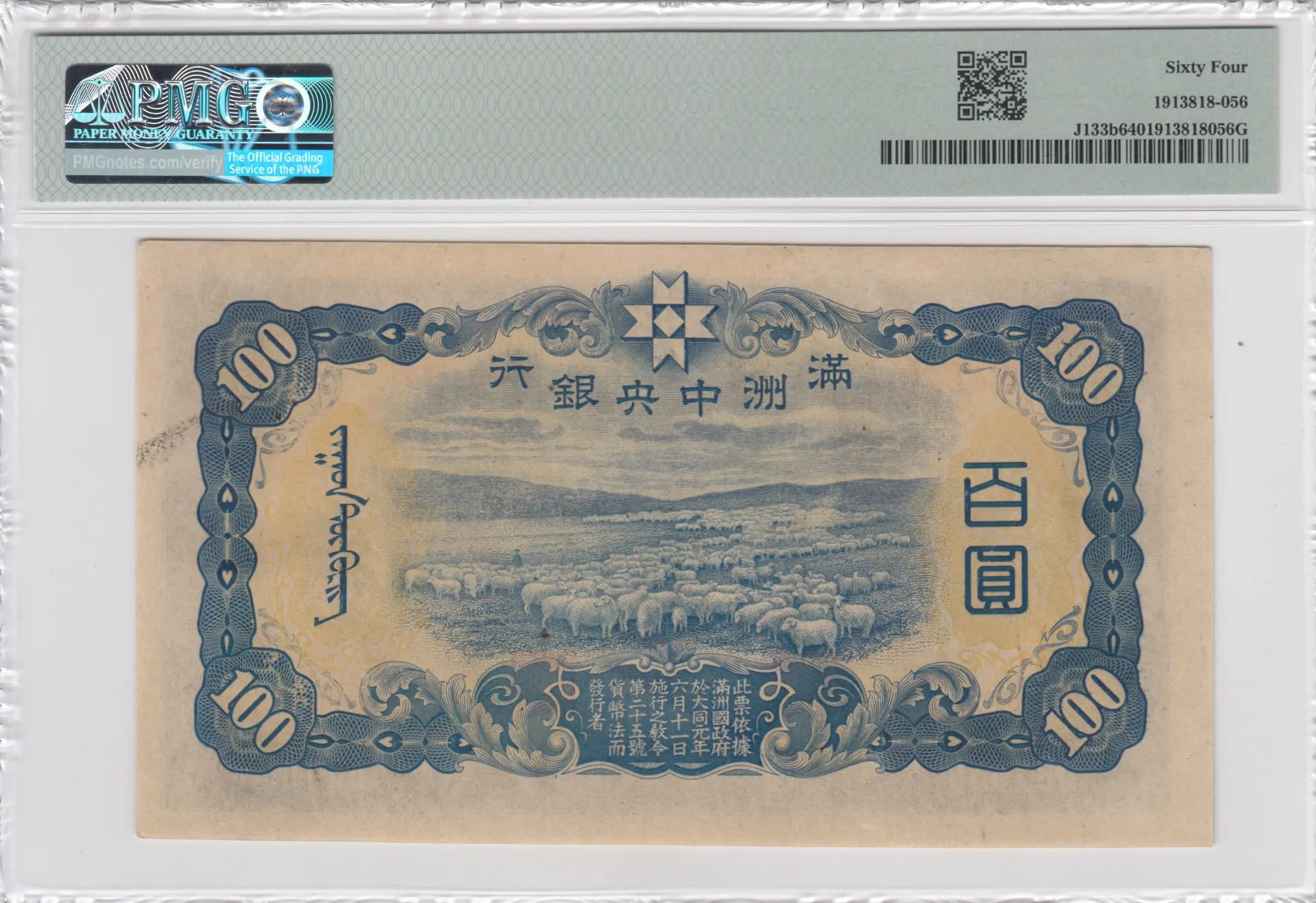
This is a PMG 64 graded 100 Yuan banknote issued by the Central Bank of Manchukuo in 1938, presenting exceptional preservation for an 86-year-old note from this historically significant Japanese-occupied territory. The obverse features a striking portrait of a bearded gentleman in profile alongside a traditional multi-tiered Asian pagoda, while the reverse showcases a pastoral landscape of sheep grazing beneath mountain ranges—both sides executed in refined intaglio printing with a sophisticated color palette of greens, blues, and earth tones. The note's excellent condition, crisp printing, and complete absence of circulation wear make it a notable specimen of this Japanese-era Chinese regional currency.
Common. The Central Bank of Manchukuo issued substantial quantities of this 100 Yuan denomination during its operational period (1932–1945). While Manchukuo currency is less frequently encountered than contemporary Chinese or Japanese notes in the modern collector market, this specific denomination and issue year do not exhibit characteristics of rarity—no documented evidence of small print runs, recalls, or extreme scarcity exists. The PMG 64 grade indicates excellent condition, which increases the note's appeal to collectors, but does not change its fundamental rarity classification. Notes from this issuer in high grades are moderately desirable but remain available to collectors at moderate price points, confirming common status.
The Central Bank of Manchukuo issued this note during Japan's occupation of Manchuria (1932–1945), when the puppet state of Manchukuo served as Japan's principal client state in Northeast Asia. The pastoral imagery on the reverse—depicting sheep herds in mountainous terrain—reflects Manchukuo's agricultural and pastoral economy, which Japan sought to integrate into its imperial economic sphere. The bilingual inscriptions (Chinese and English) and Western-influenced design elements represent the complex cultural and commercial identity of the Manchukuo regime, which attempted to position itself as a modern, internationally recognized state despite its dependence on Japanese military and political control.
The obverse features a portrait of a mature, bearded gentleman positioned on the right side, rendered in profile facing left, likely representing a significant historical or political figure of the Manchukuo era. To the left stands a prominent multi-tiered pagoda or Buddhist temple with traditional East Asian architectural styling, symbolizing Manchukuo's cultural heritage. The design incorporates ornamental dragons in the top corners—classical symbols of imperial authority and prosperity in Chinese tradition—along with delicate floral decorative patterns and red official seals bearing Chinese characters. The reverse presents an expansive pastoral landscape dominated by a large flock of sheep grazing across grassland with a mountain range visible in the distant background, framed by ornate scrollwork borders in a classical banknote tradition. The composition emphasizes Manchukuo's agricultural productivity and natural resources. All four corners feature the denomination '100' in Arabic numerals, while the bilateral inscriptions reflect the note's dual Chinese-English presentation.
Front side: '滿洲中央銀行' (Central Bank of Manchukuo), '百圓' (100 Yuan), '100 YUAN' (English denomination), Serial number '0742136' (appears twice), Block number '35'. Back side: '滿洲中央銀行' (Central Bank of Manchukuo), '百圓' (100 Yuan), '100 YUAN' (English denomination, appears in bottom corners), '100' (Arabic numeral denomination in all four corners). Additional fine print appears in a decorative cartouche at the bottom of the reverse but is not clearly legible in the provided images.
Intaglio (engraved) printing, which is evidenced by the crisp line work, fine detail resolution in both the portrait and landscape elements, and the characteristic depth of color saturation visible in the detailed border designs and ornamental elements. The multi-color printing—combining greens, blues, grays, blacks, reds, and beige tones—indicates successive color passes typical of high-security banknote production of the 1930s era. The refined execution and security features suggest professional Central Bank printing facilities; while specific printer attribution for this Manchukuo note is not immediately confirmed, such notes were typically produced under close Japanese supervision using advanced security printing methods of the period.
Pick catalog P-J133b designates this as variant 'b' of the 1938 100 Yuan issue, indicating multiple varieties exist within this denomination and year. The serial number observed is '0742136' with block number '35'. Collectors should note that Manchukuo notes of this period exist with variations in serial number prefixes, overprint styles, and signature combinations, though these details are not fully distinguishable in the provided images. The specific variety 'b' designation suggests differences from variant 'a' (possibly in signature, seal placement, or subtle design elements), but complete variety documentation would require comparison with reference catalogs or museum holdings.