100 yuan 1938
About This Note
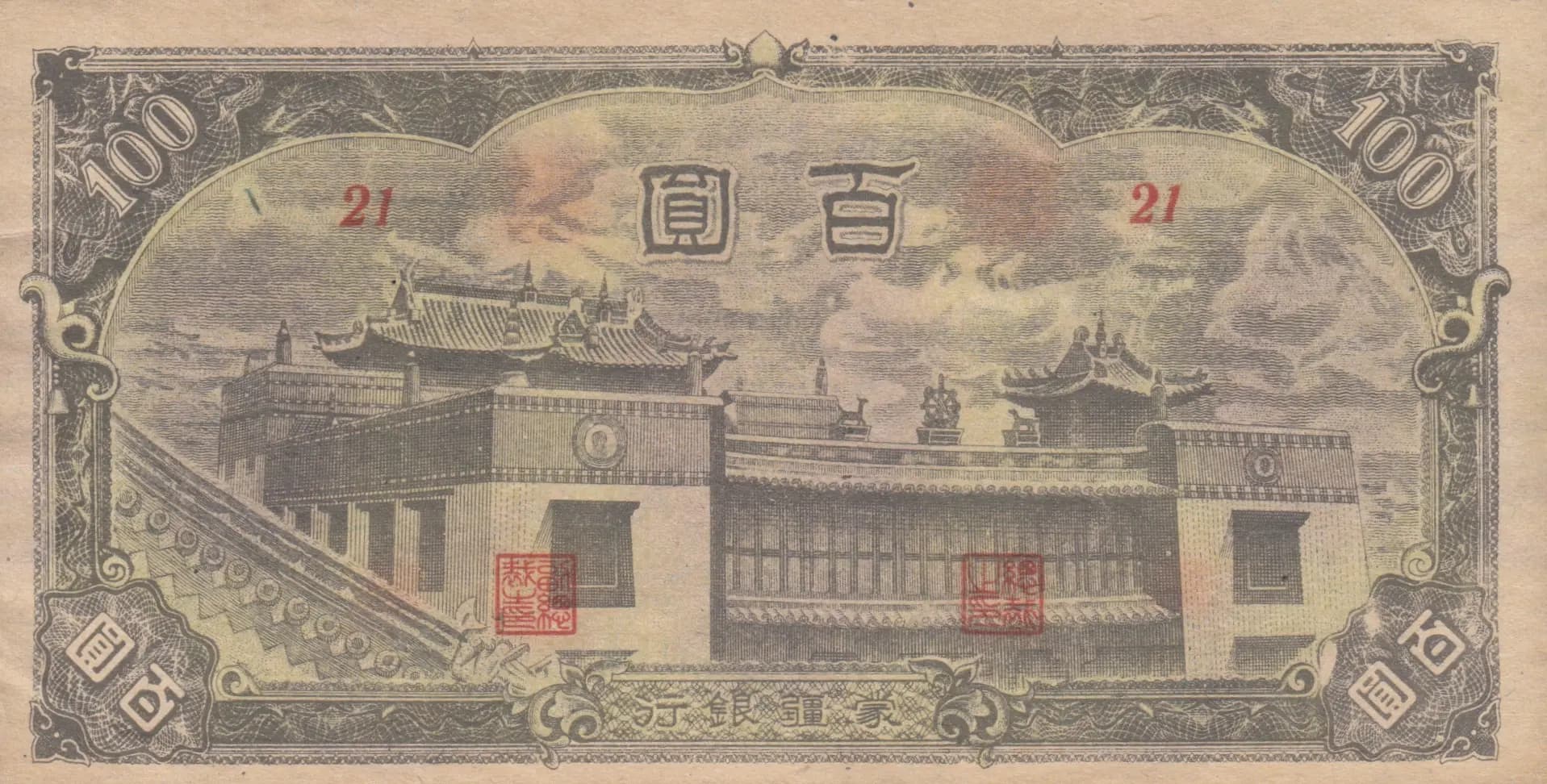
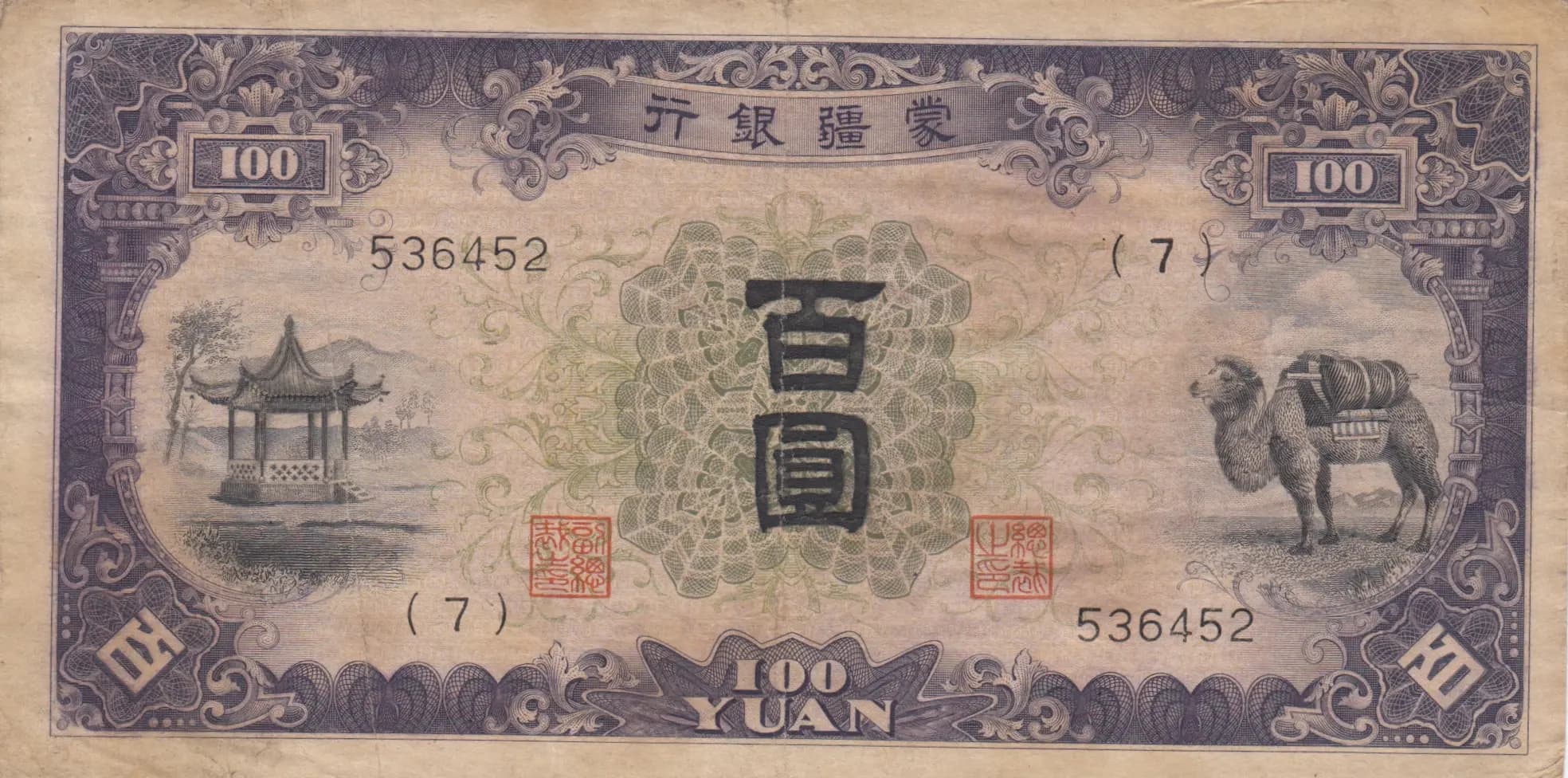
This 100 Yuan note from the Mengchiang Bank (1938) presents a fascinating artifact of Japanese-occupied China during the Second Sino-Japanese War. The note features exceptional engraved design work with a traditional Asian pagoda and camel caravan depicted on the obverse, rendered in purple and blue tones with ornate guilloche patterns. In Fair condition, the note displays moderate aging with foxing and discoloration typical of 1930s currency, yet maintains structural integrity with no major tears.
Common. While Mengchiang Bank notes represent an interesting historical subset of 1930s Chinese currency and are sought by specialized collectors, the 100 Yuan denomination in Pick P-J112 was issued in sufficient quantities to be readily available to collectors. Fair condition examples trade regularly at modest prices in the collector market, indicating regular supply. No documented evidence of restricted print runs, mass recalls, or extreme scarcity exists for this specific Pick number.
The Mengchiang Bank issued this currency for the puppet state of Mengjiang (Inner Mongolia), established under Japanese occupation from 1937-1945. The imagery—specifically the pagoda representing traditional Asian architecture and the camel caravan symbolizing Central Asian trade routes—reflects Japan's territorial ambitions and attempts to legitimize control over these regions through culturally resonant designs. This note represents a significant but controversial episode in East Asian monetary history during wartime.
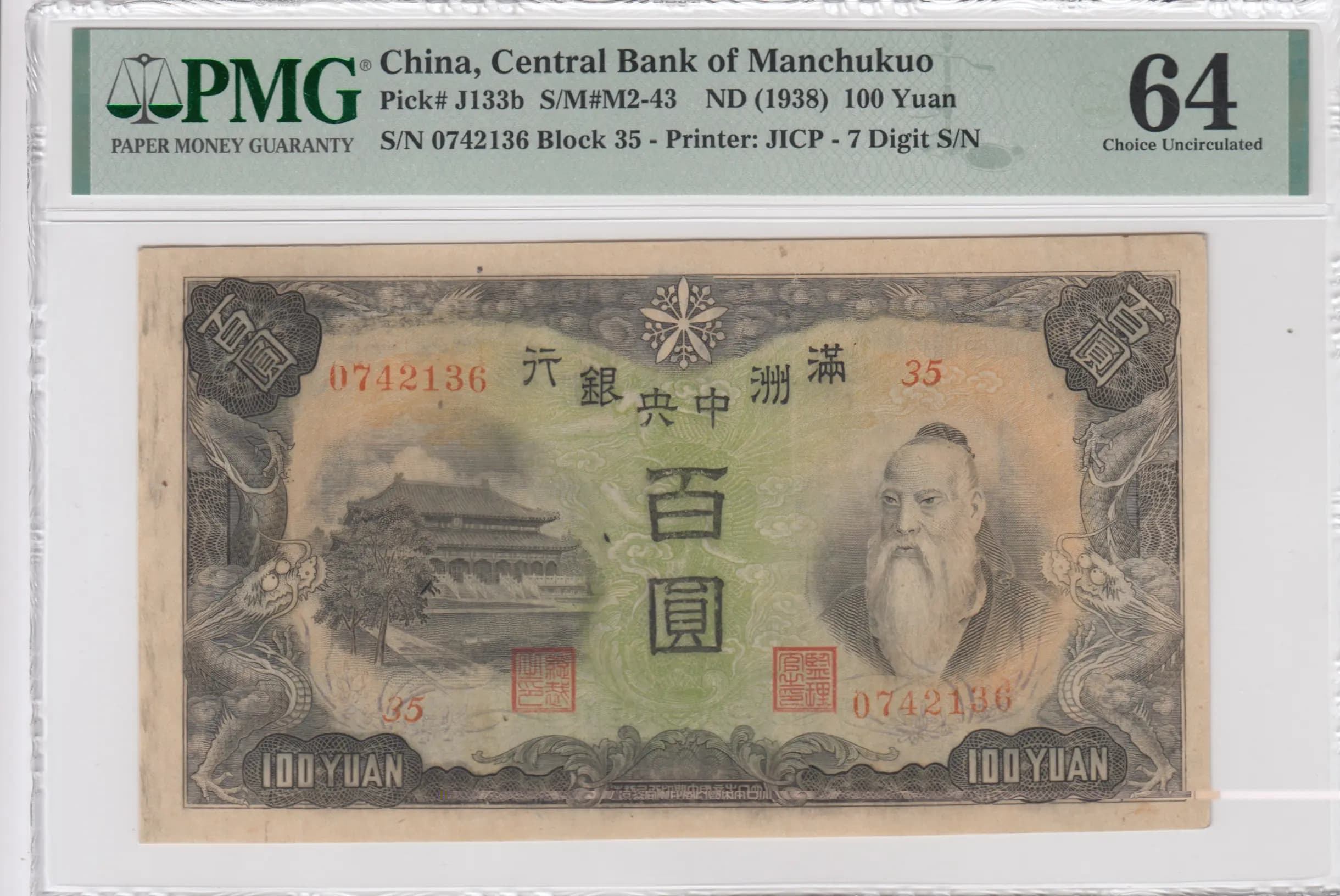
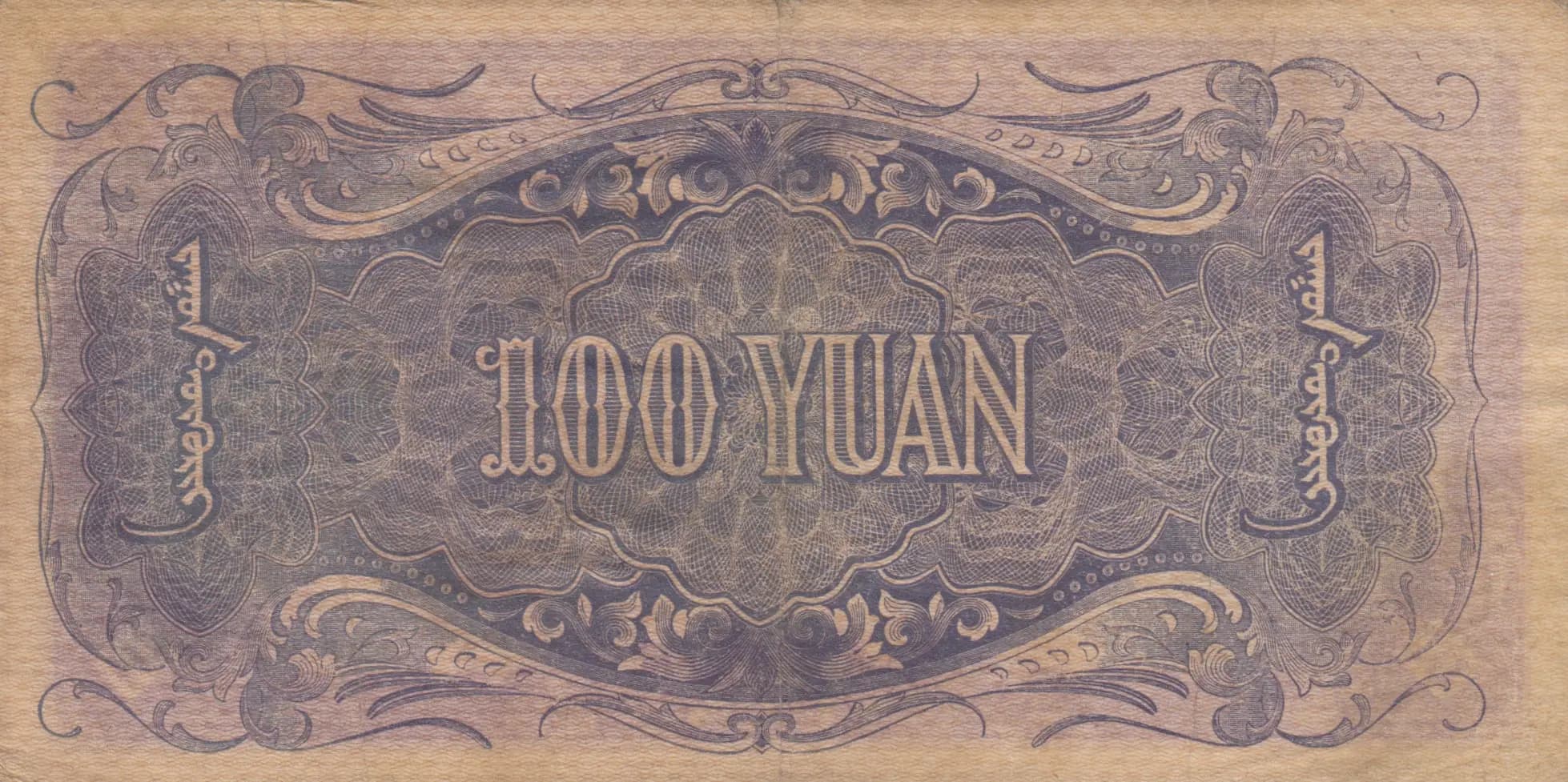
The obverse features a classical engraved design with a traditional East Asian pagoda with characteristic curved roofing positioned over a water landscape on the left side, symbolizing cultural heritage. The right side depicts a laden camel, representing the Silk Road trade tradition and desert commerce. The center showcases an intricate floral medallion surrounding the characters '百圓' (100 Yuan), flanked by red square seals containing Chinese characters. The reverse employs a symmetrical design focusing entirely on the denomination, with '100 YUAN' rendered in elaborate serif typography at the center, surrounded by an extensive floral and geometric guilloche pattern. All four corners feature ornamental decorative elements with curved scrollwork. The color palette of purple, blue, beige, and tan creates a cohesive aesthetic across both sides.
Front Side: '央行銀農' (Central Agricultural Bank or Agricultural Central Bank); '百圓' (100 Yuan); '100' (denomination in Arabic numerals); 'YUAN' (English denomination label); Serial number '536452'; Series indicator '(7)'. Back Side: '100 YUAN' (denomination in English with elaborate serif typography). Note: There is a discrepancy between the catalog issuer name (Mengchiang Bank) and the visible inscription suggesting Central Agricultural Bank, which may reflect organizational naming conventions or translation variations of the same institution.
This note was produced using intaglio engraving (copperplate printing), evident from the fine line work, detailed guilloche patterns, and the characteristic depth and precision of the floral medallions and decorative borders. The security features—including the intricate guilloche patterns, fine line engraving throughout, and color gradation—are hallmarks of high-security currency printing practices of the 1930s. The printer for Mengchiang Bank notes of this period is believed to be Japanese printing works, though specific attribution requires additional documentation.
The observed serial number '536452' with series indicator '(7)' suggests this note belongs to a specific printing series. Mengchiang Bank notes are known to exist with various serial number ranges and series indicators reflecting multiple printings. The inscription variant showing '央行銀農' (Central Agricultural Bank) rather than explicit 'Mengchiang Bank' may indicate a specific variety or translation convention for this issuer. Collectors should note that Mengchiang notes exist in multiple denominations and series, and specific serial number ranges and printing series can affect collector interest and valuation within specialized markets.