100 yuan 1949
Market Prices
8 salesAbout This Note
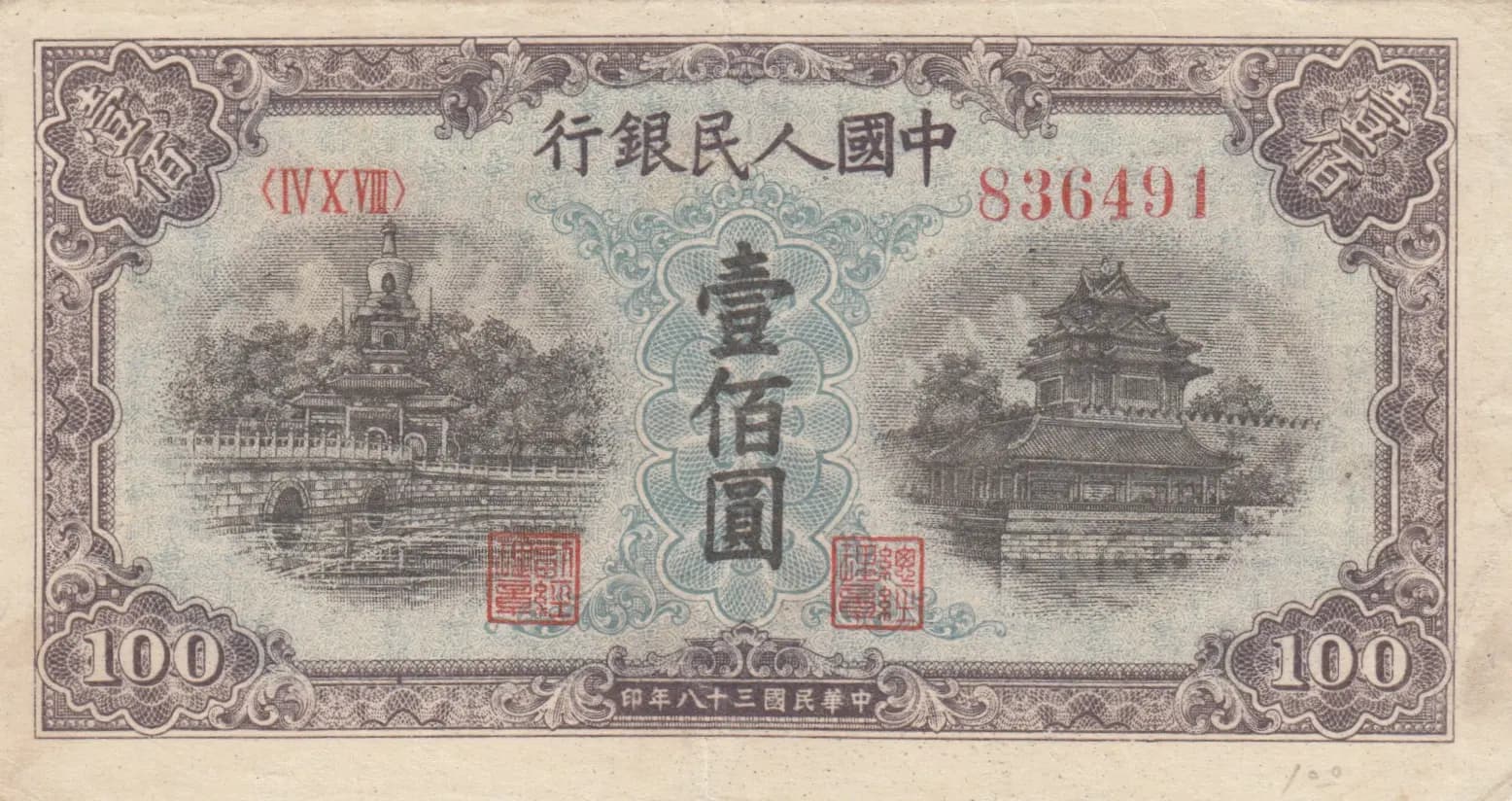
This is a VF-graded 100 yuan note from the People's Bank of China's 1949 inaugural issue (Pick P-832), featuring ornate classical Chinese design with traditional architectural vignettes of a pagoda and pavilion. The note displays characteristic age-related patina and creasing consistent with 75+ years of storage and circulation, with no major tears or damage. This early PRC currency represents an important transitional moment in Chinese monetary history and remains moderately desirable among collectors of early Communist-era notes.
Common. While this is an early PRC issue from a historically significant year, the catalog data and eBay price history indicate this note circulates with moderate regularity among collectors. VF specimens have sold repeatedly at $89.88–$202.50 over the past decade, with catalog valuations of approximately $90 for VF grade (2016 reference). The consistent market presence and multiple sales across various grades suggest adequate print runs and reasonable availability in the collector market, precluding any rare or very rare classification.
Issued in 1949 following the establishment of the People's Republic of China, this 100 yuan note represents the early standardization of currency under the newly formed Communist government. The architectural vignettes—featuring traditional Chinese pagoda and pavilion structures—symbolize continuity with China's cultural heritage despite the dramatic political transition. This note was part of the People's Bank of China's foundational currency series, replacing the earlier issues of competing Chinese authorities and establishing the PRC's monetary authority.
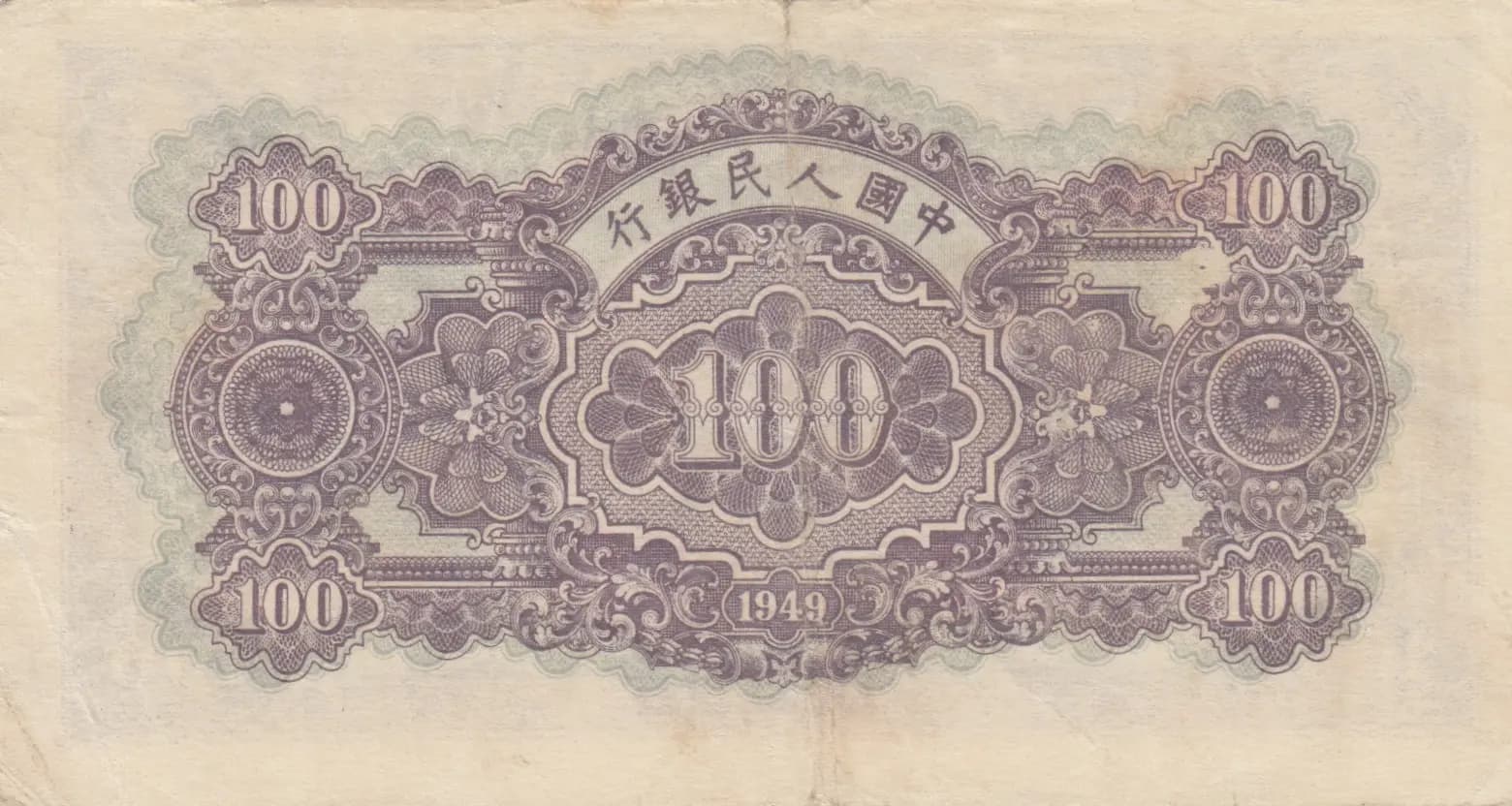
The obverse features a symmetrical design with ornate decorative borders incorporating quatrefoil corner cartouches and scrollwork patterns. Two landscape vignettes occupy the center: the left depicts a traditional Chinese pagoda surrounded by trees (likely representing the Peking Pagoda referenced in catalog sources), while the right shows a pavilion-style building with characteristic curved roof typical of classical Chinese architecture. A vertical decorative cartouche with cloud motifs separates these vignettes and contains the bank's name in traditional Chinese characters, flanked by red square seals or stamps. The reverse maintains similar ornamental border treatment with the denomination '100' prominently featured within a central decorative cartouche and repeated in all four corners, with '1949' displayed at the bottom. The overall composition is highly symmetrical and demonstrates refined classical design principles appropriate to the formal establishment of the PRC's monetary system.
Front side: '中國人民銀行' (People's Bank of China), '壹佰圓' (One Hundred Yuan), Arabic numerals '100' in corners, serial number '8364491'. Back side: '中央銀行中國人民共和國' (Central Bank of the People's Republic of China), '100' in all four corners, '1949' at bottom center indicating the issue year.
The note exhibits fine line engraving throughout, evident from the intricate scrollwork, detailed border patterns, and the precise rendering of the architectural vignettes. The multiple color plates (brown/tan, purple, green, and red for seals) indicate intaglio multi-color printing technology standard for high-security currency production of this era. The visual analysis confirms the characteristic sharp lines and dimensional depth typical of engraved banknote production rather than lithography.
The catalog reference notes three serial number varieties exist for this Pick number (P-832). The observed specimen carries the serial number 8364491. The referenced S/M catalog number is C282-44. No specific overprints, signature varieties, or date variations are evident in the visual analysis of this specimen, though collectors should cross-reference their notes against the three known serial number varieties to establish which variant they possess.