100 yuan 1948
Market Prices
4 salesAbout This Note
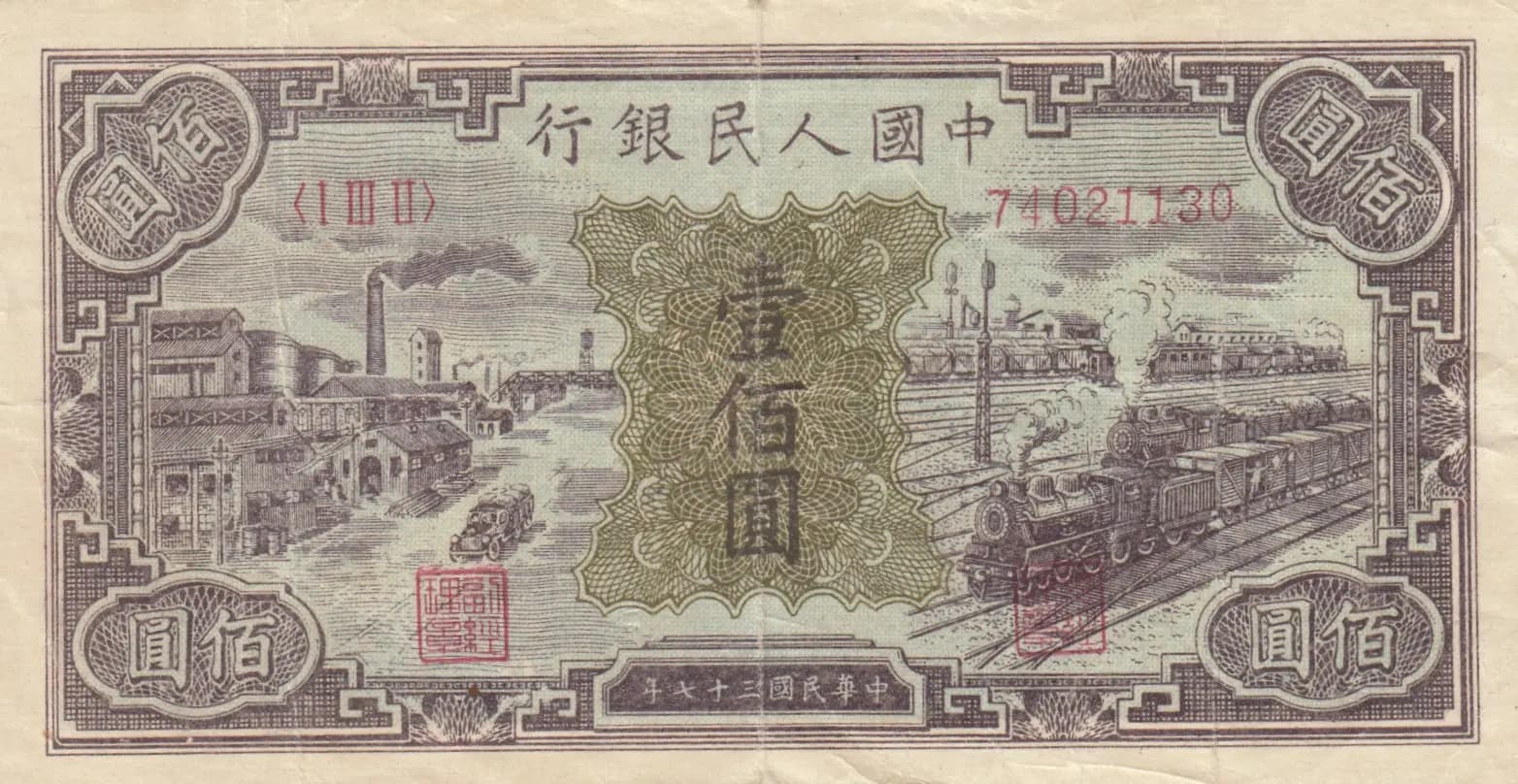
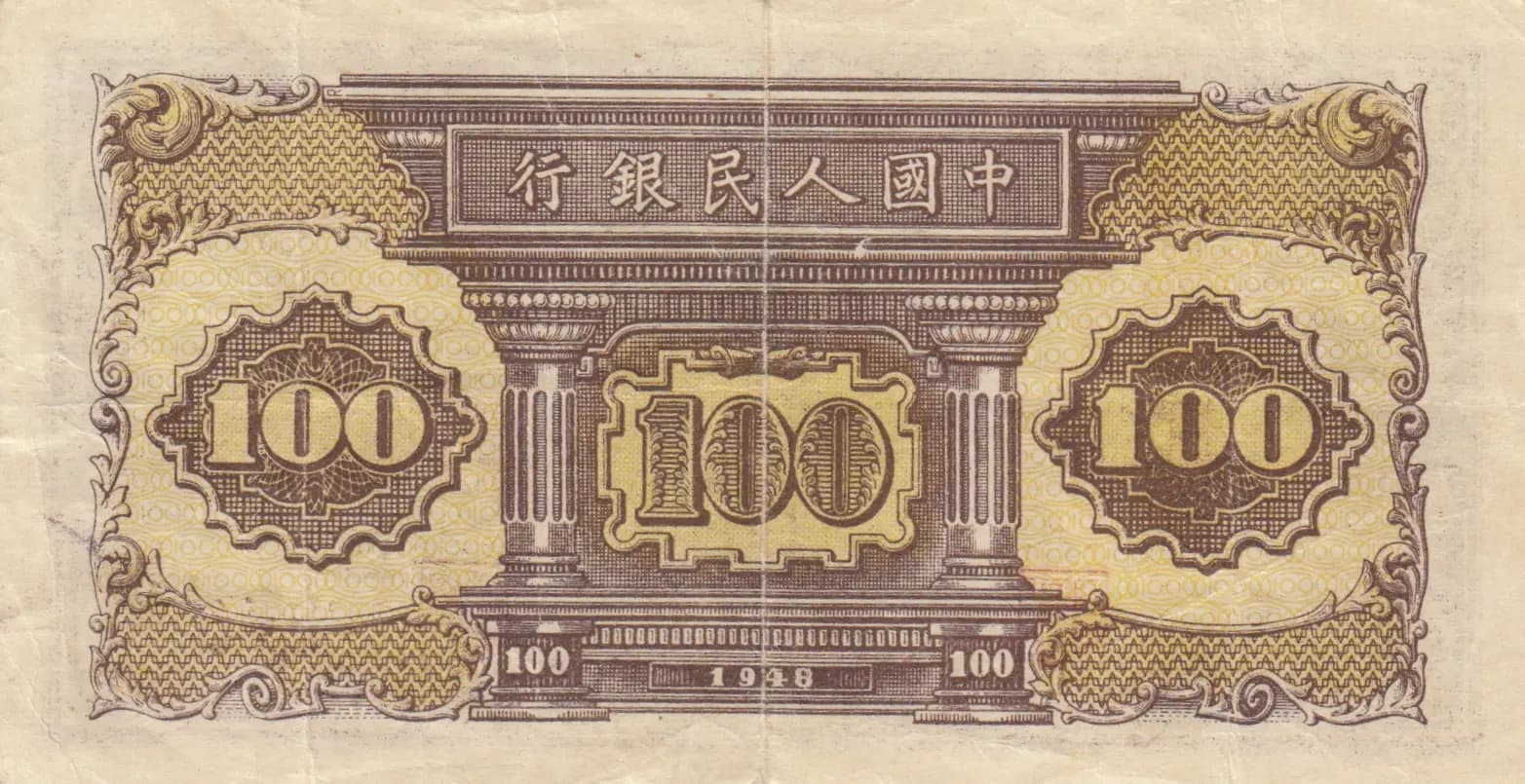
This is a VF-grade 100 yuan note from 1948, issued by the People's Bank of China during a pivotal moment in Chinese history. The note features beautifully engraved industrial and transportation imagery on the obverse—factories with smokestacks and a modern steam locomotive—while the reverse displays classical Chinese architectural elements. Despite visible creasing, foxing, and age-related patina consistent with 75+ years of circulation, the note retains strong visual appeal with crisp line work and good color definition, making it a desirable example for collectors of early PRC currency.
Common. While this is an attractive early PRC-era note, the 100 yuan 1948 (P-807) appears regularly in the collector market with moderate supply. The eBay price history shows VF examples selling for approximately $610 (as of 2014), with catalog valuations around $135 for VF condition. PMG population data indicates both major varieties (P-807a with blue underprint and P-807b without) are known, suggesting reasonable circulation among graded specimens. The note is not from a recalled or short-lived series and represents a standard regular issue from the People's Bank of China's established production run.
Issued in 1948, just one year before the establishment of the People's Republic of China, this note represents the transitional currency period under the People's Bank of China. The obverse imagery celebrating industrial factories and steam locomotives reflects the Communist government's emphasis on modernization and industrial progress as symbols of national strength. The reverse's classical Chinese architectural design—depicting a temple or palace—balances revolutionary ideology with traditional cultural heritage, making this denomination a fascinating artifact of China's mid-20th century political and economic transformation.
The obverse features a sophisticated dual-themed industrial composition: on the left, an industrial cityscape with multiple factory buildings, tall smokestacks, and waterfront structures symbolizing urban manufacturing growth; on the right, a modern steam locomotive pulling passenger cars on railroad tracks with additional industrial buildings, representing transportation infrastructure advancement. Both scenes are rendered in fine-line engraving within an ornamental border framework. The center is anchored by an intricate circular medallion with geometric guilloche patterns in olive green, providing a decorative focal point. The reverse showcases classical Chinese architectural aesthetics with a symmetrical temple or palace structure featuring an ornamental roof and classical columns, framed by baroque-style scrollwork and decorative borders. Three prominent '100' denomination markers appear in decorative cartouches (left, center, and right), ensuring easy denomination identification. The overall design employs brown and green tones on the obverse with a warm brown-on-gold palette on the reverse.
Front side: '中國人民銀行' (People's Bank of China), '百圓' (One Hundred Yuan), '中華民國四十年' (Republic of China Year 40, equivalent to 1951 in the traditional calendar but issued in 1948), serial number '7402113°', and Roman numeral '(IIII)' indicating the denomination. Back side: '中國人民銀行' (People's Bank of China), denomination '100' repeated in three decorative cartouches, and year marking '1948'.
Intaglio line engraving throughout, characteristic of high-security banknote production of the era. The fine geometric patterns in the central medallion, detailed border work, and intricate architectural rendering on the reverse all demonstrate the precision of steel-plate engraving. This printing method was typical for People's Bank of China issues of 1948 and reflects the advanced security printing standards of the period, likely produced by the Bank's own security printing facilities or contracted to a specialist banknote printer.
This note corresponds to Pick catalog P-807 with two documented varieties: P-807a (100 Yuan with Blue Underprint) and P-807b (100 Yuan without Blue Underprint). Based on the visual analysis description mentioning 'Blue underprint on face' in the reference data, this example appears to be the P-807a variant with blue underprint. The serial number visible as '7402113°' and the Roman numeral '(IIII)' are consistent with the cataloged series. No overprints or signature variations are noted in the visual analysis, indicating a standard printing of the base type.