100 yuan 1914
Market Prices
8 salesAbout This Note
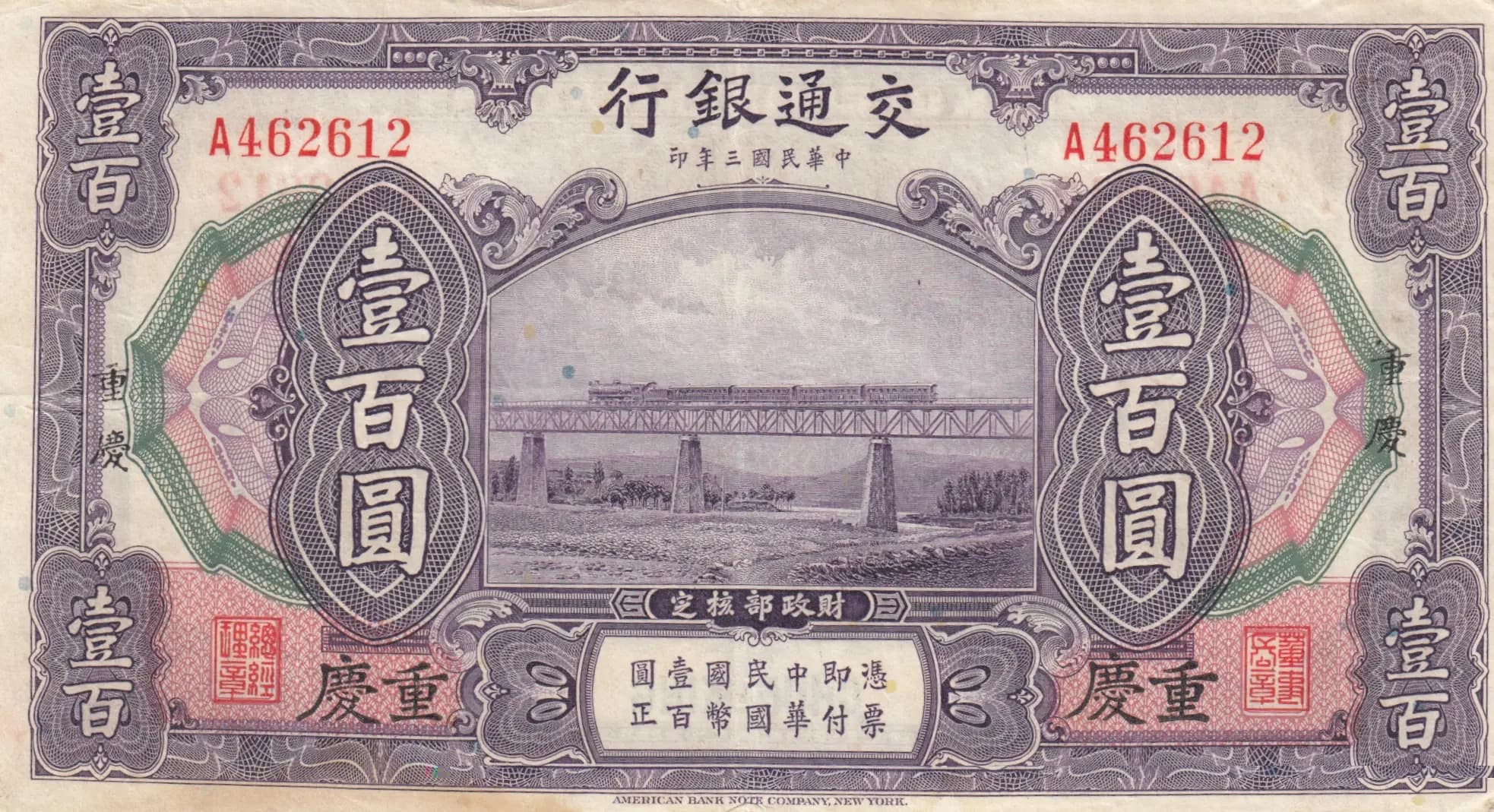
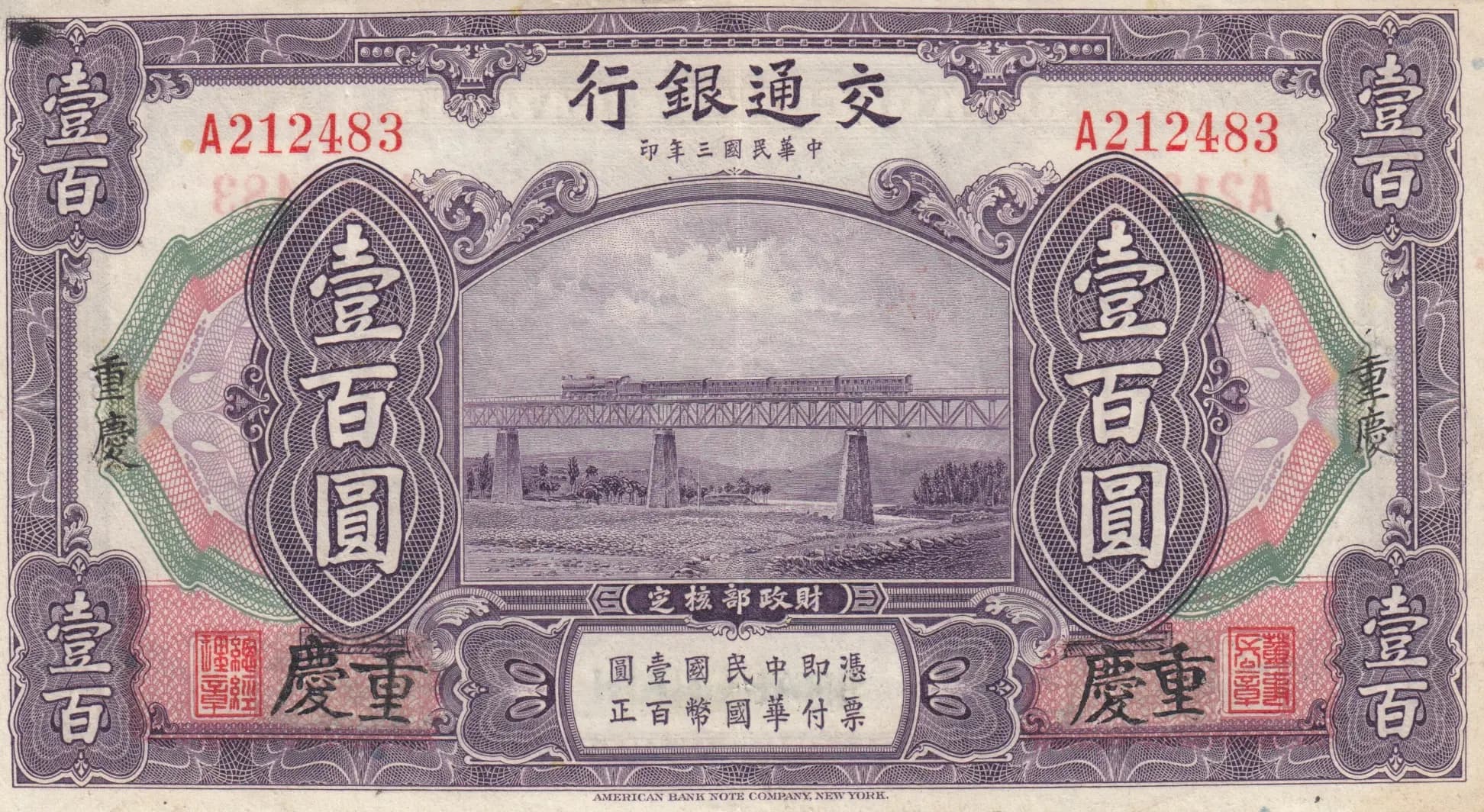
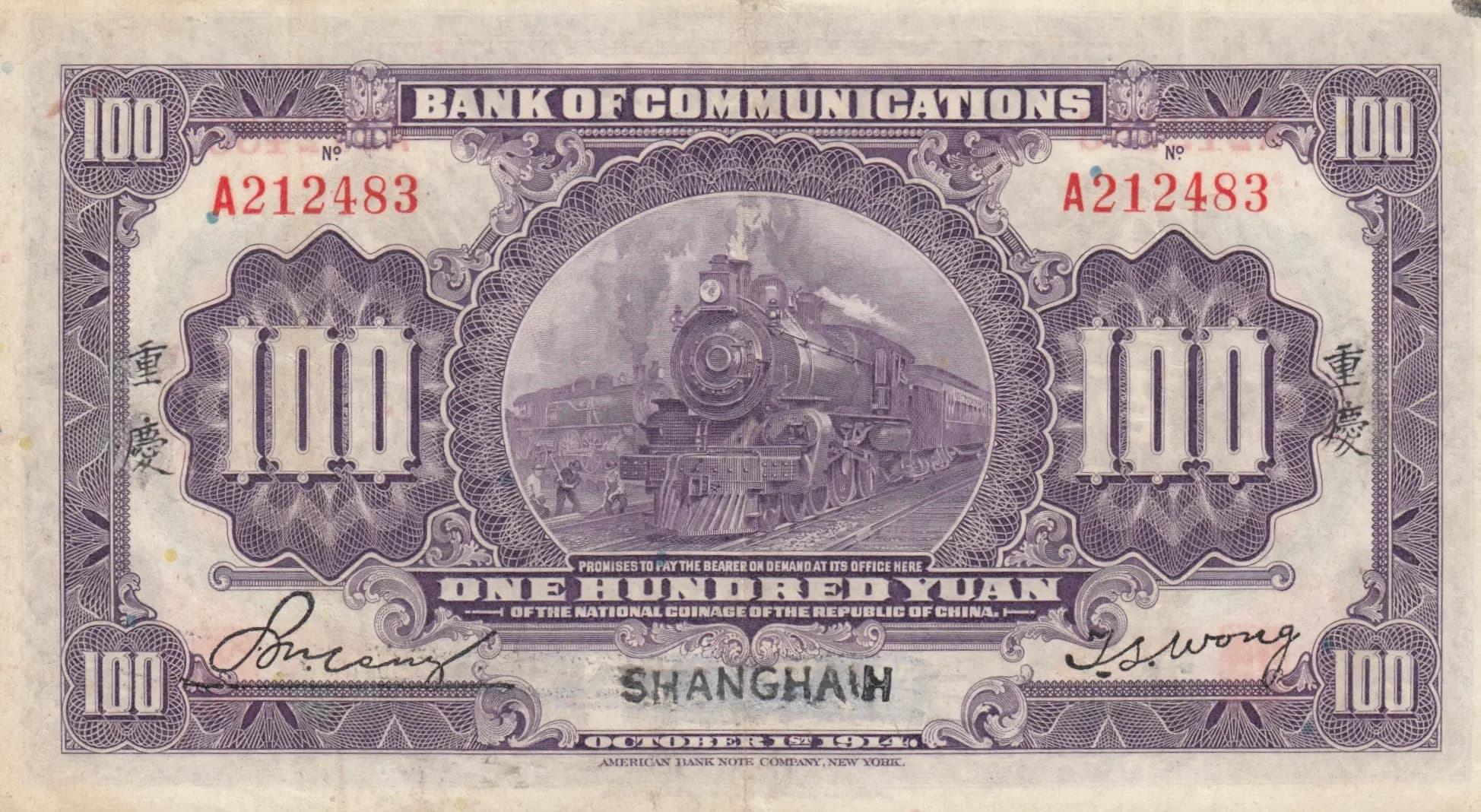
This Bank of Communications 100 yuan note from December 1914 features exceptional Art Deco-influenced design with ornate purple and multicolor borders framing two dramatic railway-themed vignettes—a steel arch bridge with locomotive on the front and a front-facing locomotive on the back. The note exhibits the fine engraving characteristic of American Bank Note Company production, with intact margins and age-appropriate patina consistent with VF condition; the historical significance of this denomination and issuer, combined with the modernization symbolism of the railway imagery, makes it a notable example of early Republican-era Chinese currency.
Common. eBay market data shows consistent sales of this type with multiple PMG 64 examples selling between $200-$847 (2018-2023), and ungraded VF examples selling for approximately $52 in 2019. The presence of multiple recent sales at relatively moderate prices, combined with the note's production by a major international security printer during a relatively stable period (December 1914), indicates substantial original printing quantities. The denomination and Bank of Communications status also suggest this was a widely circulated note. Notes consistently selling below $1,000 in higher grades are typically considered common in the numismatic market.
Issued during the early Republic of China period, this 1914 Bank of Communications note reflects the nation's embrace of industrial modernization and Western banking practices. The prominent railway imagery—featuring both an arch bridge and steam locomotives—symbolizes China's aspirations toward modern infrastructure development during a transformative era. The note's dual-language text (Chinese and English) and production by American Bank Note Company of New York underscore the international financial cooperation characteristic of this transitional period in Chinese monetary history.
This note exemplifies the sophisticated banknote design standards of the early 20th century, featuring allegorical rather than portrait-based imagery. The front depicts a major steel arch bridge spanning a river with a steam locomotive crossing it, surrounded by lush riverbank vegetation, symbolizing technological progress and infrastructure development. The reverse presents a front-facing view of a steam locomotive with railroad workers or figures in an industrial yard setting, further emphasizing the railway theme. Both sides employ elaborate Art Deco-influenced decorative borders with ornamental corner rosettes containing Chinese characters and Arabic numerals, fine mesh patterns in colored sections, and complex scrollwork—all hallmarks of American Bank Note Company's prestigious engraving standards. The color scheme of purple, pink, green, and black creates visual distinction while maintaining the elegant aesthetic appropriate to a high-denomination note.
FRONT: Serial number 'A212483' (Latin); '交通銀行' (Bank of Communications); '中華民國印行' (Printed by the Republic of China); '壹百圓' (One hundred yuan); '重慶慶重' (Chongqing); '財政部郵撥芝核' (Ministry of Finance postal transfer); 'AMERICAN BANK NOTE COMPANY, NEW YORK'. BACK: Serial number 'A212483' (matching front); '100' (Arabic numerals); '重慶慶重' (Chongqing); 'BANK OF COMMUNICATIONS'; 'ONE HUNDRED YUAN'; 'OF THE NATIONAL CURRENCY OF THE REPUBLIC OF CHINA'; 'PROMISES TO PAY THE BEARER ON DEMAND AT ITS OFFICE HERE'; 'SHANGHAI'; 'DECEMBER 1914'; 'AMERICAN BANK NOTE COMPANY, NEW YORK'.
Steel plate intaglio (engraving) printing, produced by American Bank Note Company of New York. The visual evidence of intricate fine line work, complex border designs, elaborate corner medallions with fine detail, and the precisely rendered locomotive and bridge vignettes are characteristic of intaglio engraving. The fine mesh patterns and detailed scrollwork visible throughout confirm the use of engraved steel plates rather than lithographic methods. This premium security printing technique was typical for high-value notes of this period and issuer.
This example carries serial number A212483. The visual analysis confirms it corresponds to Pick catalog P-120c. The back clearly shows the date 'DECEMBER 1914' and location 'SHANGHAI,' establishing this as the December 1914 issue. No overprints, handstamp marks, or other distinctive varieties are evident from the visual analysis, though the presence of what appear to be signatures or handwritten marks visible at the bottom center of the reverse side may indicate post-issuance handling or authentication marks common to notes of this age. Standard variety classification applies without evidence of rare serial number prefixes or printing varieties.