100 gold yuan 1949
Market Prices
13 salesAbout This Note
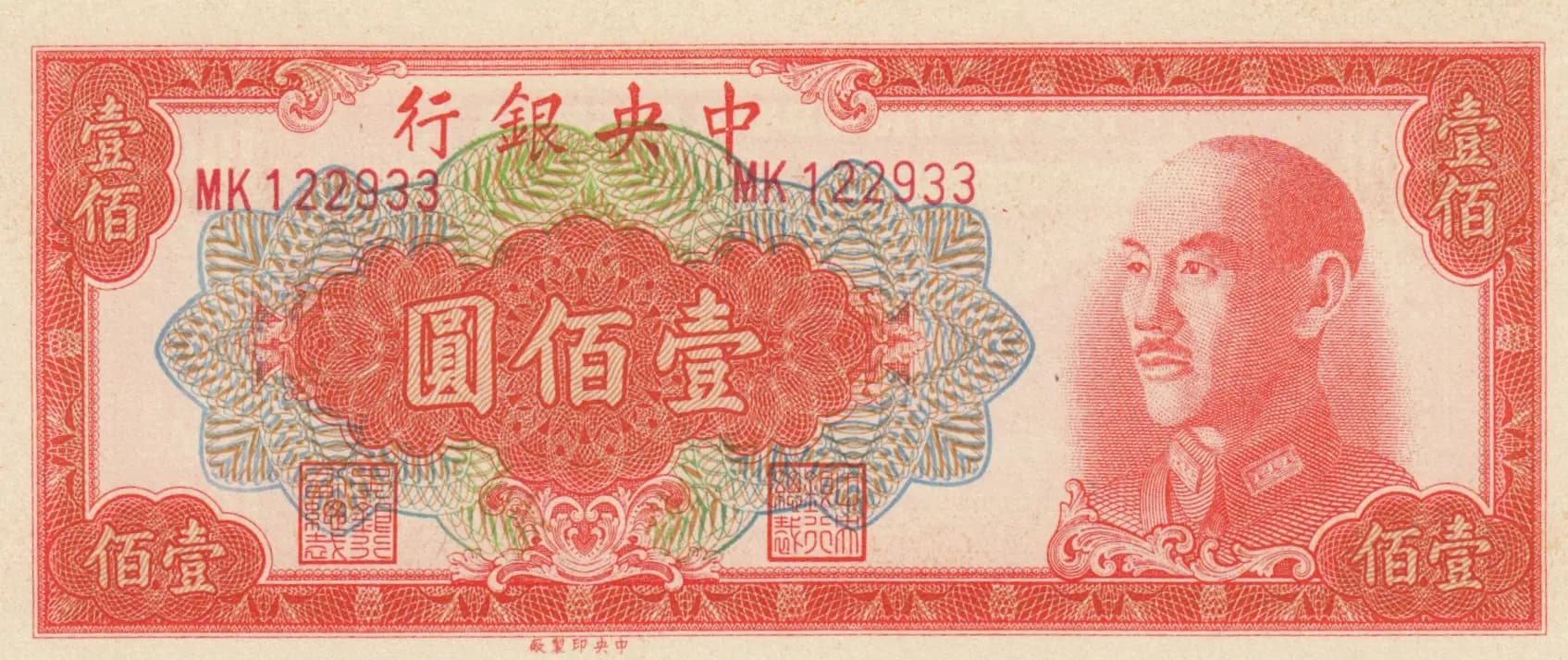
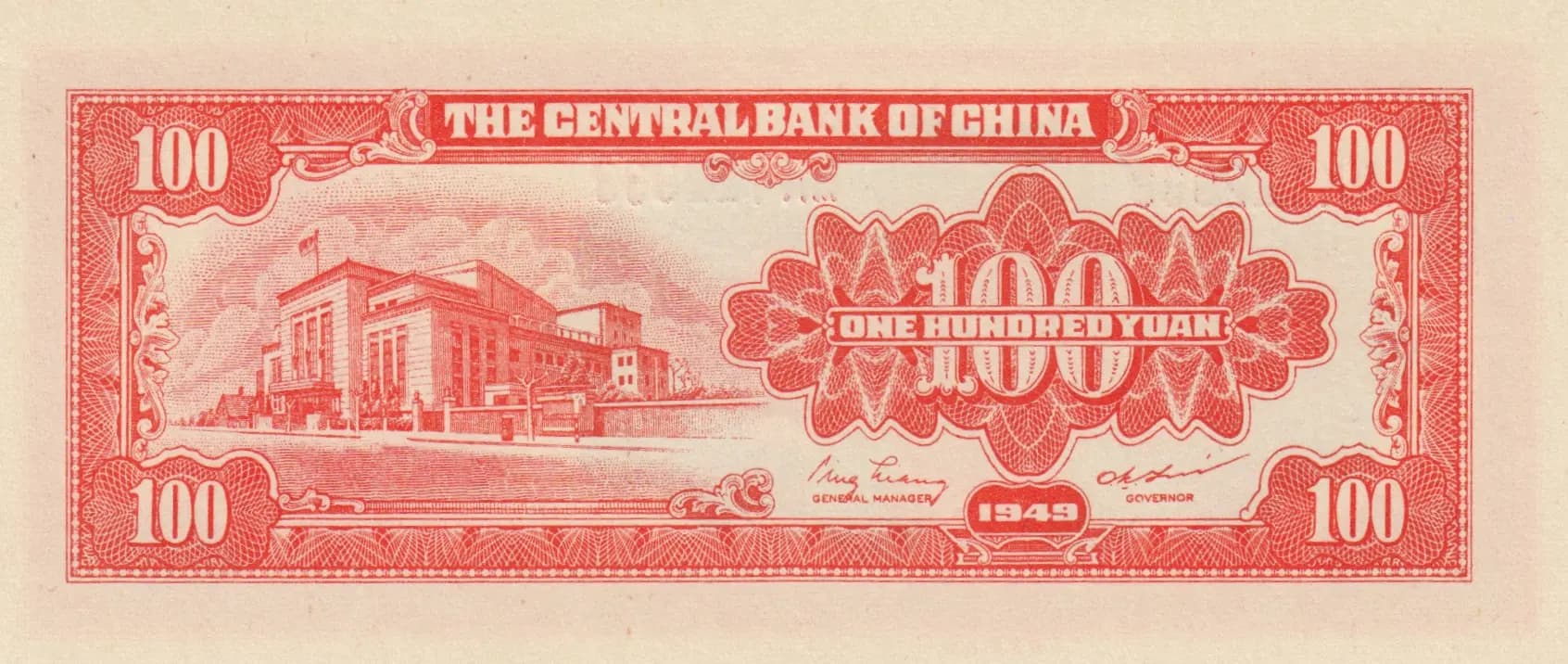
This is an uncirculated example of the 1949 Central Bank of China 100 Gold Yuan (Pick 408), displaying excellent preservation with crisp printing and no visible wear. The note features distinctive red linework on a cream background with an ornate cloud-shaped cartouche containing Chinese characters on the obverse, and a neoclassical institutional building on the reverse. The UNC condition, combined with the intricate multicolor security printing and bilingual inscriptions (Chinese and English), makes this an attractive example from the final year of the Central Bank's gold yuan issue before the currency's collapse.
Common. While historically significant as the final Gold Yuan issue before currency collapse, this denomination exhibits no rarity premium. eBay transaction data shows consistent sales across all grades (2011-2021) at modest prices: VF specimens typically sell for $4-10, PMG-graded examples for $11-65 depending on grade, and even UNC catalog values were listed at only $15 in 2016. The broad availability of this issue in the secondary market, combined with modest realized prices even for graded high-grade examples, confirms this as a common date-denomination combination.
Issued in 1949, this banknote represents the Central Bank of China's final attempt to stabilize currency during the Chinese Civil War's concluding phase, when the Gold Yuan standard was implemented to combat hyperinflation. The architectural landmark depicted on the reverse reflects the institutional authority the Nationalist government sought to project, while the bilingual inscriptions (Chinese and English) demonstrate the note's intended circulation in treaty ports and international commercial centers. By late 1949, the Gold Yuan had effectively collapsed as the People's Republic of China was established, making this denomination's circulation period extremely brief and historically significant.
The obverse features a portrait of Chiang Kai-shek (the man in military uniform rendered in profile facing left), positioned at the right side of the note, rendered in red linework characteristic of 1949-era Chinese banknote design. The central element is an elaborate cloud-shaped cartouche containing denomination text, surrounded by intricate geometric and floral border patterns in red, green, blue, and gold/tan inks on a cream background—a design aesthetic reflecting traditional Chinese artistic motifs combined with Western security printing techniques. The reverse depicts an institutional building of neoclassical architecture (likely representing the Central Bank's headquarters or a national financial institution), rendered in fine linework detail within an ornamental frame, with large denomination numerals in all four corners and bilingual text emphasizing the note's official government authority.
OBVERSE: 中中央銀行 (Central Bank, reading right-to-left in traditional orientation) | 百佰圓 (One Hundred Yuan, shown in corners) | 國民黨 (Republic of China) | MK122933 (serial number, appearing at top left and right). REVERSE: THE CENTRAL BANK OF CHINA | ONE HUNDRED YUAN | 100 (shown in all four corners) | 1949 (issue year) | GOVERNOR (signature line) | GENERAL MANAGER (signature line).
Intaglio (line engraving) printing, as evidenced by the fine detailed linework throughout both sides and the characteristic crisp impression of the portrait and architectural details. The printer was CPF (China Printing and Finishing, identified in catalog data as S/M #C302-50). The multicolor security printing was achieved through separate intaglio plates for the red primary design, with green and blue color accents applied through additional passes, a standard technique for high-security currency production of the period.
This specimen displays serial number MK122933, with the 'MK' prefix indicating the batch assignment. The note is from the regular issue of 1949 without overprints or special markings. No significant varieties are documented for Pick 408; the primary distinguishing factor among surviving examples is condition grade and the presence of printer's marks or signature variations on the reverse signature lines, which are standard for this issue and do not constitute separate varieties.