100 coppers 1914
Market Prices
About This Note
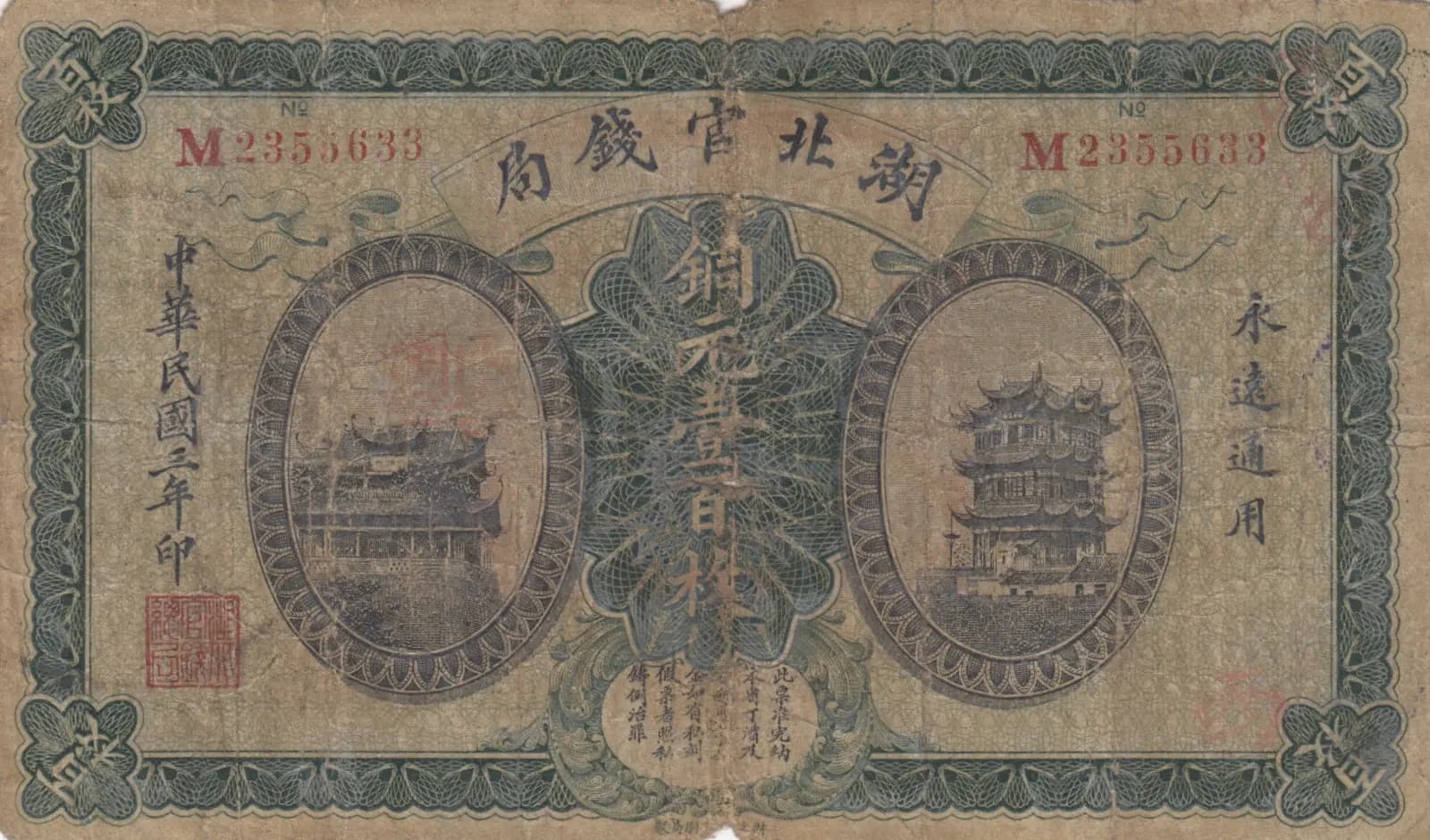
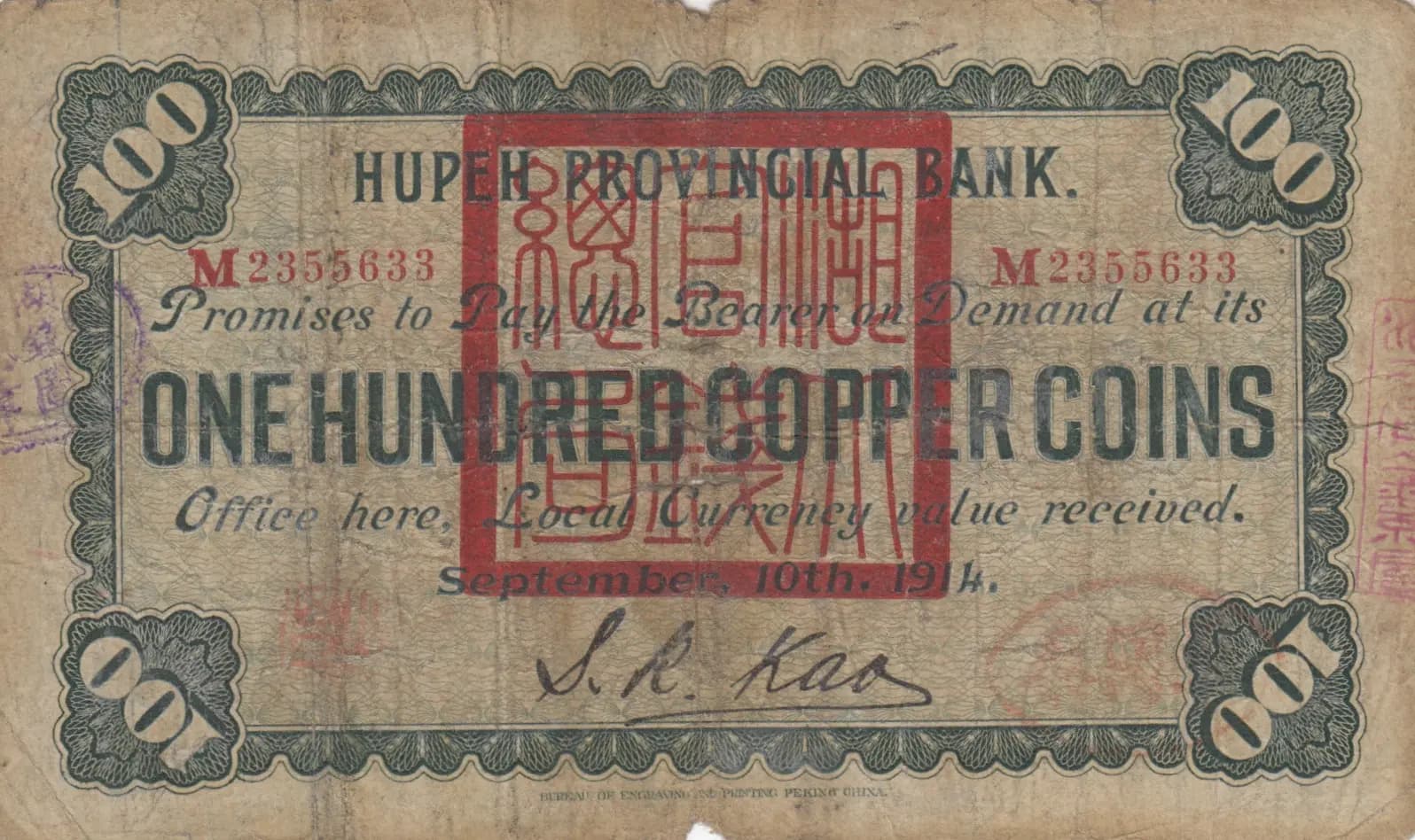
This Hupeh Provincial Bank 100 Copper note from 1914 represents a significant piece of Chinese regional banking history, featuring bilingual English-Chinese design typical of early Republic of China currency. The note displays classical Chinese architectural landmarks in ornate oval frames flanking a central dragon emblem, with a striking red institutional overprint stamp on the reverse. In VG condition, it shows expected aging with tan discoloration, creasing, and foxing, consistent with circulation during the turbulent warlord period.
Common. While provincial bank notes from this period are collected, the Hupeh Provincial Bank 100 Copper denomination appears with reasonable frequency in the market. eBay comparable sales data shows consistent availability in VG condition around $60 USD, with higher grades (VF-AU) commanding $100-$725 depending on condition and eye appeal. The relatively modest pricing and consistent market supply indicate this is not a scarce or rare variety. Large numbers of these notes likely circulated and survived given their functional design and relatively recent date.
Issued during the early Republic of China (民國三年 — Year 3 of the Republic, corresponding to 1914), this note reflects the provincial banking system established after the 1911 Xinhai Revolution when regional banks were chartered to issue local currency. The Hupeh (湖北) Provincial Bank's bilingual promissory format with English text demonstrates the Western commercial influence and treaty-port banking practices prevalent in early 20th-century China. The depicted pagoda buildings represent the architectural heritage of the Hupeh region, while the dragon symbol invokes traditional imperial authority now repurposed for the new republican era.
The obverse features a balanced composition with two oval-framed architectural vignettes depicting multi-story pagodas with distinctive upturned eaves characteristic of Hupeh region temples. These flank a central ornate dragon emblem rendered in flowing traditional style, symbolizing authority and prosperity. The entire design is surrounded by an elaborate decorative border composed of fan-like floral patterns and corner flourishes typical of turn-of-the-century Chinese bank note artistry. The reverse presents a bilingual layout with prominent English legal tender text formatted in the Western promissory note style, overlaid with a large red institutional stamp that serves as authentication. The color palette of tan/beige paper with dark green/teal and red accents reflects period printing conventions. The note measures standard dimensions for this series and employs symmetrical layout principles balancing Eastern and Western design traditions.
FRONT: Central text reads '中華民國 三年 印製' (Republic of China, Year 3, Printed). Right side contains '本 選 通 月' (partial institutional designation). Red serial numbers 'M2356633' appear in upper left and right corners. A red seal/chop mark appears in the lower left. Traditional Chinese characters at top likely form the bank name reading right-to-left. BACK: English text dominates: 'HUP PROVINCIAL BANK' / 'Promises to Pay the Bearer on Demand at its' / 'ONE HUNDRED COPPER COINS' / 'Office here, Local Currency value received.' / Date line: 'september, 10th, 19__' with signature 'K.K. Kaa'. Footer: 'BUREAU OF ENGRAVING & PRINTING PEKING CHINA'. Large red rectangular overprint stamp in center contains Chinese characters (institutional validation mark). Serial numbers repeated as 'M2355633'.
Intaglio (engraved) printing with multi-color lithographic elements, as evidenced by the detailed fine-line work visible in the ornamental borders, architectural vignettes, and dragon emblem. The Bureau of Engraving & Printing in Peking (Beijing) handled production, indicating use of advanced printing technology available in the capital. Red overprint stamp applied as separate post-printing process using either lithography or rubber stamp technique. The crisp detail work, layered color registration, and fine ornamental patterns are characteristic of high-quality security printing from this era.
Serial number variety M2356633 observed on obverse (noted as M2355633 on reverse, likely a printing variation or cataloging discrepancy common to this series). The signature 'K.K. Kaa' appears to be a specific authorized signer for this batch. The red institutional overprint stamp, while present on all known examples of this type, represents a key identifying characteristic distinguishing this 1914 issue from potential later re-printings or related varieties. Date line shows 'september, 10th, 19__' with year field partially obscured or blank, consistent with undated examples of this series from 1914-1915 production runs.