100 000 gold yuan 1949
Market Prices
2 salesAbout This Note
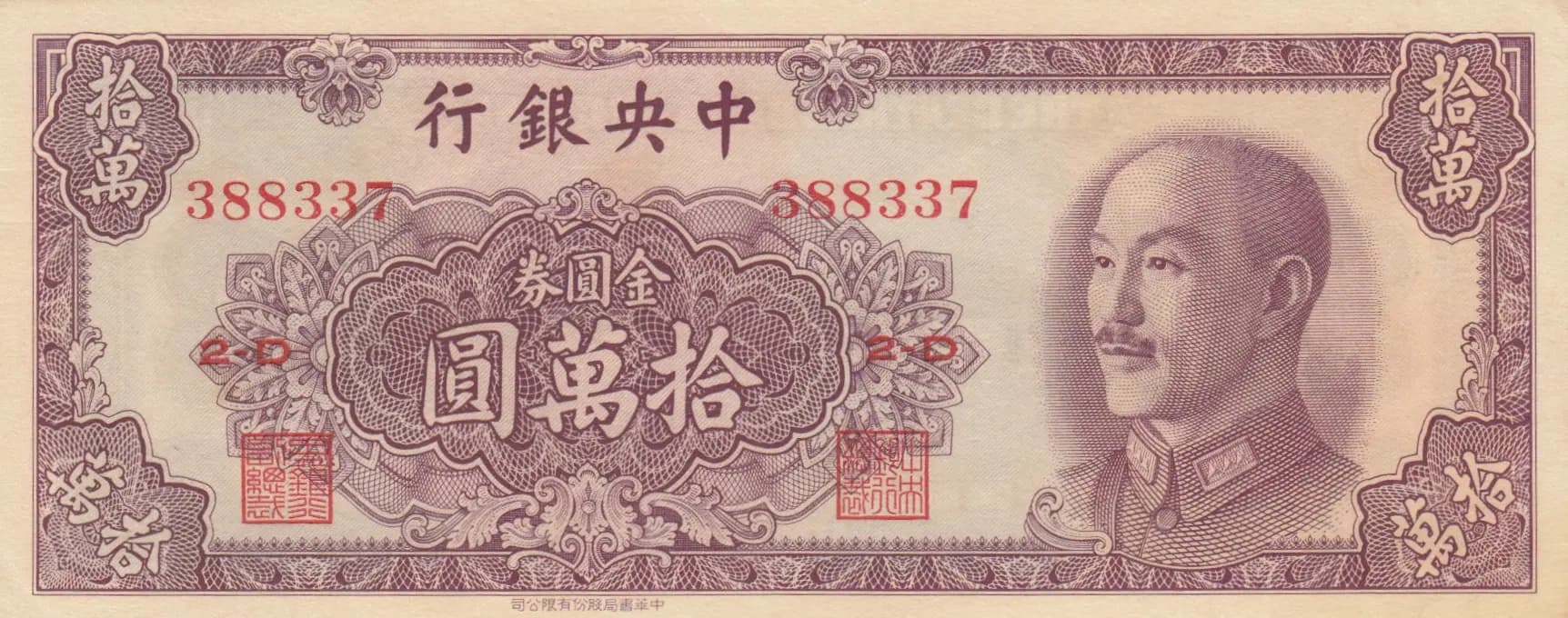
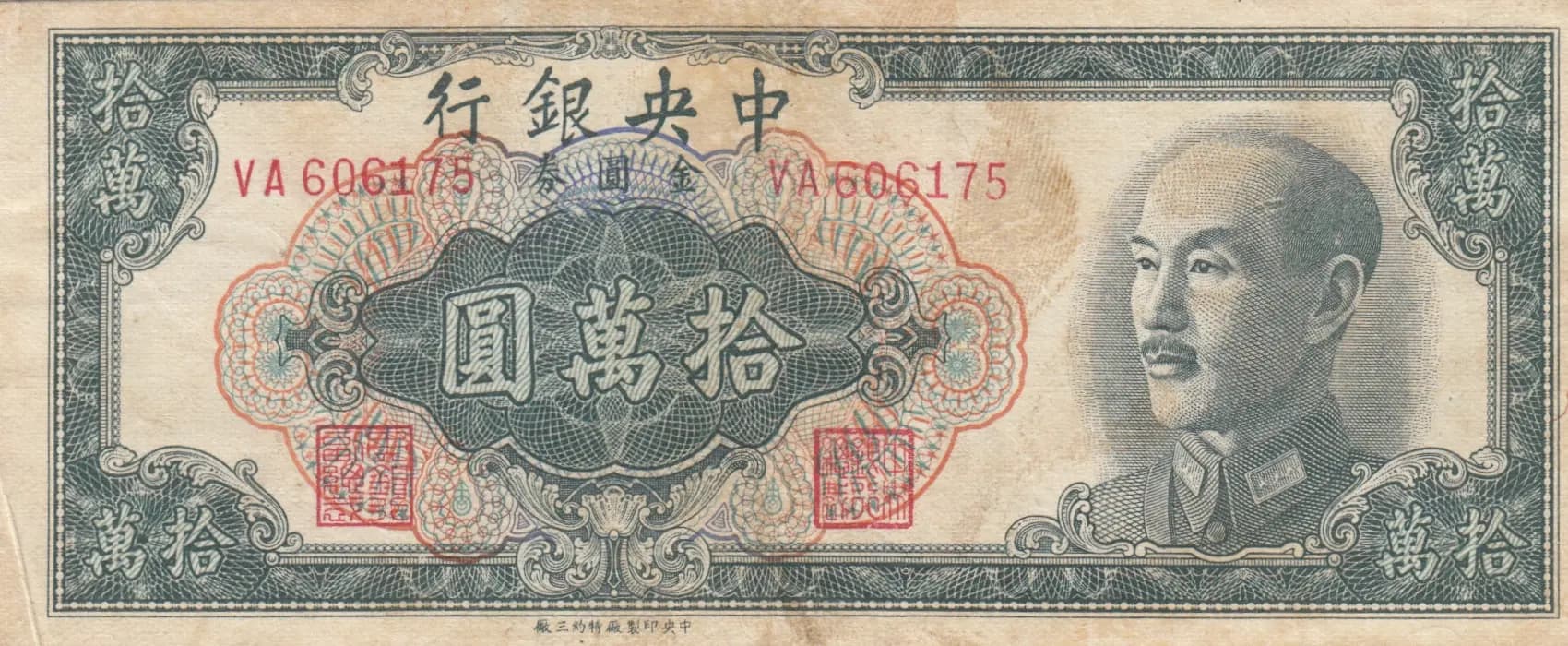
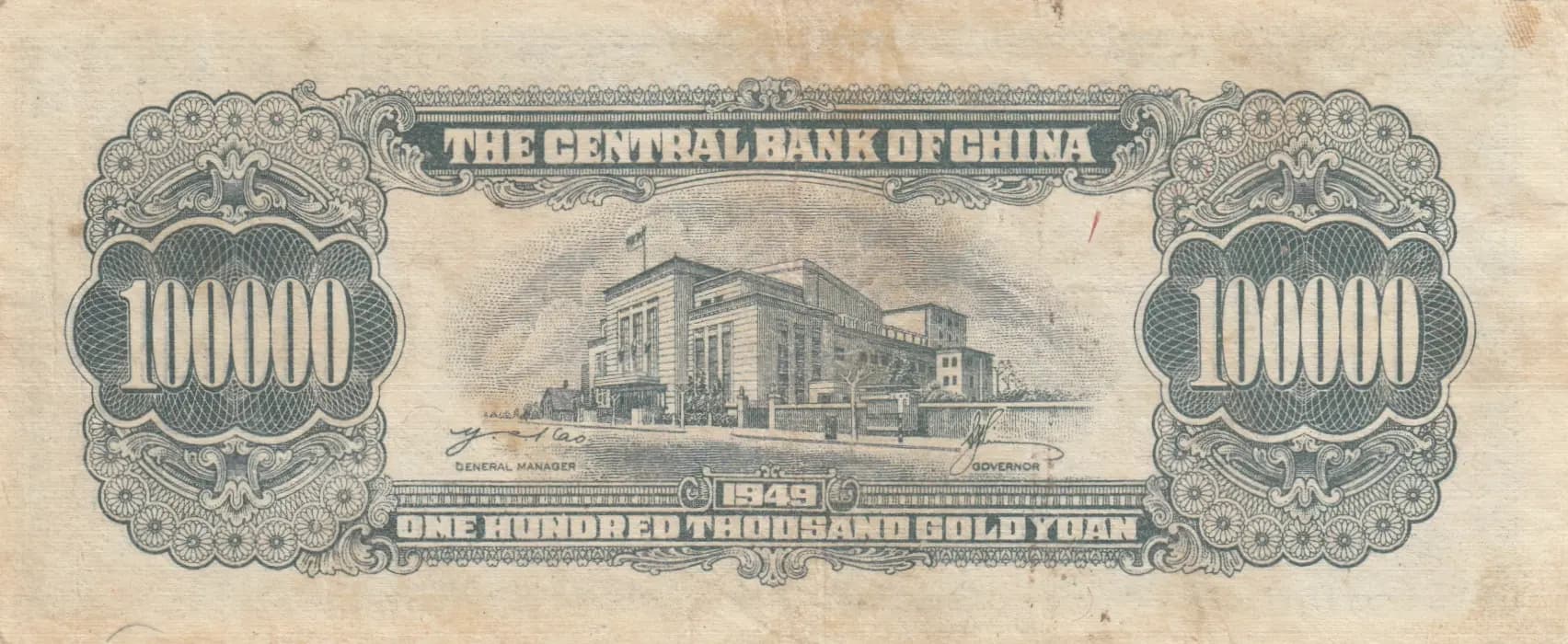
This 1949 Central Bank of China 100,000 Gold Yuan note (Pick P-422) presents a fascinating example of Chinese currency from the final year of the Republic before the Communist takeover. The note exhibits VF condition with significant age patina, cream-colored staining, and foxing throughout, yet remains structurally sound with no major tears. The design showcases exceptional engraving work featuring traditional Chinese decorative elements on the obverse and a detailed classical government building on the reverse, making it a visually compelling historical artifact.
Common. Despite the historical significance of 1949 as the final year of the Republic, these 100,000 Gold Yuan notes were produced in substantial quantities as part of the desperate monetary expansion during the hyperinflationary endgame. eBay market data shows similar notes selling in the $16-$99 range depending on condition and grading service, with the 2016 catalog value for VF condition at just $2.50. The presence of multiple examples in circulation records and modest pricing indicates this is not a scarce note.
This note was issued in 1949, the final year of the Chinese Republic (1912-1949) before the establishment of the People's Republic of China. The Central Bank of China, depicted through its building on the reverse and identified in both Chinese and English inscriptions, represents the last official monetary authority of the Nationalist government. The high denomination and 'Gold Yuan' designation reflect the hyperinflation crisis of the late 1940s, when increasingly larger denominations were required as the currency's purchasing power collapsed in the chaotic final months of the Chinese Civil War.
The obverse features an engraved portrait of a middle-aged man in formal military-style dress with high collar, rendered in classical black and white engraving technique, positioned on the right side of the note. The central design incorporates an ornate cartouche with traditional Chinese scrollwork, cloud motifs, and decorative borders typical of early-to-mid 20th century Chinese banknote design. The reverse showcases a detailed architectural engraving of the Central Bank of China's building—a symmetrical classical structure with prominent columns, multiple stories, windows, and a flag pole, flanked by ornamental scalloped cartouches containing the large denomination numerals. The cream/beige background with green/teal and black printing creates a sophisticated, period-appropriate aesthetic.
Front side: 中央銀行 (Central Bank), 拾萬圓 (Ten Thousand Yuan - note the Chinese character denomination), Serial number VA606175 in red overprint. Back side: THE CENTRAL BANK OF CHINA, ONE HUNDRED THOUSAND GOLD YUAN, 100000 (in decorative cartouches on left and right), 1949, GENERAL MANAGER, GOVERNOR. The discrepancy between Chinese '拾萬圓' (10,000 yuan) and English 'ONE HUNDRED THOUSAND GOLD YUAN' represents the Gold Yuan currency reform of 1948.
This note was produced using traditional intaglio engraving combined with letterpress printing. The fine line work visible in the decorative borders, the detailed architectural rendering on the reverse, and the portrait engraving are characteristic of intaglio production. The red overprinted serial numbers appear to have been applied via a separate red ink printing pass. The Chinese Bureau of Engraving and Printing (or contracted security printers under Chinese Republic authority) produced these notes during the final years of Nationalist control.
The serial number prefix 'VA' indicates one variety among multiple prefixes issued for this denomination. The red overprint serial numbers were applied during the printing process, and different prefix combinations exist. The visible signature lines marked 'GENERAL MANAGER' and 'GOVERNOR' would carry manuscript signatures in issued examples (not visible in this worn specimen). No significant printing varieties or error notes are documented for this Pick number in standard catalogs, making this a standard issue of its type.