100 000 gold yuan 1949
Market Prices
9 salesAbout This Note
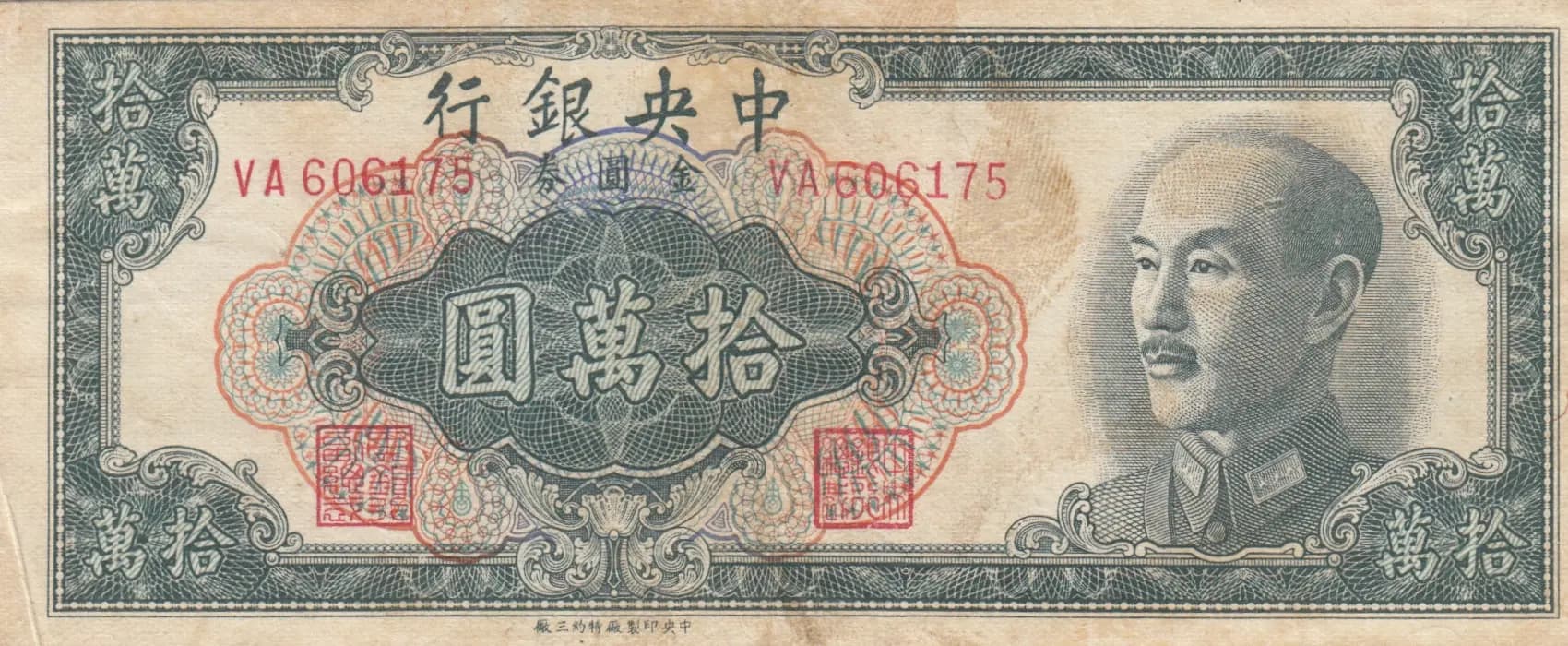
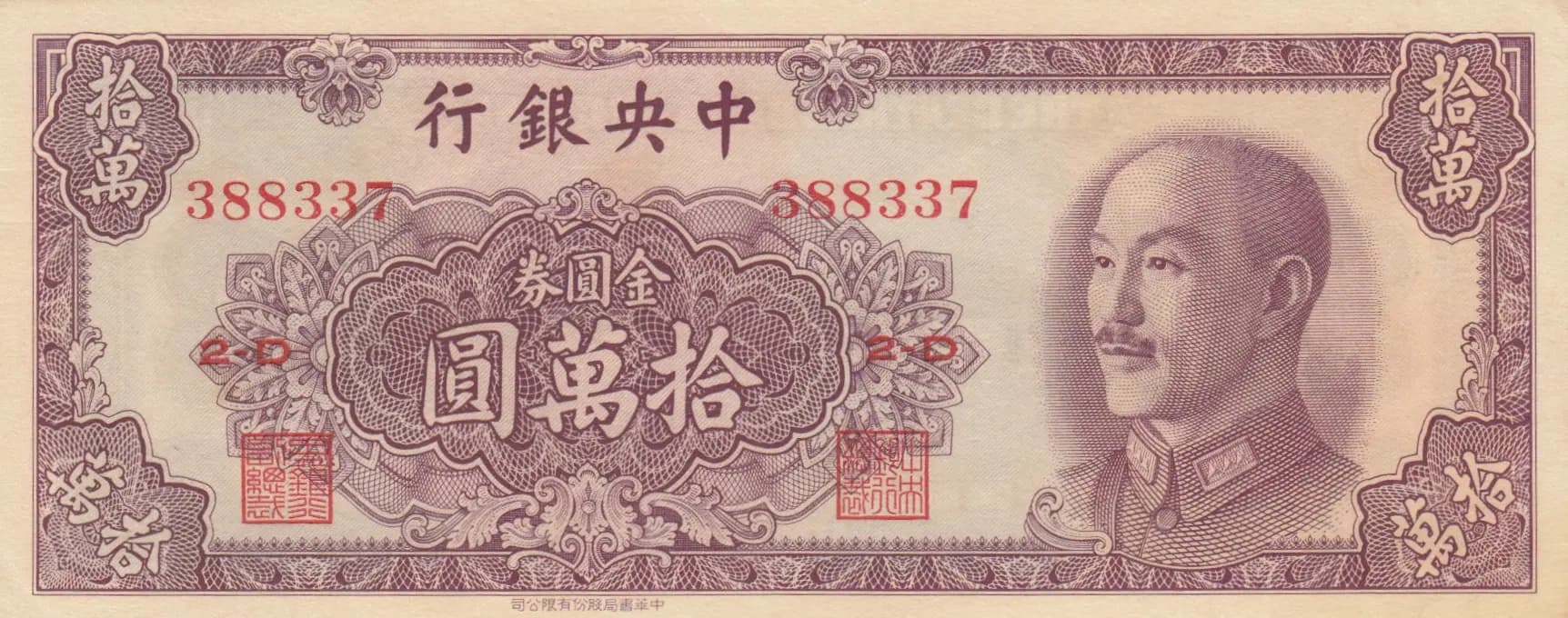
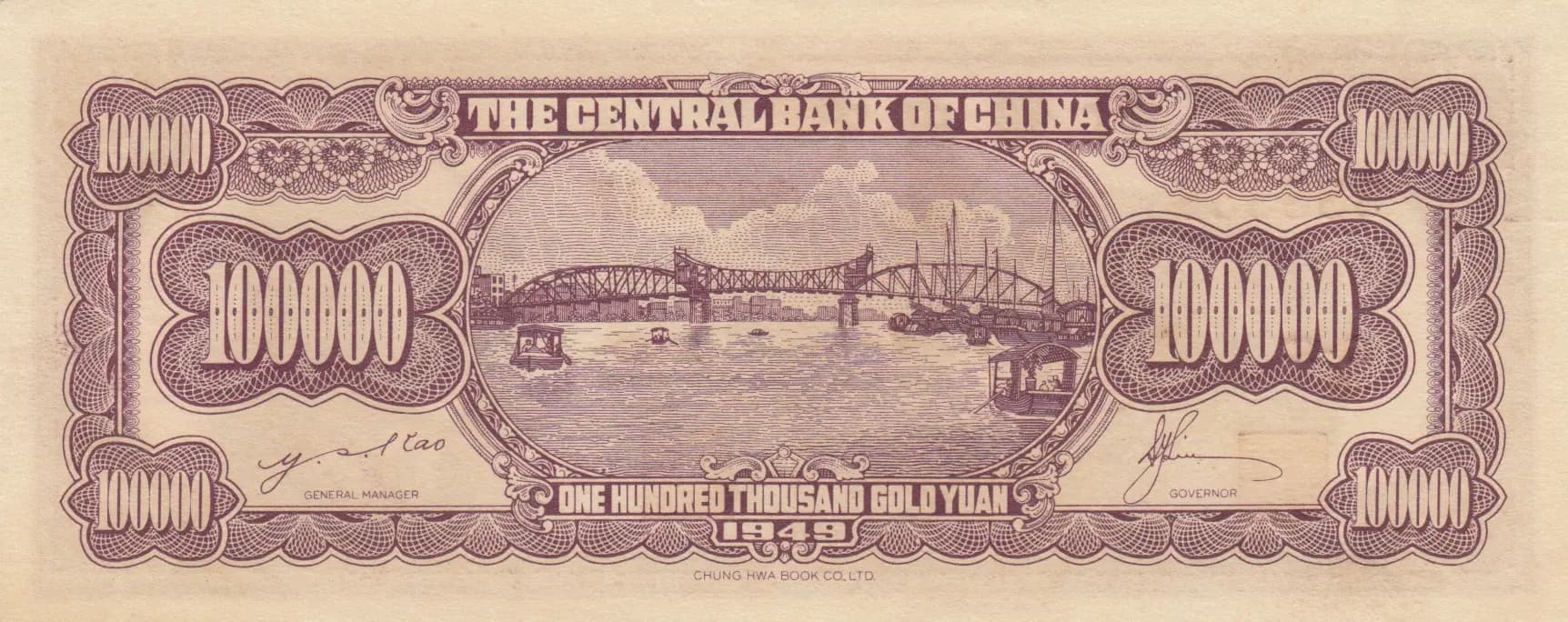
This is a stunning example of China's 100,000 Gold Yuan note from 1949, issued by the Central Bank of China during the final year of the Republic of China era. The note presents in AU (About Uncirculated) condition with crisp impressions, vibrant purple-mauve coloring, and no visible wear—displaying both an elegant portrait of a military figure on the obverse and an impressive industrial harbor vignette on the reverse that symbolizes China's modernization aspirations during this turbulent period.
Common. While this is historically significant as a final-year emission of a regime currency, the 100,000 Gold Yuan denomination was produced in substantial quantities. eBay market data shows regular sales ranging from $7.50 to $205.50, with most VF examples trading in the $30-40 range and UNC examples typically $75-115. The 2016 catalog value for UNC is only $15, indicating broad availability. No evidence of a short print run or recall exists for this particular Pick number.
The Gold Yuan (金圓券) was introduced in August 1948 as a currency reform measure by the Nationalist government, representing an attempt to stabilize China's economy amid hyperinflation during the final stages of the Chinese Civil War. The industrial harbor scene depicted on the reverse—featuring a modern steel bridge, smokestacks, and bustling port infrastructure—reflects the government's vision of economic modernization and industrial progress, even as political control was rapidly being lost to Communist forces. By 1949, when this note was issued, the currency had already become virtually worthless, and the Nationalist government would retreat to Taiwan within months, making these notes a poignant artifact of a regime's final desperate monetary efforts.
The obverse features an ornate baroque-style border frame with elaborate nested rectangles and decorative floral corner ornaments. The central design showcases a lobed cartouche containing Chinese denomination text, flanked by red rectangular seal stamps on either side. A dignified military portrait of a man with distinctive facial hair, shown in left profile, occupies the right portion of the note. The reverse displays a comprehensive industrial vignette depicting a large steel bridge spanning a river with multiple industrial buildings, prominent smokestacks, and maritime vessels—all rendered in fine line engraving. Large denomination numerals (100000) appear in elaborate scalloped frames at all four corners. The entire composition demonstrates the security printing conventions of the late 1940s, with extensive use of fine geometric patterns and landscape engraving to prevent counterfeiting.
FRONT SIDE: '中央銀行' (Central Bank), '金圓券' (Gold Yuan Certificate), '合拾萬圓' (One Hundred Thousand Yuan), serial number '388337' (appearing twice). BACK SIDE: 'THE CENTRAL BANK OF CHINA', 'ONE HUNDRED THOUSAND GOLD YUAN', '100000' (denomination numerals in all four corners), 'GENERAL MANAGER' and 'GOVERNOR' (signature lines), 'CHUNG HWA BOOK CO. LTD' (printer attribution).
Steel engraving (intaglio printing) throughout, executed by Chung Hwa Book Company Limited, the noted Chinese security printer. The technique is evident from the fine line detail visible in the background patterns, portrait rendering, architectural vignette, and border designs. Multiple passes and nested frame structures indicate professional security printing standards of the period.
The observed specimen displays serial number 388337 (appearing twice as per standard practice). This specific Pick-421 note exists in multiple series based on Chinese serial number prefixes and signatures by different Central Bank officials (Governor and General Manager lines). The visual analysis does not reveal overprints or exceptional varieties, suggesting this is a standard issue from the main production run. Collectors should note serial number prefixes and signature combinations when assembling comprehensive collections of this denomination.