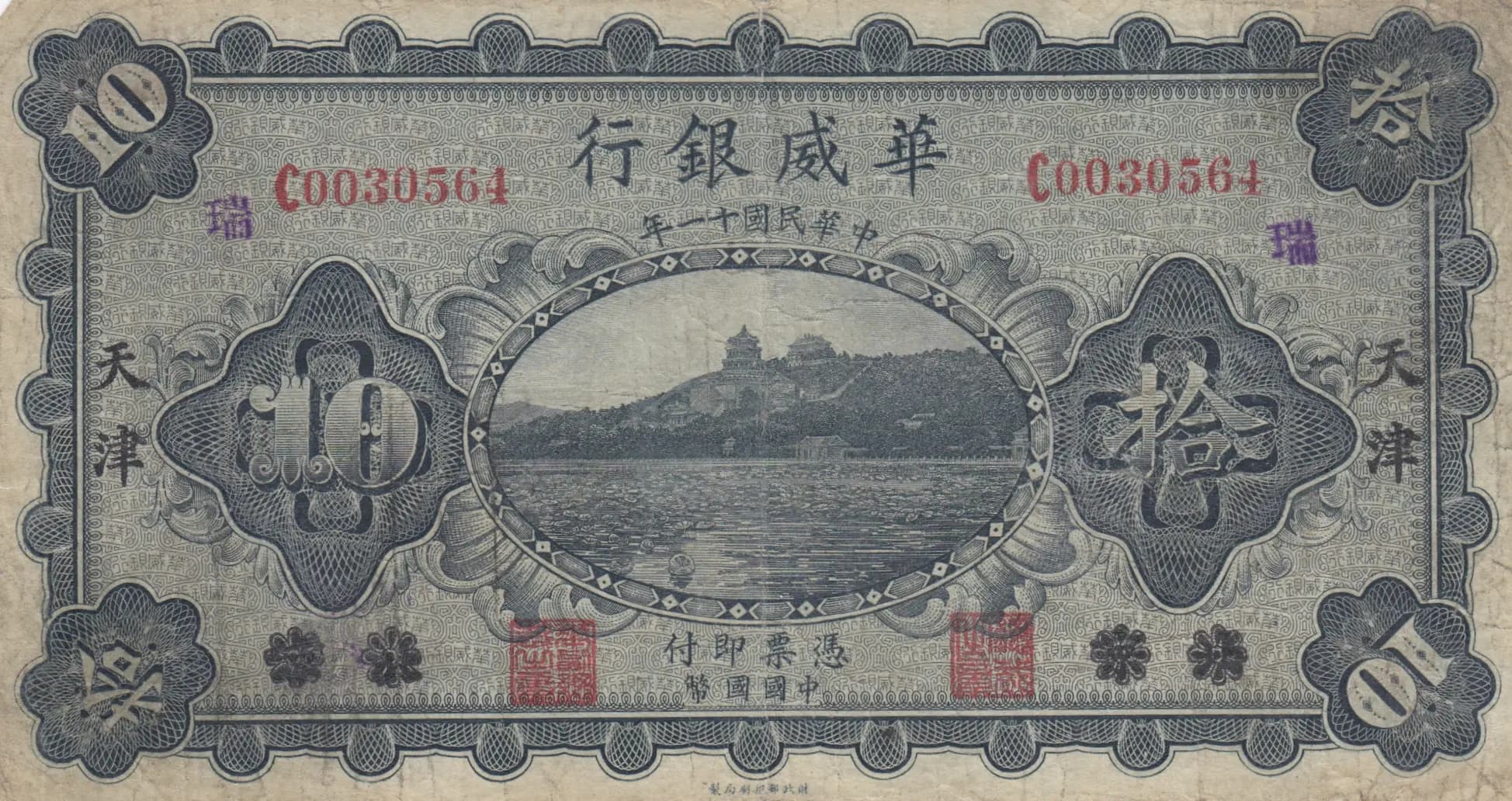
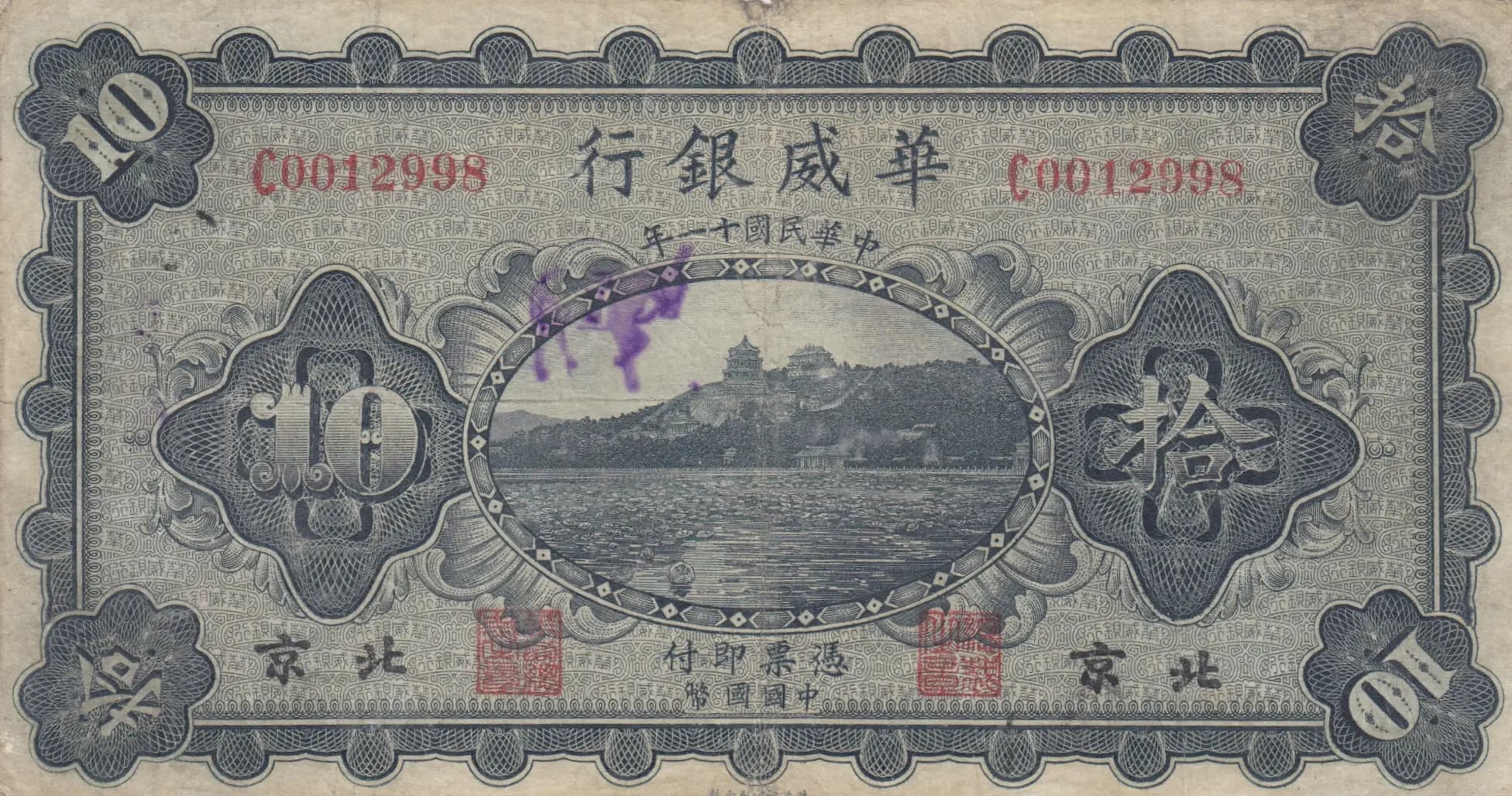
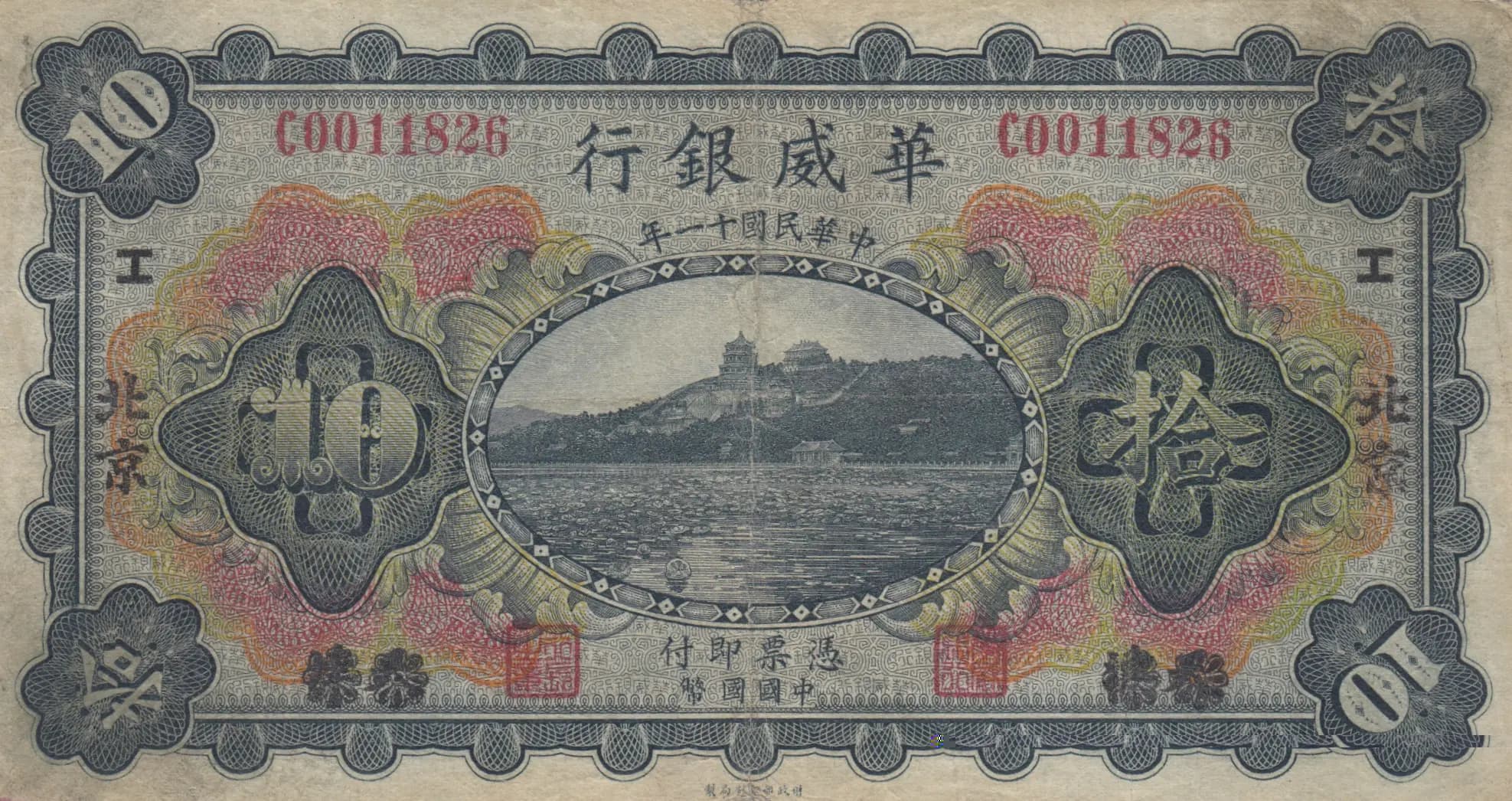
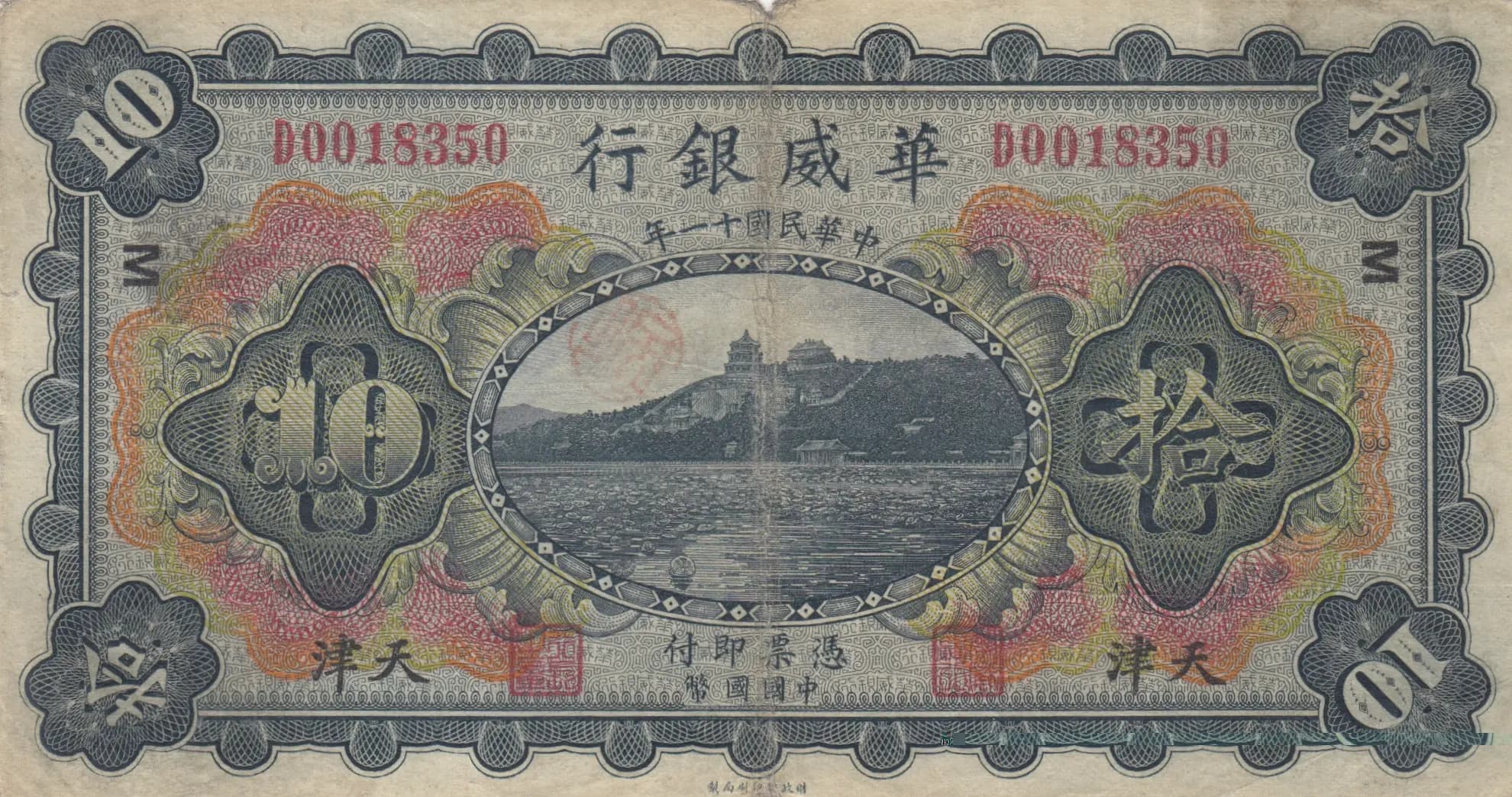
10 yuan 1922
Market Prices
About This Note
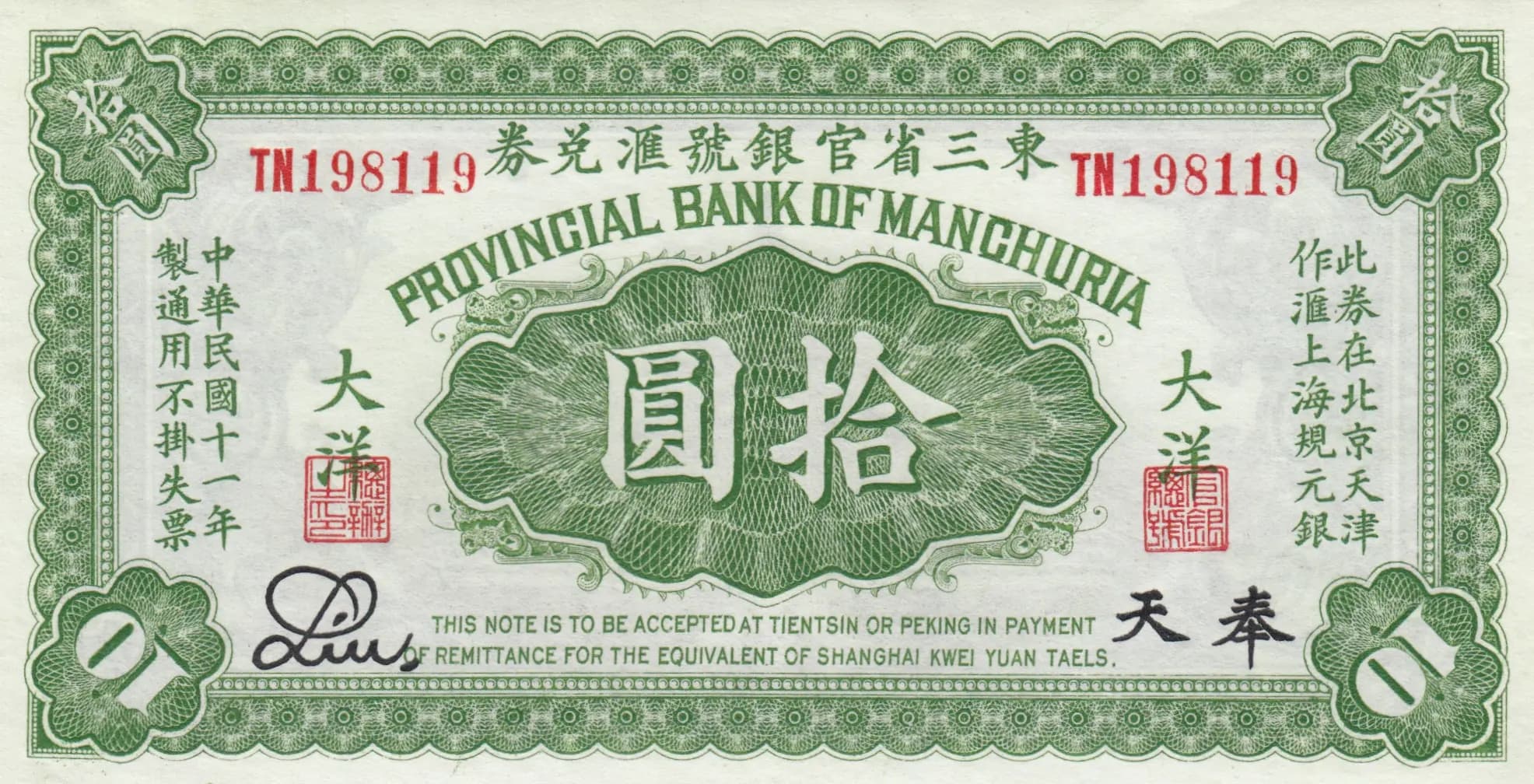
This is an uncirculated example of a 10 Yuan note issued by the Provincial Bank of Manchuria in 1922, representing an important piece of early Chinese republican currency. The note exhibits pristine condition with sharp impressions, vibrant green obverse and dark blue reverse printing, and complete margins—characteristics typical of UNC specimens. The dual-language design (English and Chinese) and reference to Shanghai silver dollar standards reflect the complex financial arrangements of 1920s Manchuria during a period of regional autonomy.
Common. The eBay price tracking data shows UNC specimens listed at $492.00 USD, which represents a premium for uncirculated preservation, but numerous lower-grade examples trade regularly at $7–$32 USD. The Provincial Bank of Manchuria operated for an extended period and produced substantial quantities of this denomination. While regional Chinese banknotes from this era are not as common as later issues, this specific Pick number does not show characteristics of a rare or short-run issue. The wide range of condition grades appearing on secondary markets indicates adequate surviving population.
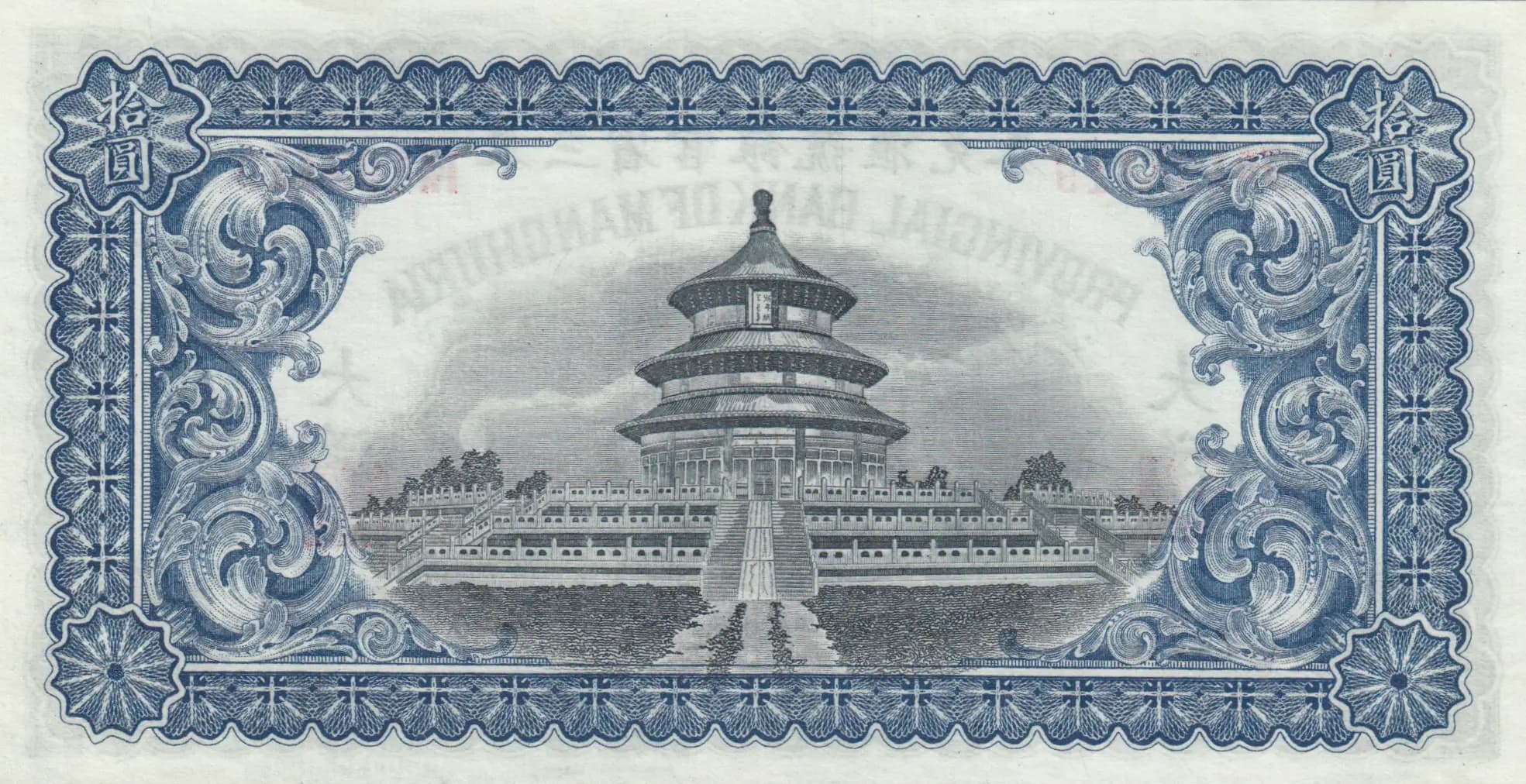
The Provincial Bank of Manchuria operated during the early Chinese Republic era (1922 corresponds to the 12th year of the ROC calendar), when Manchuria maintained quasi-independent financial institutions under Japanese influence. The note's explicit reference to redemption in Tientsin (Tianjin) and Peking (Beijing) underscores the bank's role in facilitating inter-regional commerce during a fragmented period of Chinese governance. The Temple of Heaven depicted on the reverse symbolized Chinese imperial tradition and national identity, even as regional banks asserted local financial authority.
The obverse features an ornate green-printed design with elaborate floral and geometric borders in all corners. A decorative oval cartouche dominates the center, flanked by red administrative seals or chops typical of Qing-era imperial seals adapted for republican use. Serial numbers in red alphanumeric characters (TN prefix) appear in the upper corners. The reverse displays a detailed line-engraved representation of the Temple of Heaven (Tiantan)—identifiable by its distinctive three-tiered circular pavilion structure with multiple surrounding buildings and landscaped grounds. The reverse employs dark blue/navy printing on a cream background with matching ornate scroll and floral borders in all four corners. Both sides demonstrate fine engraving technique consistent with professional security printing of the era.
FRONT: English inscriptions include 'PROVINCIAL BANK OF MANCHURIA' and 'THIS NOTE IS TO BE ACCEPTED AT TIENTSIN OR PEKING IN PAYMENT OF REMITTANCE FOR THE EQUIVALENT OF SHANGHAI KWEI YUAN TAELS.' Serial number appears as 'TN198119' (upper left and right). Chinese inscriptions: 東北三省銀行匯兌 (Provincial Bank of Manchuria), 十圓 (Ten Yuan), 中華民國十二年製造不用掉失票 (Made in the 12th year of the Republic of China, not to be used if damaged), 天奉 (reference marking), and 作北派遣北京天津上海北銀元規 (dispatch authorization for Beijing, Tianjin, and Shanghai with silver dollar standards). BACK: 拾圓 (Ten Yuan in traditional characters).
This note was produced using intaglio line engraving, evidenced by the sharp, crisp detail work visible in both the decorative borders and the architectural rendering of the Temple of Heaven. The multi-color printing (green obverse, dark blue reverse, red serial numbers and seals) indicates sequential passes through separate printing plates—a standard technique for security printing in the early 1920s. The precise registration and fine line work suggest production by a professional international security printer, likely contracted by the Provincial Bank of Manchuria; however, the specific printer attribution for Pick S2938 is not definitively documented in standard references.
The observed serial number prefix 'TN' is consistent with this Pick catalog designation (S2938). Serial number '198119' represents one variety within the regular issue. No overprints, altered dates, or emergency variants are visible in this specimen. Standard varieties for this pick number relate to serial number prefixes and ranges; collectors should note that different prefix codes (if any exist for this issue) may represent distinct sub-varieties, though detailed variety cataloging for Provincial Bank of Manchuria notes remains incomplete in English-language references.