10 yuan 1926
Market Prices
About This Note
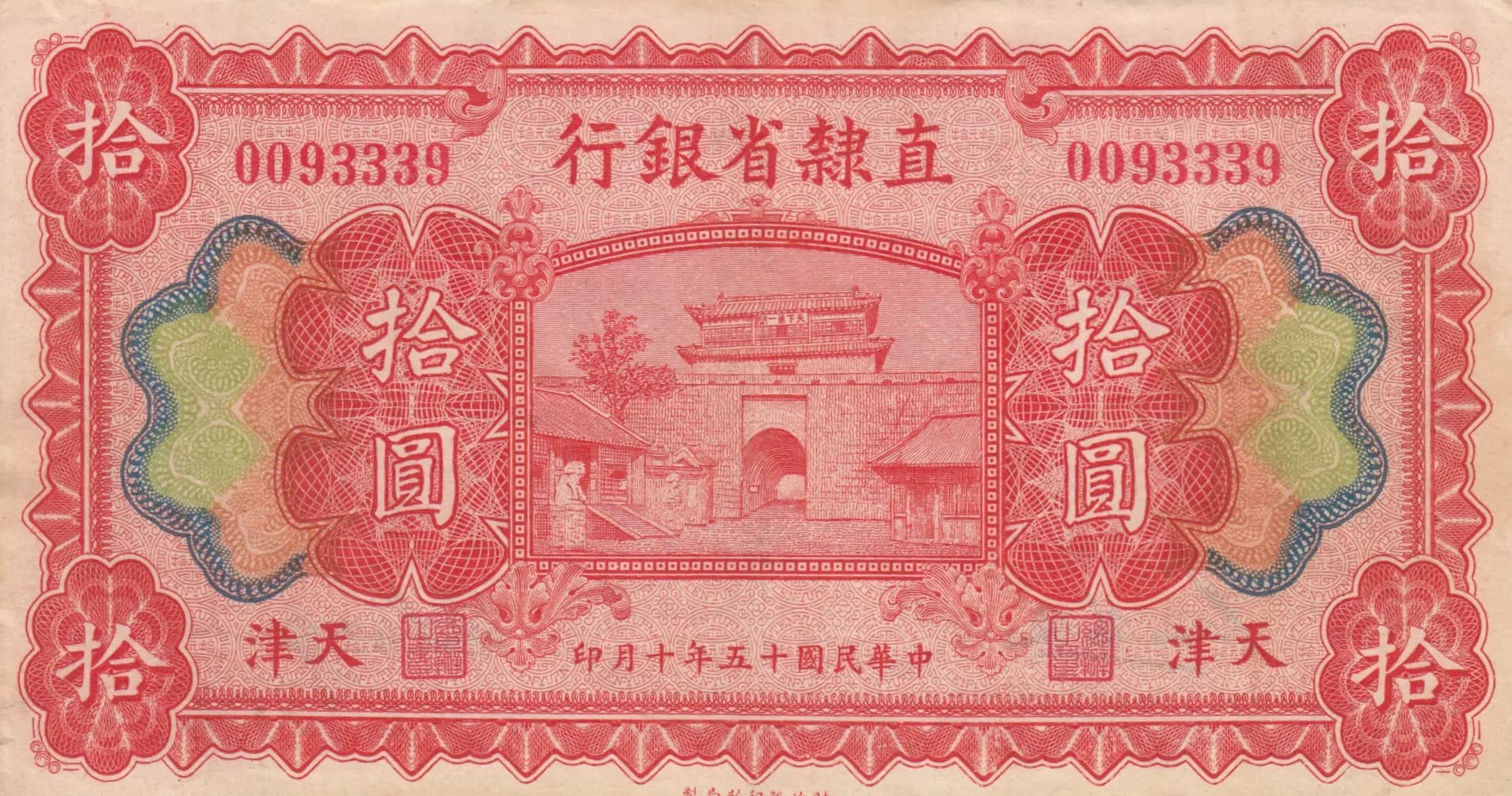
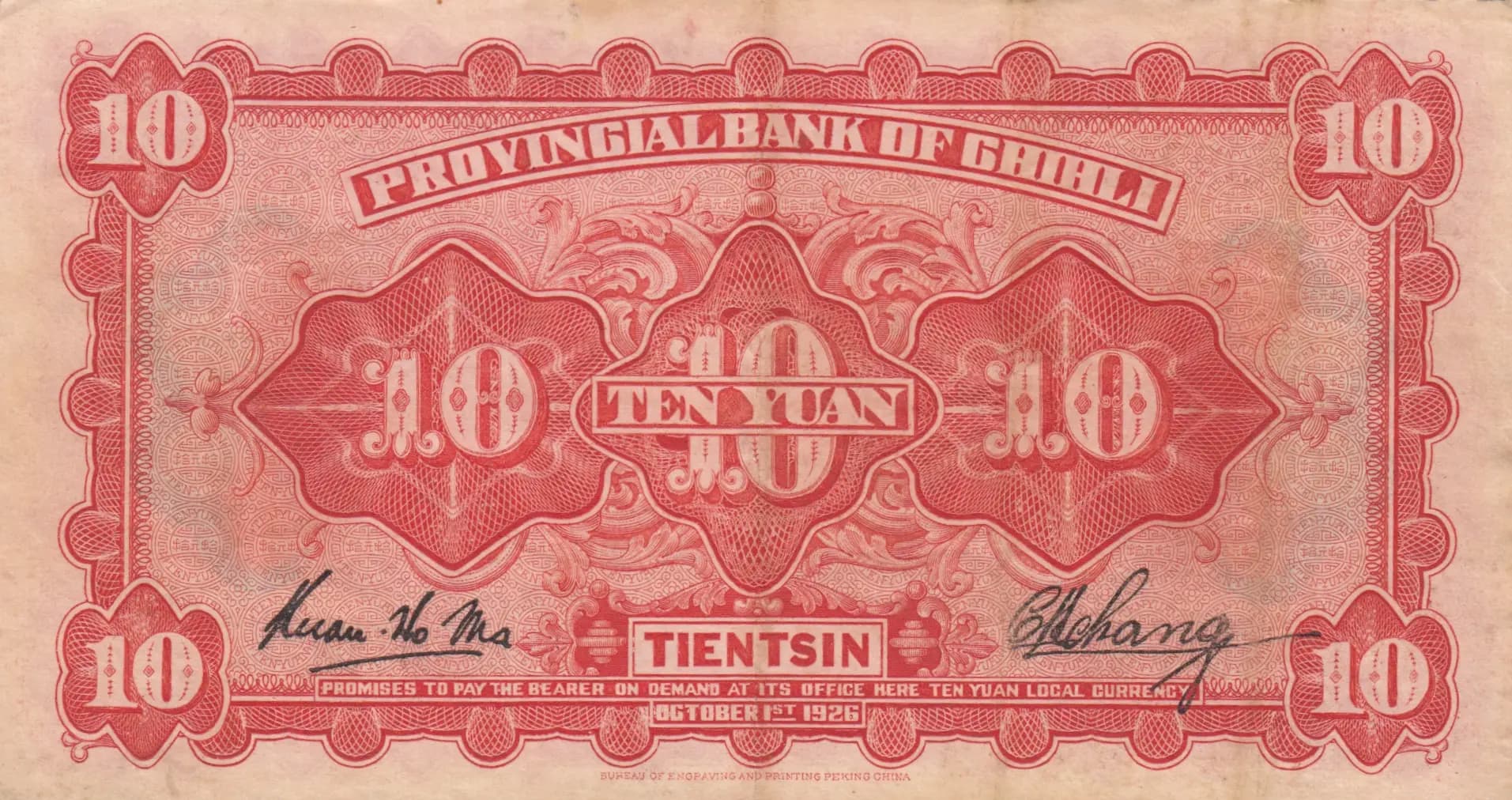
This is a VF-grade 10 Yuan note from the Provincial Bank of Chihli dated October 1, 1926, issued during the early Republic of China period. The note features a striking red/pink color scheme with ornate decorative borders, a traditional East Asian architectural gate structure as the central vignette, and bilingual Chinese-English text. Age-related discoloration and foxing are visible throughout, consistent with a nearly century-old banknote, though the printing remains relatively clear and the structural integrity is sound.
Common. The eBay market data provided shows VF specimens trading at $395.00 USD, with circulated examples ranging from $35.00-$65.00 USD and UNC examples reaching $700-$800.00 USD. These moderate to strong secondary market prices indicate reasonable availability of this issue in various grades. Provincial Bank of Chihli notes were issued in substantial quantities for local circulation during 1926, and this Pick number does not appear in catalogs as a short-run or rare variety. The fact that multiple examples appear regularly on the market in various grades confirms common status.
Issued by the Zhili (Chihli) Provincial Bank from Tianjin during the tumultuous 1926 period of the early Republic of China, this note reflects the era's regional banking autonomy before centralization of currency. The traditional architectural imagery on the front (the Zhili gate structure) symbolizes provincial identity and cultural continuity during a period of political fragmentation. The bilingual English-Chinese text and reference to the "Bureau of Engraving and Printing Peking China" indicate Western-influenced modern banking practices being adopted in China during this transitional period.
The obverse features a symmetrical design centered on a traditional multi-tiered East Asian gate or watchtower structure with curved roofs characteristic of Qing-era architecture, likely representing a Zhili provincial landmark. Large denomination numerals '拾' (ten) appear in all four corners in decorative cartouches. Ornate floral rosette medallions with cross-hatching in green and peacock blue are positioned on the left and right sides. The reverse emphasizes the English-language denomination, displaying '10' in decorative frames at all four corners, with 'TEN YUAN' prominently featured in a central cartouche. The phrase promising payment on demand reflects Western banking conventions being adopted in China during this period. Fine line work, intricate borders, and multi-color printing dominate both sides.
FRONT SIDE: Chinese characters include '拾圓' (Ten Yuan), '直隸省銀行' (Zhili Provincial Bank), '中華民國十五年' (Year 15 of the Republic of China, corresponding to 1926), and '天津' (Tianjin). Serial number: 0093339. BACK SIDE: English text reads 'PROVINCIAL BANK OF CHIHLI,' 'TEN YUAN,' 'TIENTSIN' (romanization of Tianjin), 'PROMISES TO PAY THE BEARER ON DEMAND AT ITS OFFICE HERE TEN YUAN LOCAL CURRENCY,' 'OCTOBER 1st 1926,' and 'BUREAU OF ENGRAVING AND PRINTING PEKING CHINA.' Two signatures appear: 'Huan Ho Ma' and 'Blichang' (likely transliterations of Chinese names).
Intaglio engraving (line engraving/steel plate engraving), produced by the Bureau of Engraving and Printing in Peking (Beijing), as credited on the reverse. The note exhibits characteristic intaglio security features including fine cross-hatching, intricate ornamental borders, detailed line work creating dimensional effects, and multi-color printing layering. The precise technical execution visible in the decorative rosettes and border patterns is consistent with early 20th-century security printing standards employed by the Peking Bureau.
This example is identified as Pick S1290a, the 'a' suffix typically indicating the first recorded variety of this denomination/date combination. The serial number 0093339 and signatures 'Huan Ho Ma' and 'Blichang' are consistent with the standard issue. The October 1, 1926 date is definitional for this note. No obvious overprints, test marks, or unusual security features distinguishing this as a rare variety are visible. The condition grade VF suggests this is a standard circulation example that has seen moderate handling.