10 yuan 1940
Market Prices
104 salesAbout This Note
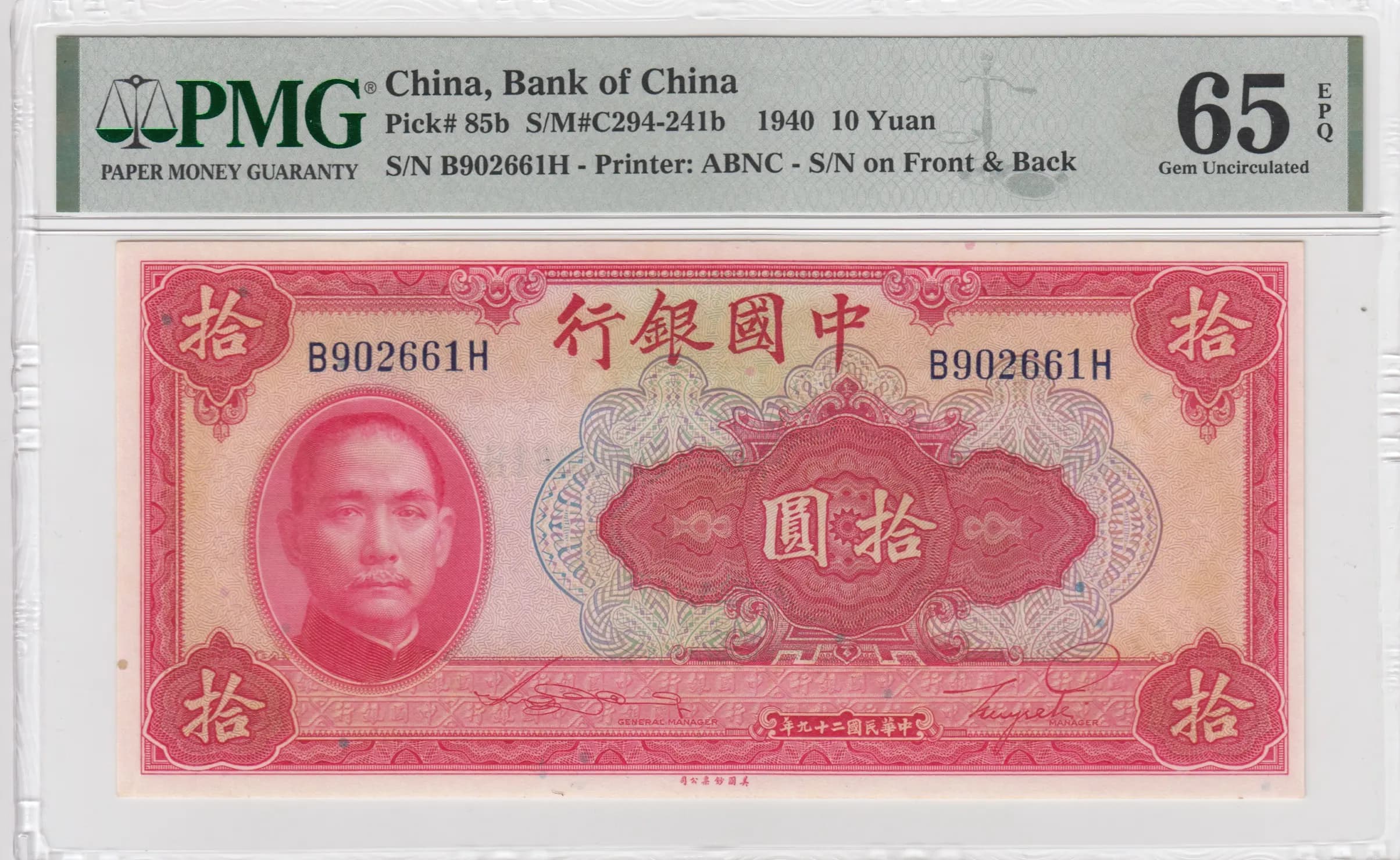
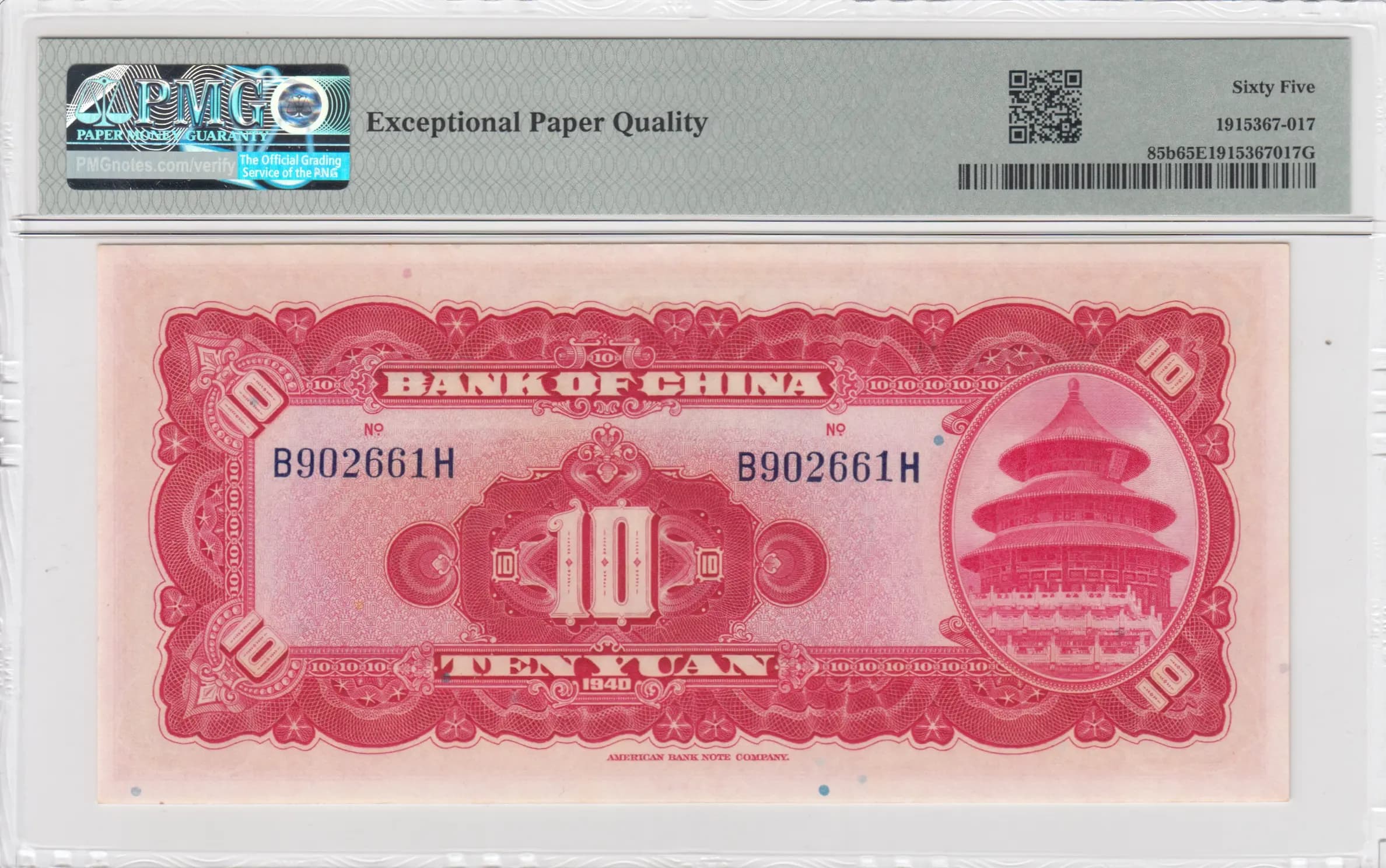
This is a PMG 65 EPQ example of the Bank of China's 1940 10 Yuan note (Pick P-85b), featuring exceptional preservation with pristine paper quality and bright, consistent coloring throughout. The obverse displays a portrait of Sun Yat-sen in an oval frame against a predominantly pink-red background with ornate corner badges, while the reverse showcases the Temple of Heaven in a similar oval cartouche with bilingual (Chinese-English) inscriptions. This gem-graded specimen represents one of the finer examples of this Republican-era Chinese currency, with recent eBay market data showing PMG 65 examples consistently realizing $20-45 USD, reflecting solid collector demand for high-grade examples of this historically significant issue.
Common. This note, while historically significant, was issued in substantial quantities by the Bank of China during wartime operations. Market data from eBay clearly demonstrates commonality: ungraded examples regularly sell for $1-8 USD, while PMG 65 graded specimens typically realize $20-45 USD. Over the past decade-plus of price history provided, even high-grade examples (PMG 66-67) rarely exceed $150 USD, with most transactions clustering in the $20-40 range. The consistent, relatively modest pricing across all grade levels indicates robust supply. This is a collector-accessible note rather than a scarce or rare issue.
This 1940 issue represents the Bank of China's paper currency during the height of Japanese occupation and the Second Sino-Japanese War, a tumultuous period in Chinese history. The portrait of Sun Yat-sen, founder of the Chinese Republic, served as a patriotic symbol of Chinese nationalism and continuity of the Republican government, while the Temple of Heaven—one of China's most sacred architectural landmarks—reinforced cultural identity and legitimacy during wartime. The bilingual English-Chinese inscriptions and American Bank Note Company printing reflect China's continued financial and diplomatic connections with Western powers during this critical historical moment.
The obverse features a formal portrait of Sun Yat-sen (孫中山), founder of the Republic of China, rendered in fine intaglio detail within a left-positioned oval frame, surrounded by ornate geometric badge designs in all four corners incorporating the Chinese character for 'ten' (拾). The reverse depicts the Temple of Heaven (天壇), Beijing's most iconic religious and architectural monument, presented similarly in an oval cartouche on the right side with matching decorative corner elements. Both sides employ symmetrical, ornate border patterns in dark red and maroon against cream-beige background areas, with the denomination prominently displayed as both Chinese characters (圓拾) and English numerals (10). The overall design reflects classical Republican-era Chinese banknote aesthetics, emphasizing national symbols and historical figures.
FRONT: '中國銀行' (Bank of China), '拾' (Ten), '圓拾' (Ten Yuan), serial number 'B902661H' appearing twice. BACK: 'BANK OF CHINA', 'THE BANK', '10' (Ten), '1940' (Year of issue), 'AMERICAN BANK NOTE COMPANY' (printer attribution), serial number 'B902661H' appearing twice with 'NO' prefix designation. Chinese character '拾' (Ten) repeated in decorative cartouches throughout margins on both sides.
This note was produced using intaglio engraving (also called steel plate engraving), evidenced by the fine, detailed line work visible throughout the portrait, architectural elements, and decorative borders. The intricate parallel line patterns in backgrounds and the precise rendering of the Temple of Heaven architectural details are characteristic of high-quality intaglio work. American Bank Note Company (ABNC), one of the world's premier security printers, produced this note, and their signature appears on the reverse. The multi-color printing effect (pink-red on cream underprint) was achieved through the traditional intaglio process using multiple plates and careful registration.
This note is catalogued as Pick P-85b, representing one of two known variants for the 1940 10 Yuan Bank of China issue (P-85a and P-85b designations exist in PMG records). The 'b' designation typically indicates a minor variety difference from the 'a' variant—potentially involving subtle changes to design elements, serial number characteristics, or printing characteristics, though specific distinguishing features between these variants require detailed comparison with P-85a examples. The serial number on this specimen is B902661H, appearing on both obverse and reverse as required for this issue.