1000 yuan 1949
Market Prices
8 salesAbout This Note
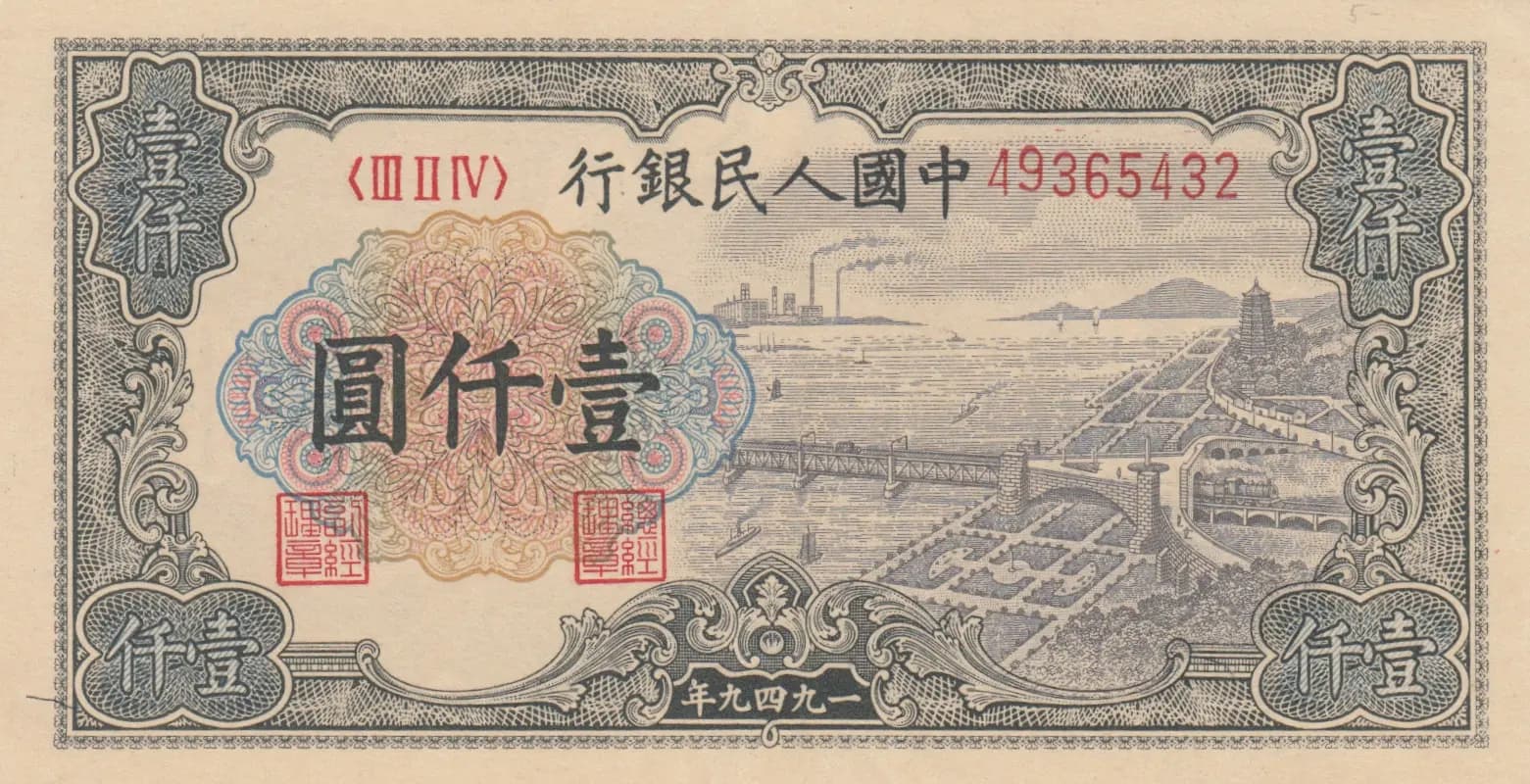
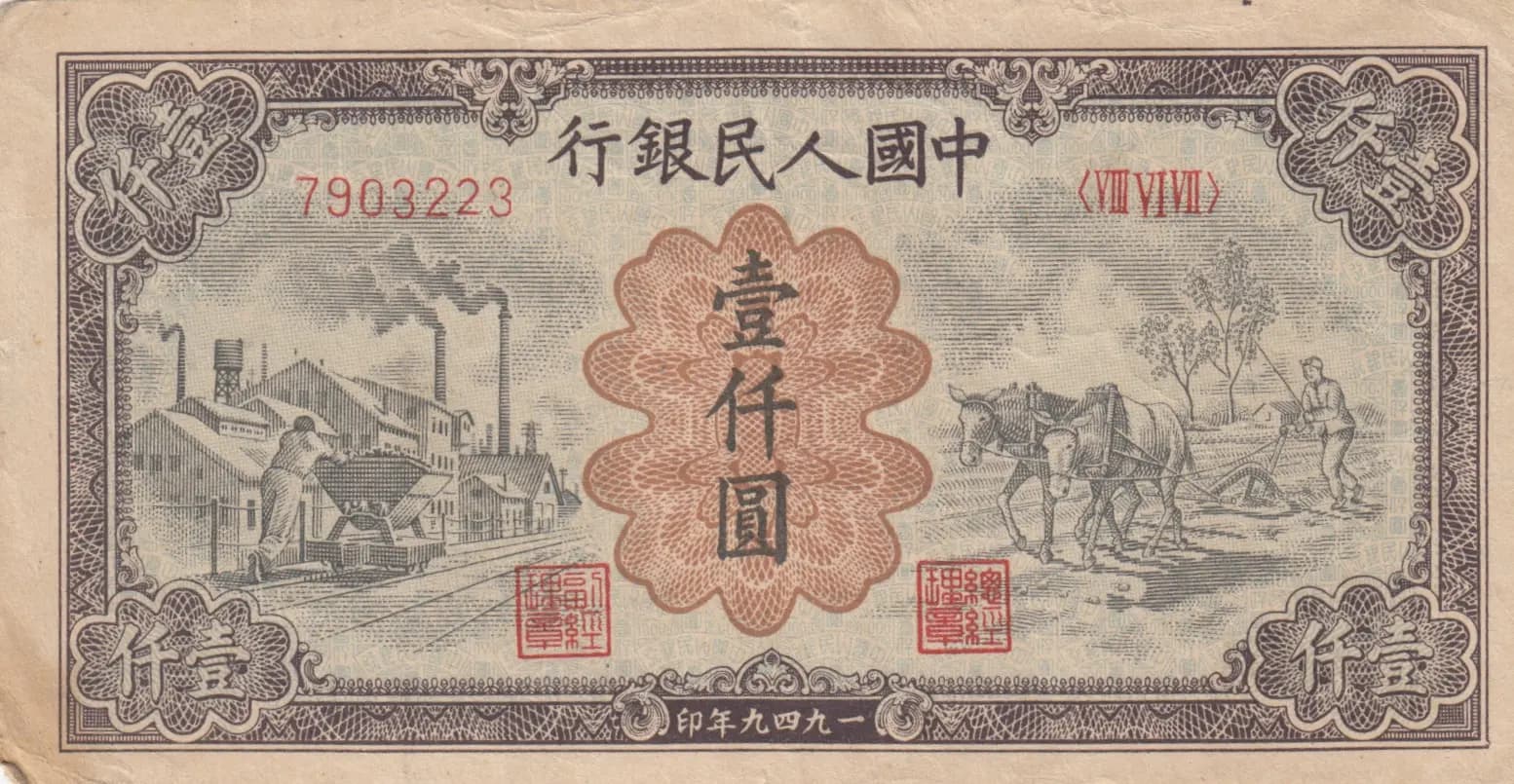
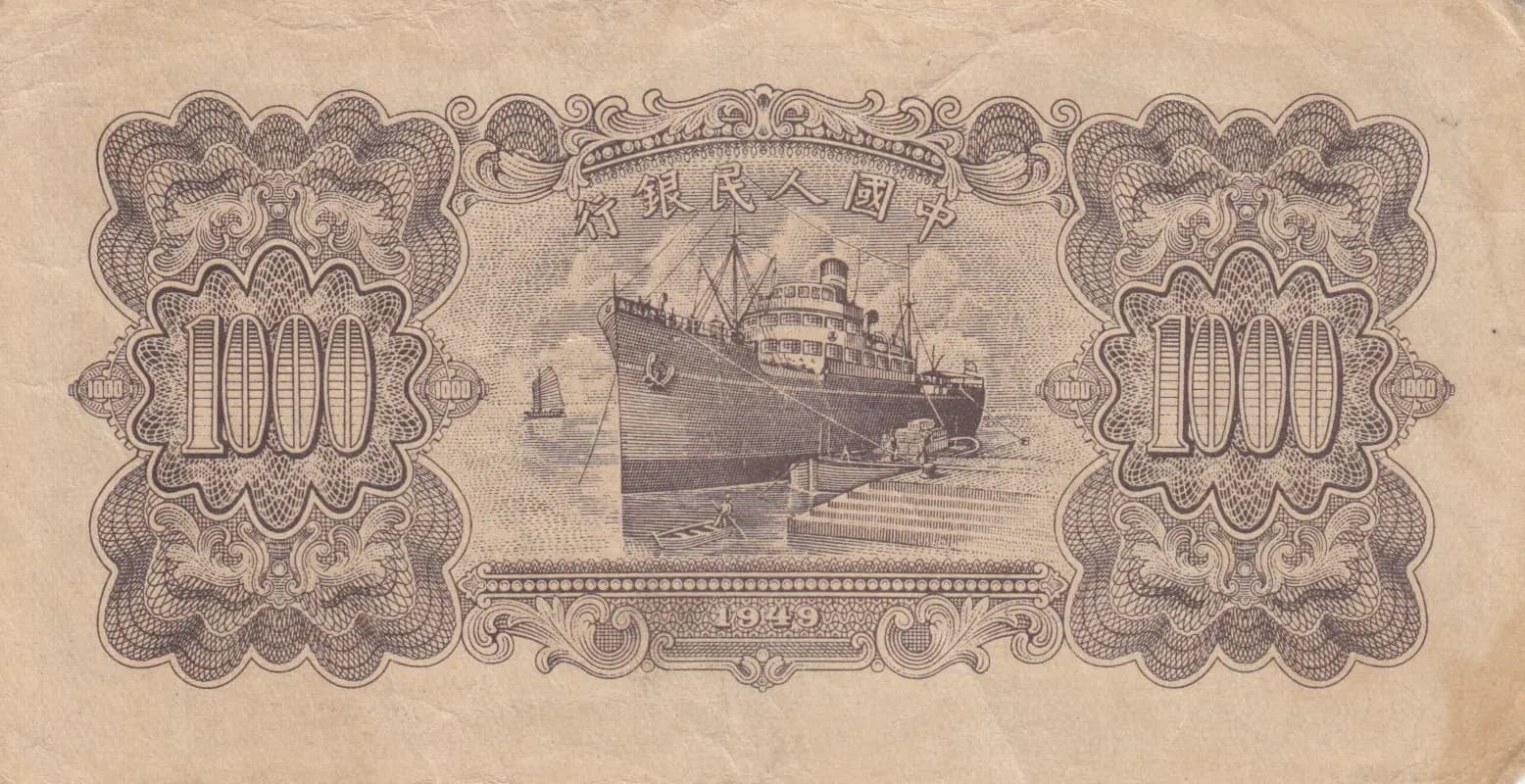
This is a 1000 Yuan note from the People's Bank of China's first regular issue in 1949, presented in VF condition showing appropriate age-related patina for a 75-year-old note. The obverse features an allegorical representation of new China's dual economy—industrial factories with workers on the left and agricultural workers with oxen on the right—framing a central medallion, while the reverse displays a detailed engraving of a cargo ship at port symbolizing maritime commerce and modernization. Despite foxing and yellowing consistent with its age, the note remains well-preserved with no major damage, making it a desirable example of early PRC currency.
Common. The eBay transaction history shows consistent sales activity across multiple condition grades from 2013-2024, with VF examples selling in the $150-$400 range, and more numerous lower-grade examples selling for under $200. The 2016 catalogue value of $150 for VF is congruent with actual market realizations, and the regular appearance of this note in sales with moderate competition (6-19 bids typical) indicates adequate supply in the collector market. As a regular issue from the first year of the People's Bank of China, this denomination was produced in substantial quantities and remains accessible to collectors.
This 1949 issue represents the People's Bank of China's first year of operation under the newly established People's Republic, with imagery deliberately emphasizing the party's vision of a unified industrial and agricultural economy. The depicted factory with workers and peasants plowing with oxen symbolized the Communist Party's commitment to both industrialization and rural collectivization, while the port scene with the ocean liner reflected aspirations for international trade and national modernization in the post-war reconstruction period. These allegorical designs served as propaganda tools to legitimize the new regime and its economic ideology to the Chinese population.
The obverse presents a dual-economy allegorical composition: on the left, an industrial complex with multiple smokestacks and workers operating ore hoppers representing heavy industry; on the right, an agricultural scene with peasants plowing using two-ox teams, symbolizing the traditional agrarian base being integrated into the new state. A large scalloped circular medallion in rust-brown occupies the center, containing Chinese characters and serving as the design's focal point. The reverse features a prominently engraved cargo ship or ocean liner at a port facility with attending vessels, framed by ornate scalloped cartouches on either side with vertical striping patterns, emphasizing maritime commerce and international connectivity. The entire design is executed in black and rust-brown inks on a cream background with elaborate engraved ornamental borders incorporating traditional Chinese cloud-scroll patterns in all corners.
Front side: '中國人民銀行' (People's Bank of China), '壹仟圓' (One Thousand Yuan), '印年九四九一' (Print year 1949). Serial number: 7903223. Roman numeral designation: VIII VIII. Back side: '中華民國為人民' (Republic of China for the people), '1949' (year designation). Note: The back inscription references the Republic of China, reflecting transitional nomenclature in early 1949 before full PRC consolidation.
Intaglio engraving on banknote stock, characteristic of early PRC currency production. The fine line work visible throughout the design—particularly in the factory smokestacks, agricultural detail work, and intricate ship engraving—indicates traditional steel-plate engraving. The ornamental borders and security features employ fine-line engraving patterns typical of currency produced by the Chinese government's printing facilities in this period. No specific security printer attribution is definitively documented for this Pick number, but early PRC notes were typically produced domestically by government-controlled printing works.
The specific variety identification follows the S/M (Shafer-Muschietti) catalog numbering as C282-62. The observed serial number (7903223) and Roman numeral designation (VIII VIII) are consistent with standard 1949 production. This particular specimen shows no evidence of overprints, special seals, or other distinguishing marks that would indicate a rare variety. Minor variations in serial number prefixes and seal placements exist across the print run, but these do not significantly affect value or rarity classification for this common issue.