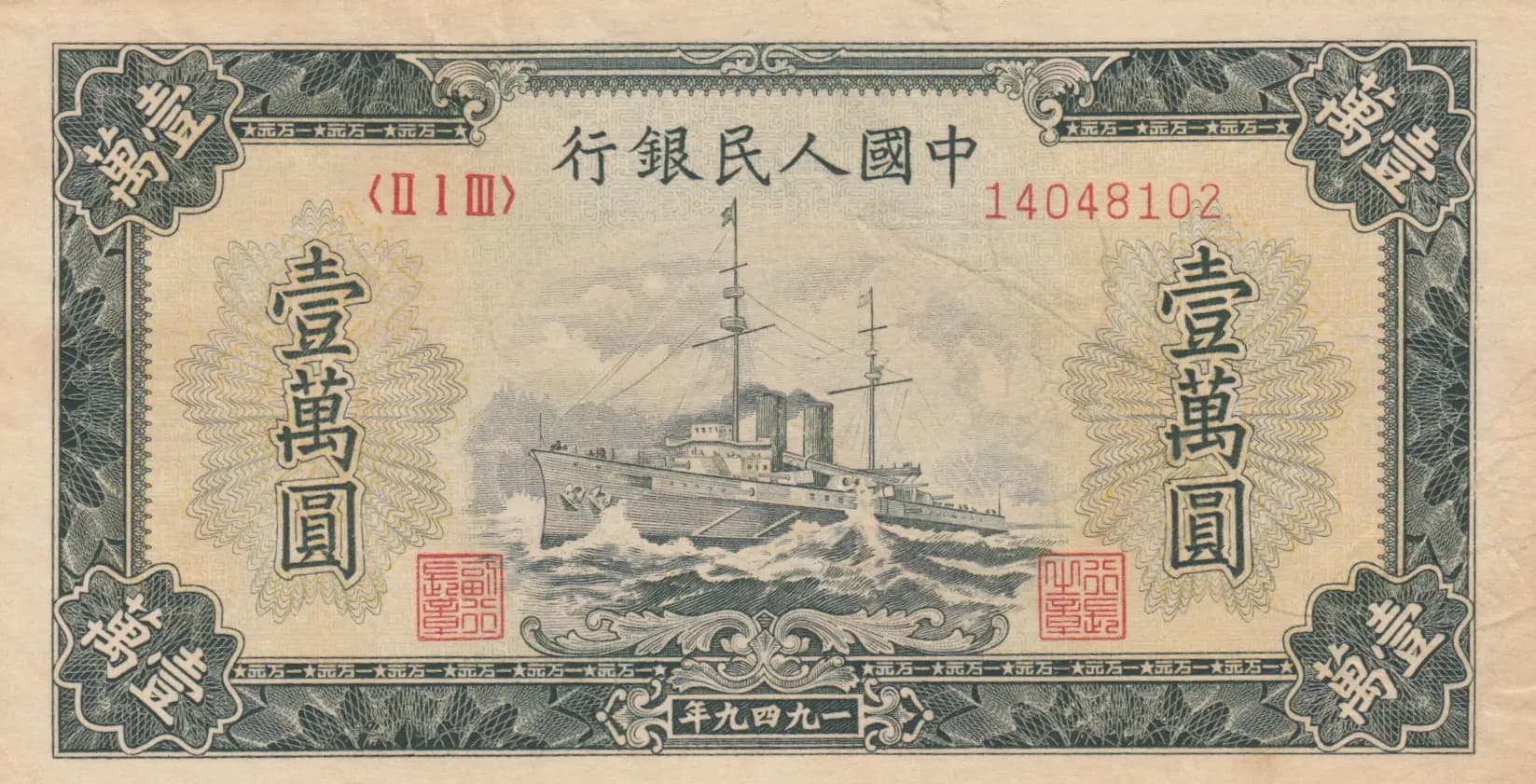
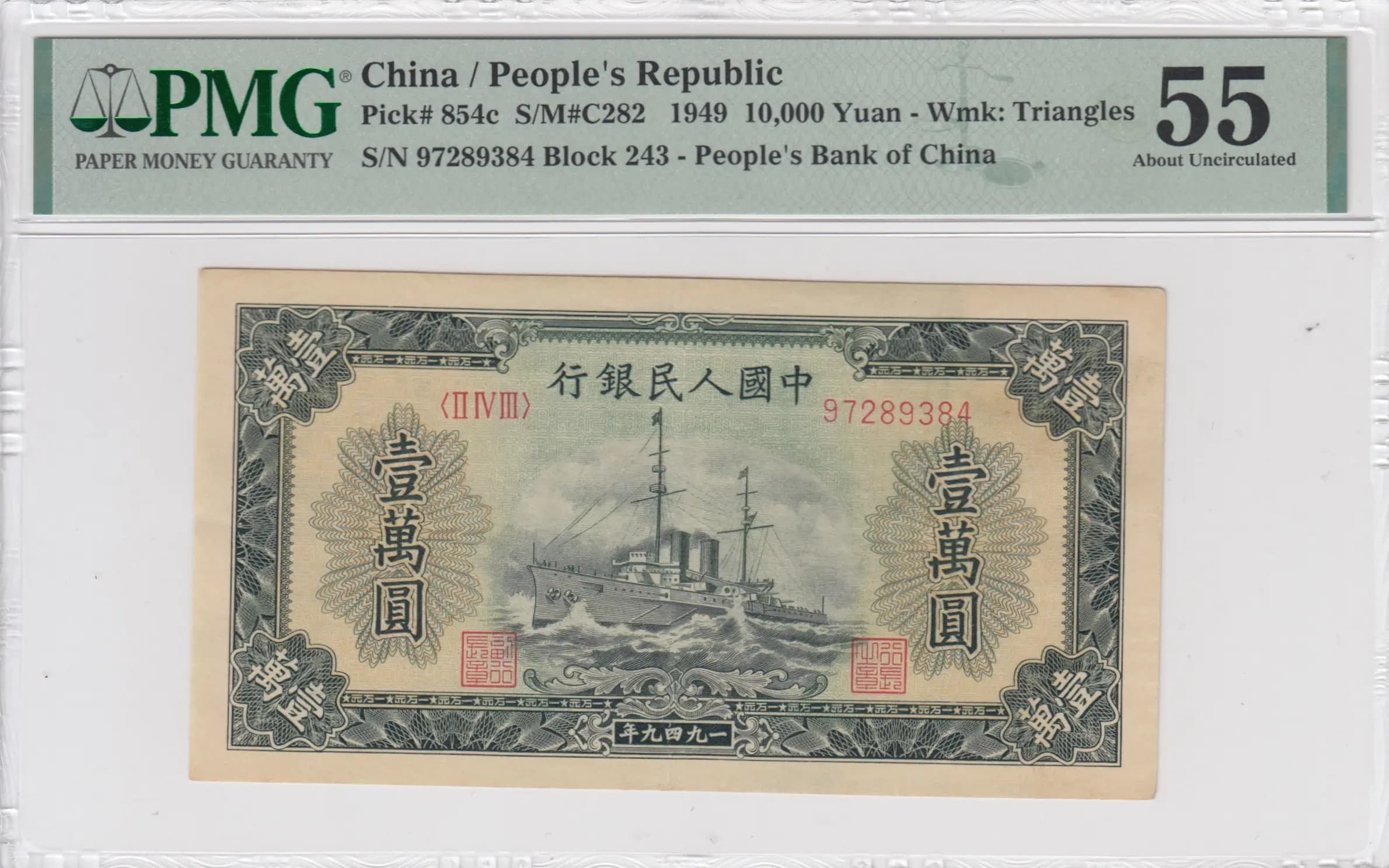
10 000 yuan 1949
Market Prices
16 salesAbout This Note
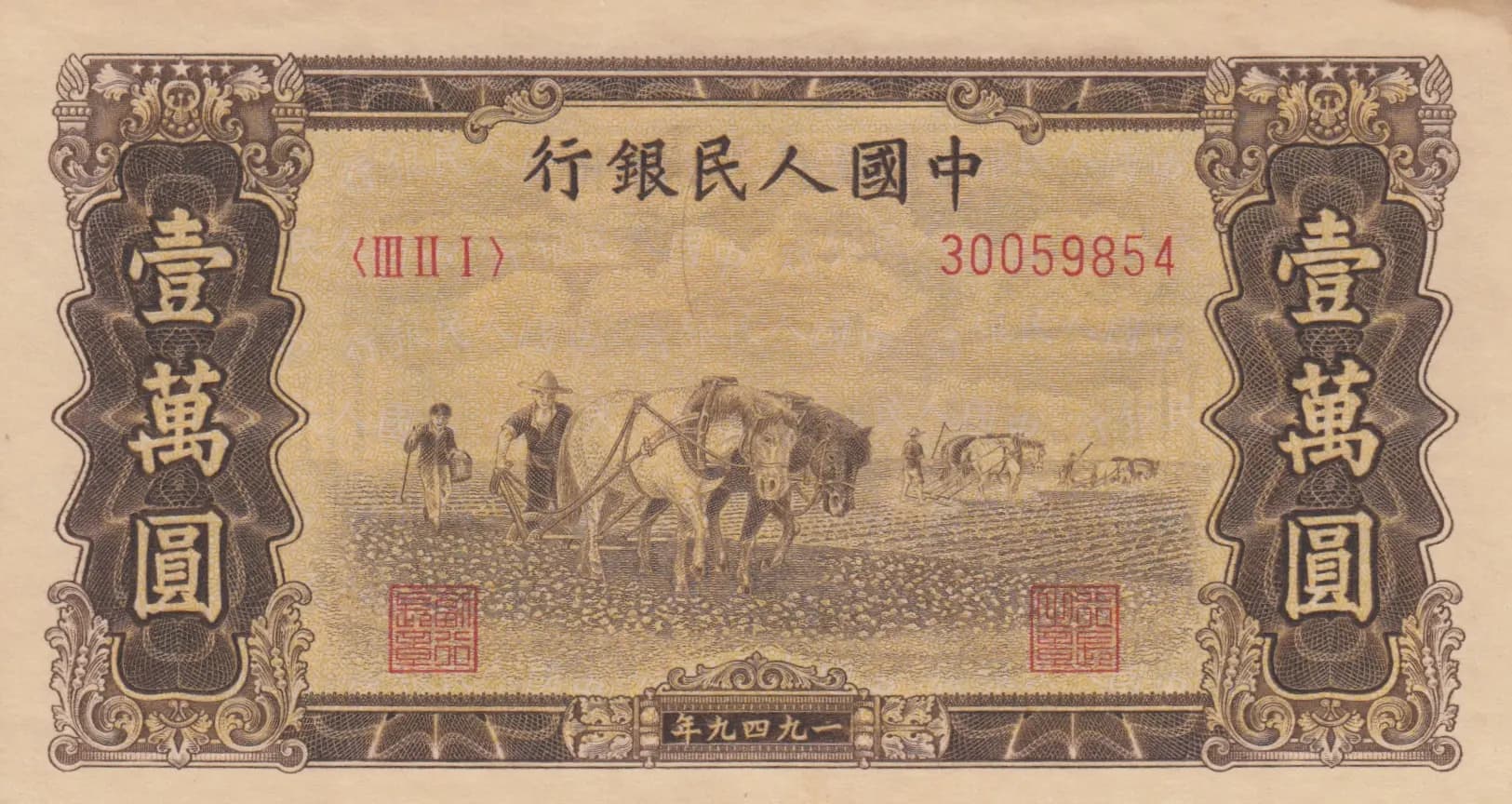
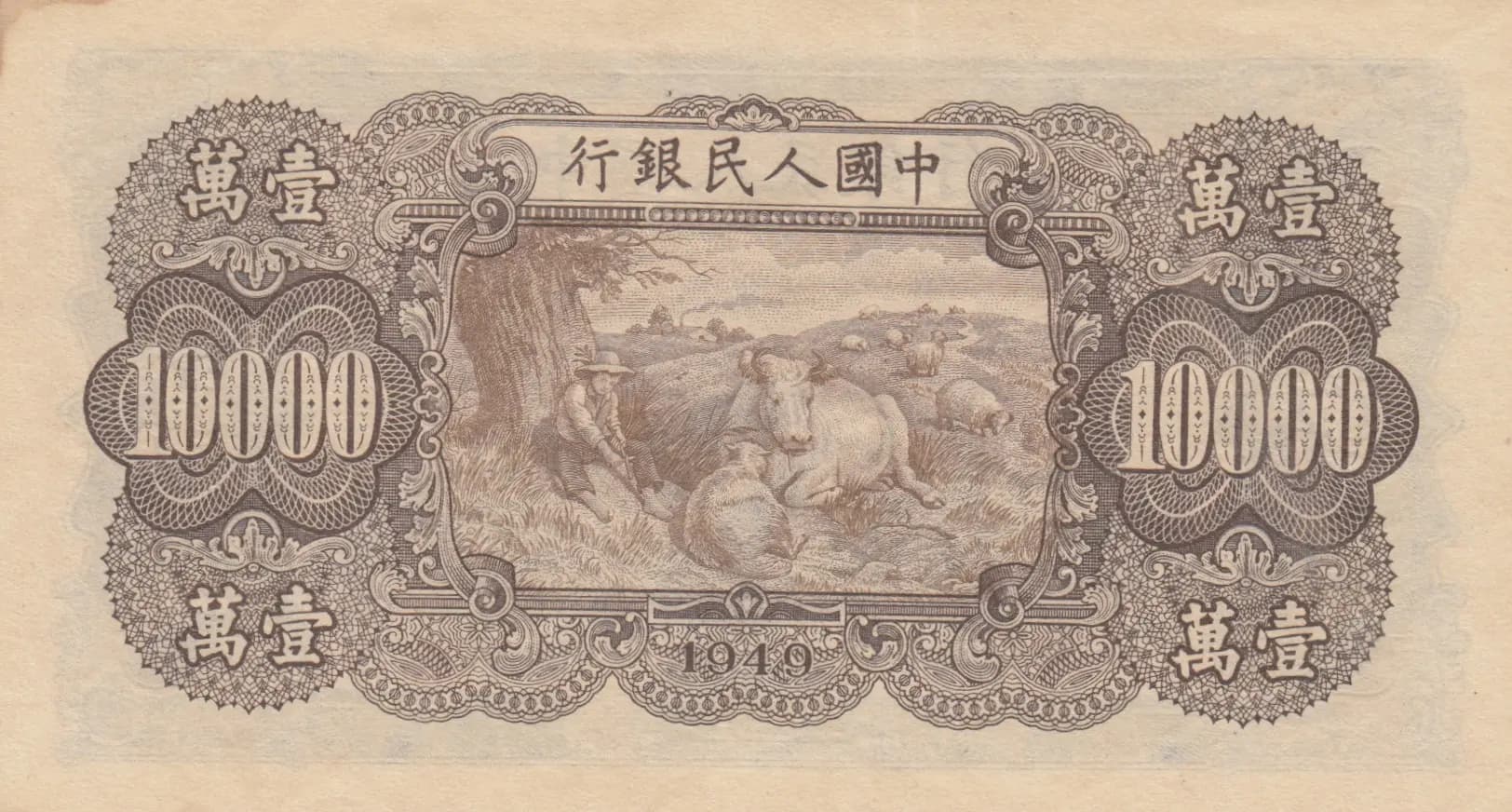
This is a spectacular example of the 1949 People's Bank of China 10,000 Yuan note (Pick P-853), presented in AU condition with crisp, uncirculated appearance and no visible wear, folds, creases, or damage. The note features exceptional engraving quality depicting agricultural laborers and horses on the obverse and pastoral workers with livestock on the reverse, rendered in rich brown and tan tones with intricate ornamental borders. This early PRC currency represents a historically significant transitional period in Chinese monetary policy and remains a desirable collectible, with market evidence showing AU-graded examples consistently achieving prices between $800-$2,000 at auction.
Common. While this is an early PRC banknote with historical significance, the eBay price history provided demonstrates consistent availability in the collector market, with regular sales occurring across multiple condition grades from VF to PMG 64-65. The catalogue value for UNC specimens ($275 in 2016) and the frequency of sales at moderate prices ($437-$2,026 across various grades from 2012-2024) indicate adequate supply relative to collector demand. Large print runs of this denomination were typical for primary circulation currency, and survival rates remain sufficient to classify this note as common despite its age and historical importance.
Issued in 1949, this note represents the People's Bank of China's early post-revolutionary currency, released during the establishment of the People's Republic of China and the consolidation of communist monetary authority. The agricultural imagery—featuring farmers with horses and herds of livestock—reflects the new regime's ideological emphasis on agrarian labor and peasant-based economy, consistent with early communist propaganda and economic messaging. This denomination and design belong to the first series of PRC banknotes, making it a foundational artifact of the new nation's financial system during its formative year.
The obverse depicts a classical rural labor scene with multiple farmers engaged in field work, using horse-drawn farming equipment in an agricultural landscape. The vignette occupies the center field and is framed by elaborate ornamental borders featuring intricate scrollwork and floral patterns in the corners and sides, characteristic of high-quality engraved currency design. The reverse presents a complementary pastoral composition showing agricultural workers herding cattle or water buffalo through a rural setting, similarly surrounded by complex geometric and ornamental frames containing large denomination numerals (10000) in decorative oval cartouches. Both sides employ fine line engraving with detailed crosshatching, demonstrating sophisticated anti-counterfeiting security measures. The color scheme of dark brown, tan, and black on light brown underprint creates strong visual hierarchy and artistic balance across the note's surface.
Front Side: 中國人民銀行 (People's Bank of China) - appears at top center; 壹萬圓 (Ten Thousand Yuan) - denomination in Chinese characters; 30059854 - serial number in red; (III I) - series designation in Roman numeral notation. Back Side: 中國人民銀行 (People's Bank of China) - appears at top center; 壹萬圓 (Ten Thousand Yuan) - denomination in Chinese characters; 10000 - denomination in Arabic numerals within decorative oval frames on left and right sides; 1949 - issue year in Arabic numerals at center-bottom.
Intaglio engraving (line engraving), characteristic of high-security banknote production in the early PRC period. The fine line patterns, detailed crosshatching, ornamental scrollwork, and the crisp impression visible throughout the note all confirm traditional intaglio printing methods. The note was produced by the Chinese government's security printing facilities established for PRC currency production; specific printer attribution for P-853 corresponds to the State's banknote printing operations in 1949.
This specimen exhibits the standard design for Pick P-853 (also catalogued as S/M C282-67). The serial number 30059854 and series designation (III I) are visible and consistent with known examples. No notable overprints, signature variations, or printing anomalies are evident from the visual analysis. The note represents the standard regular issue variety for this Pick number with no reported major varieties affecting this catalog entry's classification.