10 yuan 1949
Market Prices
19 salesAbout This Note
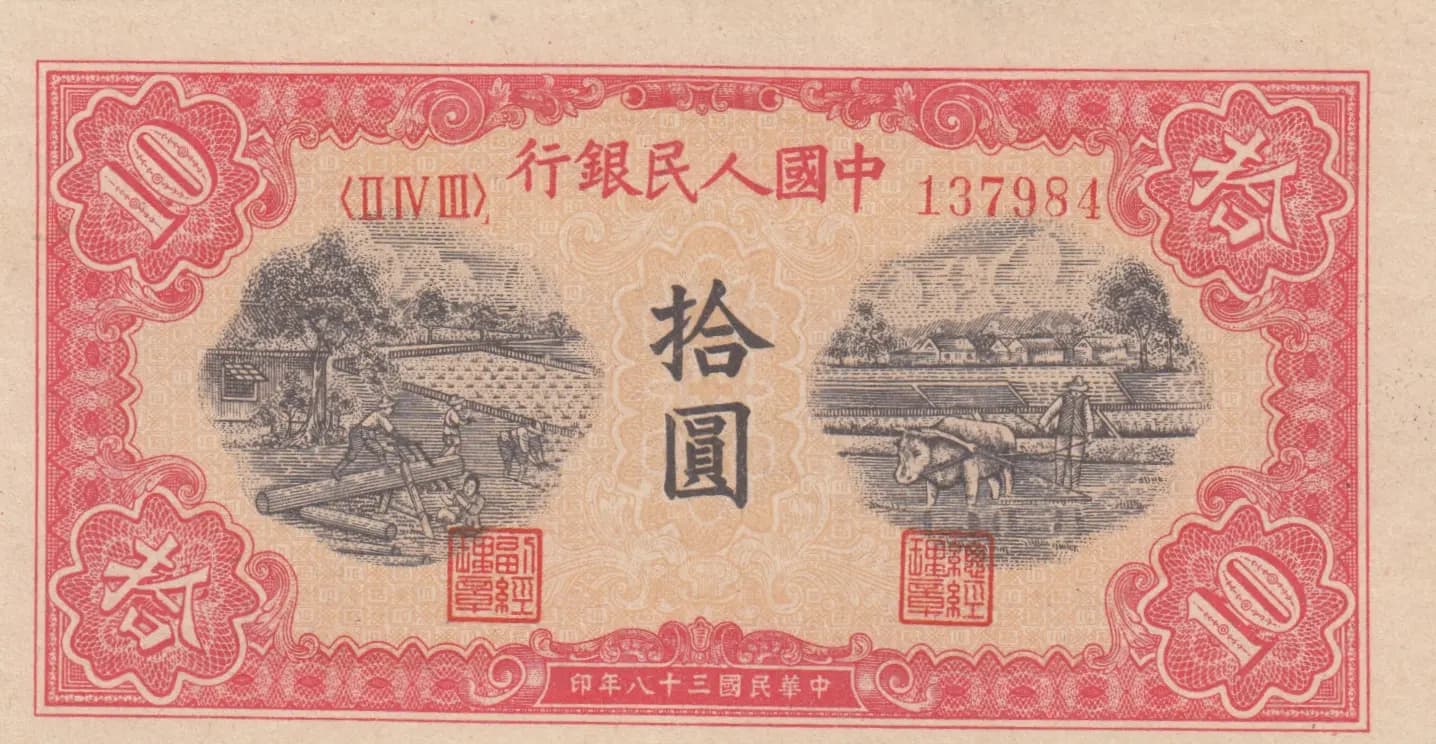
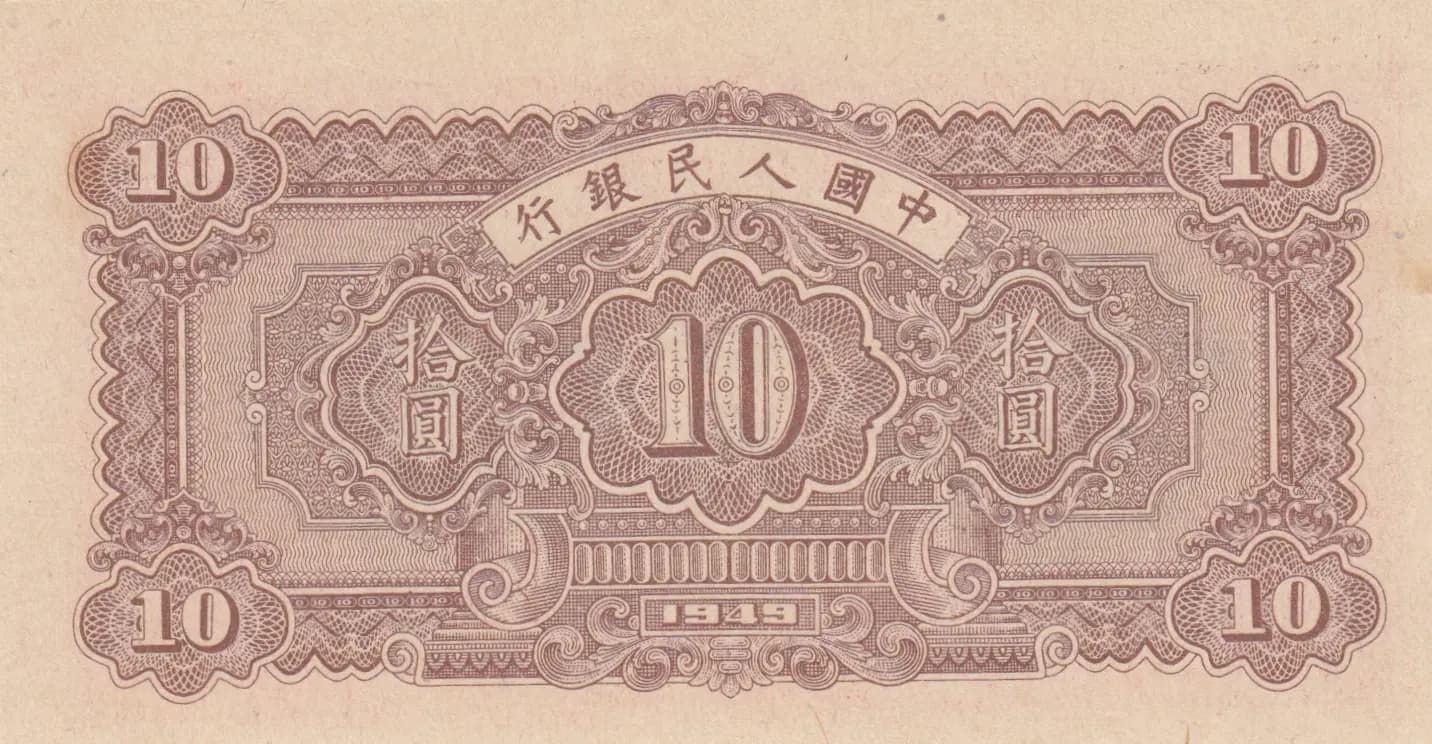
This is a 1949 People's Bank of China 10 yuan note (Pick P-815) presented in UNC condition, featuring distinctive agricultural imagery reflecting the early PRC's rural economic foundation. The note displays excellent preservation with minimal wear, light foxing consistent with age, and intricate fine-line engraving throughout. The obverse presents dual vignettes of farming scenes framed by ornate red decorative borders, while the reverse showcases elaborate brown/purple ornamental design—making this an attractive example of early Communist China currency design.
Common. The eBay market data shows consistent sales activity across multiple condition grades (PMG 30 through PMG 64) from 2013 to 2024, with prices ranging from $188.50 to $1,445 depending on grade. Even UNC examples have appeared on market at $610 (2015), indicating adequate supply relative to collector demand. The 2016 catalogue value of $90 for UNC condition, combined with regular market appearance, confirms this is a readily available note in the collector market. No historical evidence suggests this was a short-run issue or subject to significant recall.
Issued in 1949 during the founding year of the People's Republic of China, this note represents the transition from Nationalist to Communist monetary authority. The deliberate emphasis on agricultural labor through the prominent farm vignettes reflects the ideological focus of the early PRC on peasant-based revolution and rural development. The traditional Chinese aesthetic combined with modern security printing techniques demonstrates the People's Bank's effort to establish legitimacy through a blend of cultural continuity and technological sophistication.
The obverse features a cream-colored center field framed by an ornate red decorative border with elaborate floral scrollwork and rosette corner pieces. Two black and white engraved vignettes dominate the center: the left depicts agricultural labor with cultivated fields and workers, while the right shows rural pastoral farming with oxen or draft animals—both representing the agrarian foundation emphasized by early Communist ideology. The denomination '拾圓' (10 yuan) in large Chinese characters is centrally positioned between these scenes, with red square seals beneath each vignette. The reverse presents an entirely ornamental design in brown and purple tones, centered on a large circular medallion containing the numeral '10' surrounded by elaborate geometric patterns, scrollwork, and stylized floral designs. Four corner medallions echo the central '10' denomination, with fine-line engraved repeating patterns filling the entire field. This design approach—emphasizing labor and production on the obverse with abstract ornamental security patterns on the reverse—was typical of early PRC currency design.
Front side: '中國人民銀行' (People's Bank of China), '拾圓' (10 Yuan), '中華民國三十八年印' (Printed in Year 38 of the Republic of China [1949]), Serial number '1379834', Series designation '(III)(III)'. Back side: '中國人民銀行' (People's Bank of China), '合圓' (10 yuan), Numeral '10' appearing in central medallion and four corner positions.
Intaglio (fine-line steel engraving), evidenced by the detailed line work, sharp definition in the vignettes, and complex geometric background patterns visible throughout both sides. The consistent depth and quality of impression suggests professional security printer production. Early PRC currency of this period was typically produced by the Chinese government printing bureau with technical assistance from Soviet expertise, employing traditional engraved steel plate technology.
Series designation '(III)(III)' indicates this is from the third printing series. The serial number '1379834' shows standard numbering without apparent overprints or special designations. The date inscription '中華民國三十八年印' (Year 38 of the ROC, equivalent to 1949) confirms the issue year. No visible signatures or printer marks that would indicate sub-varieties are apparent from the visual analysis. Standard varieties for this Pick number are primarily distinguished by series designation and printing sequence rather than major design changes.